Editor’s Note: This is part two of a two-part article assessing the past, present, and future of U.S. Army Special Forces. See part one here.
The Green Beret's greatest legacy was never the beret. It was the audacity to imagine something that did not exist. That same audacity is needed now more than ever.
The Army built Special Forces (SF) for a world that no longer exists. The force that defined irregular warfare for a generation is no longer sized, structured, or trained to meet the demands of the contemporary battlefield. The current Special Forces model requires fundamental change.
Restructuring is not optional. It is the only path back to relevance. This is not elimination of the Special Forces branch; it is revolution. The Green Beret does not disappear, the model does. What emerges is a smaller, more capable, more genuinely special force: one that survives in environments the current model cannot even penetrate, delivers effects the Joint Force cannot produce any other way, and serves a role so clearly defined that no operational planner could afford to leave it out.
Mismatch
There is a mismatch between the current Special Forces model and the environment where they must operate. The environment has changed, but SF’s structure has left it without a clearly valued role. The branch must confront both before transformation is possible.
The contemporary operating environment is not the jungle of Southeast Asia or the mountains of Afghanistan. It is the mega-city, the electromagnetic spectrum, and the drone-saturated contested environment. Adversaries have built surveillance architectures of extraordinary sophistication. China has tripled its intelligence, surveillance, and reconnaissance satellite platforms since 2018. Russia has exported facial recognition and biometric identification systems to Iran and other partners, creating what analysts have called an authoritarian surveillance commons.
On battlefields of Ukraine, drone swarms have replaced conventional reconnaissance. Electronic warfare saturates every frequency. Pattern of life analysis identifies and kills commanders within hours of establishing a command post. Centralized headquarters die. Rapid adaptation is not an advantage; it is a survival requirement. Both sides have invented and reinvented their formations continuously as context has demanded. The rate of change on the Ukrainian battlefield exceeds the rate of change inside any American military institution.
Structurally, Special Forces are embedded in a Joint Force that, true to the American way of war, values decisive victory above all else. A force built by America for annihilation, not attrition . Shaping operations prior to combat are considered mere preamble, while decisive combat operations are the crux. SF lives and operates in the space the Joint Force considers irrelevant to their outcome. SF's real value proposition is asymmetric, executed through presence and relationships. It is slow, patient, unglamorous work of shaping environments through the full conflict continuum. This is at fundamental odds with how the American Joint Force conceives of winning. SF does not occupy a supporting role in the Joint Force's theory of victory. It occupies a space the Joint Force considers largely beside the point.
Special operations still have a necessary and strategic role. However, that role has always been divided. The United States maintains two distinct special operations enterprises. The first is strategic direct action, such as the Bin Laden and Maduro raids. JSOC and the intelligence community own strategic direct action and always have. Green Berets were never designed for those missions. Despite this fact, SF continues to extensively train for direct action. A review of Army Special Forces imagery in the Defense Visual Information Distribution Service reveals a force that predominantly trains for direct action, close quarters battle, helicopter insertion, and night-raids.
Green Berets were designed for Special Warfare, including Unconventional Warfare (UW) and Foreign Internal Defense (FID). UW is sabotage, subversion and insurgent activities for extended periods in denied areas. FID is training, advising, assisting and accompanying partner nation forces in special operations. The modern environment has rendered UW as infeasible, and FID’s strategic value is questionable.
Operation Epic Fury struck more than 13,000 targets against Iran. The Joint Force demonstrated unmatched precision strike capability. And yet the campaign has not proved decisive. Iran has not capitulated. Ground forces are still required for regime change and to control terrain and populations. A Special Forces UW campaign should be the answer to that requirement. They have not reportedly deployed. The most likely reason is that survivability in the Iranian environment is assessed as too low and American casualties carry an unacceptable political cost. In Ukraine, a combat FID mission with SF advisors embedded with Ukrainian forces could meaningfully thicken Ukrainian capability. They are not there. The reason is the same: survivability and political cost.
The pattern is clear and it is damning. In these strategically consequential and ongoing conflicts, Special Forces have not been employed for any special warfare mission they were designed to execute. If the Joint Force considers SF inconsequential to operational success and political leaders assess SF employment as too risky, the force is serving neither a military nor a political purpose. The idea that current model A-Teams will infiltrate China, Russia, North Korea, or Iran, foment an insurgency, and survive is not strategy. It is nostalgia.
The result is a force optimized for missions the Joint Force does not prioritize, too large to be truly special, too busy to fundamentally change, and too politically costly to employ where it matters most. This leaves SF conducting a plethora of theater security cooperation events with inconclusive return on investment and fighting within the Joint Force to define their value proposition and identity. Do those events justify a U.S. Army Special Operations Command (USASOC) force of 36,000? I believe the answer is self-evident. It is time to build what the next fight requires.
Fomenting Revolution
Now is the time for change. Transformation is imperative. Special Forces were born from that spirit. To create something irregular, agile, flexible, and adaptive by design. The Green Beret was never meant to be an institution. Somewhere between Saigon and Kandahar, it became a bureaucracy.
Two questions are central to transformation: What are we doing that we shouldn't be? What aren't we doing that we should be? Special Forces must affect, distract, confuse, and manipulate in ways no one else does and that others haven’t even imagined. Unpredictable, unreadable, undefendable.
The neo-Special Forces soldier is not a combat advisor on a six-month rotation. They are an invisible, technically lethal, culturally fluent operator who holds adversary critical capabilities at risk in denied environments, strengthens allies in ways no conventional force can replicate, and creates strategic dilemmas that cost the adversary more than they cost us. That soldier does not exist yet at scale. Building them is the mandate.
The immediate priority is consolidation. One Special Forces Group, one Civil Affairs company, and one Psychological Operations company should be folded into Joint Special Operations Command. A Special Forces Group inside the global strike complex preserves the combat advise, assist, and accompany capability inside a command that is apt to use it as a core competency in support to the Joint Force.
3rd Special Forces Group, with a second more stringent selection, is the right unit for consolidation. They should bring one company of Civil Affairs and one company of Psychological Operations with them. 19th and 20th Special Forces Groups from the Army National Guard should remain in their current design and mandate, hedging against a future need for a combat advisor force. The role of the Special Forces advisor can still exist in the future, though not at the scale we maintain today.
The remaining groups, brigades, and battalions of USASOC would not be disbanded—they would be unleashed. Immediately removed from theater security cooperation events across all geographic combatant commands, these forces become laboratories. The mandate is straightforward: design, build, train, and test a force relevant to the contemporary environment. Experiment aggressively. Discard what does not work. Pulling SF from security cooperation plans entirely has a second benefit: a complete audit of where the true Joint Force priorities for Special Forces lie.
When elements are ready, they deploy forward in support of priority combatant commands not to fill a theater security cooperation slot, but because they offer a capability the Joint Force cannot find anywhere else. Theater Special Operations Commands provide the ends. 1st Special Forces Command controls the means and makes the reorganization decisions.
USASOC must find the Green Beret's new raison d'etre, much as the Navy's Special Warfare Command has done with the SEALs. On a world that is seventy percent water, the reinvention of SEALs as exquisite frogmen seems prescient. While the SEALs' return to water certainly has brought internal challenges, their customers, the geographic combatant commands and the Navy, have welcomed the change. Army Special Forces must find their own pathway to the future.
Dangers of Staying the Course
The counterargument is serious and deserves honest engagement. Gray zone competition demands exactly what Green Berets provide: language skills, cultural expertise, indigenous relationships, and the ability to shape conditions prior to and during conventional conflict. I have argued publicly for the strategic value of special operations forces on the European continent. That argument remains valid, yet it merely addresses amalgamated special operations forces broadly, not the Army Special Forces Regiment specifically.
The current claim that SF are cultural experts deserves particular scrutiny because it is used to justify budgets, high operations tempo, and institutional resistance to reform. Consider what genuine expertise requires. Fluency in a language takes years of total immersion, not a four-to-six-month course at the Defense Language Institute. Cultural nuance requires living inside a society long enough to understand what is not said, what silence means, what gestures signal across generations. Historical context requires education deep enough to understand why a population thinks the way it thinks.
SF may have more relative cultural knowledge than any other element in the US Joint Force. However, relative advantage is not the same as genuine capability. And genuine capability is what peer adversary environments demand. The adversaries SF would need to penetrate—China, Russia, Iran, North Korea—have the most closed, controlled, and surveilled populations on earth. The gap between what SF claims and what true expertise requires cannot be closed by Green Berets with improvisation or the current training and rotation model. It is a structural problem.
The security cooperation and advisory mission argument deserves an honest answer. That mission is real and Special Forces have historically owned it. But occupying a mission adequately is not the same as owning it decisively. A force simultaneously tasked as an unconventional warfare unit, combat advisor force, theater security cooperation enabler, counterterrorism fighter, civil affairs integrator, and psychological operations platform is a jack of all trades and master of none. If everything is a priority, nothing is.
A force adequately present across every phase of competition without decisively moving the needle to strategic success in any one of them is not filling that space. It is haunting it. The historical record shows that adequate presence in inconsequential spaces has not produced strategic outcomes in peacetime, has not deterred adversaries in competition, and has not won in conflict. Nor has it proved employable in consequential irregular warfare environments of the current era. The partnership and advisory mission demand excellence, not adequacy. The current model produces the latter. Persistence is not a strategy. It is inertia. The gray zone demands a stiletto dagger and the Special Forces Regiment is a Rambo knife.
Every New Beginning Comes from Some Other Beginning's End
Green Berets did not fail. They have done what they always do: live off the land, partner with local forces, and make hard missions happen. The legacy of Vietnam, the Global War on Terror, and other battlefields these warriors have fought on will stand for all time. It is a legacy I am proud to be a part of, a legacy that I feel is not diminished by revolutionary change. But the world has moved on. The contemporary battlefield is vastly different from the jungles of Southeast Asia in the 1950s when Special Forces were designed. Can the United States Army Special Forces Regiment, Army Special Operations Command, and the United States Special Operations Command move on? Now is our best chance to change with the moment. We ignore it at the peril of those who come after us, those we will pin silver wings on. Bury the beret. Build what comes next.
Ned Marsh is a United States Army Special Forces Colonel (R); he led elite American military units over 26 years. Educated and experienced in irregular warfare, his purpose now is leadership and guiding organizations into the future by challenging assumptions and embracing uncertainty.
The views expressed are those of the author and do not reflect the official position of the Irregular Warfare Initiative, Princeton University’s Empirical Studies of Conflict Project, the Modern War Institute at West Point, Department of the Army, Department of War, or the United States Government.
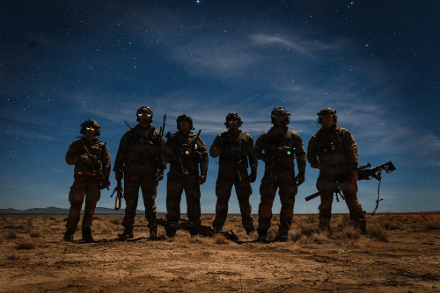
Main image is of Green Berets at White Sands Missile Range, February 2026, taken from DVIDS.
If you value reading the Irregular Warfare Initiative, please consider supporting our work. And for the best gear, check out the IWI store for mugs, coasters, apparel, and other items.