
Economic & Legal Warfare

Examining the non-traditional tools of conflict—economic warfare, lawfare, influence operations, and societal pressure—that define the expanding gray zone between war and peace.

From Coal to Code to Reactors: How Wyoming’s State and Local Decisions Shape Irregular Warfare

For much of the twentieth century, Wyoming powered the United States by extracting coal and sending it elsewhere. From the postwar boom through the early 2000s, trains left the Powder River Basin loaded with fuel that kept distant lights on, factories running, and bases operational. Wyoming’s contribution to national

Disaster Diplomacy: A Backdoor to Improved Inter-Korean Relations Amid Great Power Realism?

It has been stated many times that the more things change, the more they stay the same. Such a description aptly describes the enduring geopolitical reality on the Korean Peninsula. Currently, North Korea and South Korea, (officially the Democratic People's Republic of Korea and the Republic of Korea,

Mercenaries, Private Security, and the Civilian Cost of Outsourced Coercion

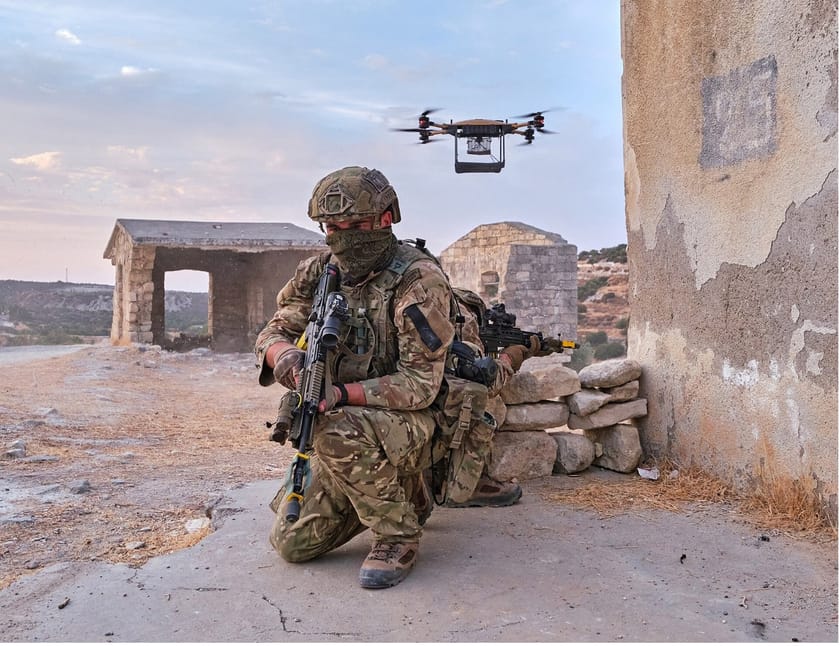
While states still use military force in pursuit of national interests, private military and security companies (PMSCs) have become an increasingly common instrument, enabling states to apply pressure, manage escalation, and maintain deniability in ways that conventional deployments cannot. As resistance to foreign troop deployments grows and strategic competition shifts

Digital Finance as a Geopolitical Arena: China, Web3, and the Competition Over Africa’s Digital Payments Landscape

A young Nigerian man uses cryptocurrency for peer-to-peer transactions to avoid the challenges of Naira inflation, while thousands of miles away, a farmer in rural Kenya uses her smartphone to access a mobile credit platform for a microloan. These two examples represent just a small sample of how the payments

Geoeconomics of Irregular Warfare: Iran and the Global Ripple Effects — Part VII

In Part Seven of Irregular Warfare Initiative’s series on the Iran conflict, produced by IWI’s Economic & Legal Warfare team, the focus turns to how escalation is being applied across economic, legal, and cognitive domains. The discussion features an expert panel including, Gianni Koskinas (CEO, Hoplite Group), Hamlet

Economic Warfare Reimagined: Insurance as a Tool of U.S. Strategic Influence

The U.S. is losing the war on sentiment in the Global South, where the world’s most economically vulnerable countries rely on larger powers for economic support and security. Russia and China have capitalized on this dynamic by seizing the economic initiative in this region, often at the expense

Capital Controls: The Evolution of Outbound Investment Security Strategy

The United States sits in the middle of an interconnected global financial system, and American investors form a significant segment within the bedrock of global economy. The country’s share of outbound investment is quite staggering, with U.S. multinational enterprises holding a cumulative investment position of more than $6.

Geoeconomics of Irregular Warfare: Iran and the Global Ripple Effects — Part VI

In Part Six of Irregular Warfare Initiative’s special series examining the unfolding conflict with Iran, Gianni Koskinas (CEO, Hoplite Group), Hamlet Yousef (IWI Economic & Legal Warfare Advisor), and Ed Bogan (Founder, Institute for the Study of States of Exception) analyze how innovation and industrial capacity are reshaping the

Geoeconomics of Irregular Warfare: Iran and the Global Ripple Effects — Part V

In Part Five of Irregular Warfare Initiative’s special series examining the unfolding conflict with Iran, Hamlet Yousef (IWI Economic & Legal Warfare Advisor), Ioannis Koskinas (CEO, Hoplite Group), Tom Johansmeyer (Co-Director, IWI Economic & Legal Warfare Group), and Ed Bogan (Founder, Institute for the Study of States of Exception)

Chokepoints: American Power in the Age of Economic Warfare

Episode 151 of the Irregular Warfare Podcast explores how the United States wields power not only through military force, but through dollars, sanctions, export controls, and supply chains. Anchored in Eddie Fishman’s book Chokepoints: American Power in the Age of Economic Warfare, this episode examines the rise of economic

Showing of 26 posts

Bridging the gap between irregular warfare scholars, practitioners, and policymakers.

Stay in the Loop

Subscribe for the latest articles, podcasts, and events.

Subscribe

The Economic and Legal Warfare (ELW) Project explores and illuminates the non-traditional tools of conflict that come with a vastly expanded domain of operations. The expansion of security strategy beyond orthodox military perspectives over the past 30 years has led to a larger and more complex battlespace, which now includes political, economic, legal, societal, cognitive and psychological vulnerabilities. Conventional military confrontation is now part of a broader toolkit, and much of that expanded toolkit remains in its infancy.

Irregular warfare thrives in the “gray zone” between war and peace. The ELW project takes a close look at the current use and future potential associated with influence and information operations, new forms of economic warfare and lawfare, and innovative approaches to societal influence and pressure. While not solely a military concept, Joint Publication 1, Doctrine for the Armed Forces of the United States, outlines the Diplomatic, Informational, Military, and Economic (DIME) model, emphasizing the interconnected nature of these instruments in achieving national security objectives. The “economic domain,” in particular, remains an underutilized yet decisive factor in shaping adversarial behavior, reinforcing its role as a critical complement to military power in modern conflict.

These hybrid methods align with irregular warfare’s emphasis on shaping the entirety of the operational environment – weakening opponents and achieving goals through disruption, influence, and manipulation. Recognizing and countering such tactics is crucial as state and non-state actors increasingly challenge stronger adversaries while necessarily avoiding the costs and risks of conventional war.

Our project is aligned around the following topics:

  • Sanctions & Embargoes (Trade Controls)
  • Inbound & Outbound Investment Security Regimes
  • Tactical Economic Warfare Supply Chain
  • Weaponizing Aid & Contingent Capital
  • Natural Disasters and the Nexus of Economic and Information Influence (“Disaster Diplomacy”)
  • Agricultural & Food Security
  • Dual Use Technology in Action
  • Natural Resources & Critical Minerals

Meet the Team

Matthew Flug Matthew Flug General Counsel, Co-Director, Economic & Legal Warfare
Tom Johansmeyer Tom Johansmeyer Co-Director, Economic & Legal Warfare
Eric Lebson Eric Lebson Advisor, Economic & Legal Warfare
Erik Bethel Erik Bethel Advisor, Economic & Legal Warfare
Hamlet Yousef Hamlet Yousef Advisor, Economic & Legal Warfare
Kipling “Kip” Kahler Kipling “Kip” Kahler Advisor, Economic & Legal Warfare
Matt McCabe Matt McCabe Advisor, Economic & Legal Warfare
Patrick Sweeney Patrick Sweeney Private Sector Engagement, Economic & Legal Warfare
Zayd Haufe Zayd Haufe Intern, Economic & Legal Warfare