It has been stated many times that the more things change, the more they stay the same. Such a description aptly describes the enduring geopolitical reality on the Korean Peninsula. Currently, North Korea and South Korea, (officially the Democratic People's Republic of Korea and the Republic of Korea, respectively), mark their 73rd year under an uneasy armistice. Enacted in 1953, the armistice halted a bloody war between the Koreas that resulted in millions of casualties and displaced civilians. While imperfect, the armistice has kept the peace, despite several flare-ups over the past seven decades. Nevertheless, the threat of war remains.
The Spoils of Status Quo
An unexpected effect of the armistice is the regional implications it has had for many states, most notably China, Russia, and the United States. The “Big Three” have benefited from the frozen conflict, as the arrangement provides each with geopolitical advantages for minimal investment. Coupled with the threat of another war, current conditions have paved the way for stagnation to remain the default option for the Peninsula. But while the Big Three reap the spoils of status quo, Koreans stand to pay the price, ranging from crippling cyberattacks in peacetime to a devastating preemptive nuclear strike to start another war. With Seoul well within range of North Korean artillery, even a conventional conflict would all but ensure the destruction of the capital city, home to 25 million and the economic engine of the country. With such dire consequences only a moment away, diplomatic efforts should remain a priority for all parties involved. But with current progress all but non-existent between the Koreas, alternative approaches should be considered. Rekindling Disaster Diplomacy on the Peninsula could benefit both Koreas, rather than their powerful allies, and defuse the current powder keg on the Peninsula.
Disaster Diplomacy in Action: A Recent History
Disaster Diplomacy is generally defined as the use of relief activities to strengthen political relationships. Disaster Diplomacy encompasses operational components such as Disaster Risk Reduction, which involves cooperative efforts between states to manage shared risk; the former the output of strategic-level state interaction, the latter the ground-level actions taken to reduce disaster. Focusing on joint concerns through Disaster Diplomacy allows both parties to collectively create and institute measures that safeguard their populations. Occasionally, Disaster Diplomacy has given momentum to existing reconciliation efforts and resulted in lasting improvements in state relations. Earthquakes in 1999 saw eternal enemies Greece and Turkey improve relations, as cooperative disaster relief efforts buoyed the ongoing negotiations. The 2005 Indian Ocean tsunami spurred ongoing peace talks between Aceh separatists and Indonesia, culminating in a peace agreement. In 2001 and 2005, earthquakes in India gave added impetus to negotiations with its archenemy Pakistan, though these proved short-lived. A cyclone that affected Myanmar in 2015 led to better relations with China; the catalyst was the timely aid provided by Beijing. A volcanic eruption and tsunami in 2022 boosted ties between Tonga and Australia and provided a starting point for further diplomatic overtures.
Despite the numerous data points espousing the benefits of Disaster Diplomacy, there is no guarantee better relations between rival states will materialize. However, it does offer an option in environments where all other diplomatic overtures have failed. Korea certainly fits into this category. Current relations remain very tense, despite the election of a more North-friendly government in the South. However, two areas could support Disaster Diplomacy and serve as starting points for better relations: Foreign Humanitarian Assistance (FHA) and Non-Combatant Evacuation Operations (NEO). Fortunately, there has been previous cooperation, albeit episodic, between the Koreas in these areas. Most notable was South Korean assistance sent to the North during the famines of the mid-1990s. Reengaging and codifying previous cooperative agreements could foster nascent efforts toward better relations. Disaster Diplomacy could begin the process with small steps and build momentum for further discourse on trickier items.
One Peninsula, Two Koreas, and Few Options
Currently, diplomacy of any kind on the Peninsula is all but dead. South Korea has not sent direct humanitarian aid to North Korea since late 2024, marking the first time it hasn’t since 1995, amid deteriorating relations between Pyongyang and the hawkish Yoon administration. Some aid flows through international bodies like UNICEF, but North Korea requires much greater foreign aid to alleviate its host of internal problems, most notably food insecurity. New leadership under Lee Jae Myung has attempted to restart engagement by dangling aid as a diplomatic tool, but with little progress to date. With Pyongyang enjoying improved relations with Moscow and historically strong ties with Beijing, it sees little need to engage with the “puppet government” in the South. Nevertheless, Lee has appropriately remained steadfast in offering assistance as one of many “trust-building measures” to improve relations. Pyongyang could be persuaded to talk with Seoul if the dialogue is FHA; any dialogue is better than none and might gradually lead toward talks on more sensitive issues.
Other hazards loom in the future beyond food insecurity. A nuclear accident or natural disaster on the Peninsula could trigger a massive humanitarian crisis and displace millions of people. Koreans won’t be the only affected; China, U.S., Russia, and Philippines have sizable populations on the Korean Peninsula, totaling over 1.2 million. China has the most, with over 900,000 citizens, while the US is a distant second at 140,000, and Russia and the Philippines with 72,000 and 70,000, respectively. Evacuating even a fraction of displaced foreign nationals off the Peninsula would be a Herculean task during peacetime; attempting to do so during a disaster without prior coordination and planning makes it a fool’s errand. A massive, uncoordinated influx of people toward airfields and port cities for evacuation would all but unsure a chaotic disaster, invoking images of previous U.S. NEO efforts in Vietnam and Afghanistan.
Civil Affairs: Operational Execution, Strategic Effects
Fortunately, US Civil Affairs units have facilitated FHA and NEO in the past and are well equipped to serve as the operational and tactical component of strategic-level Disaster Diplomacy, particularly acute given the abrupt demise of USAID. The tsunami in Indonesia in 2004 provides a useful historical example of the synergy between CA capabilities and strategic-level Disaster Diplomacy. With the breakaway province of Aceh the epicenter of the storm, Indonesian losses were appalling. Fatalities exceeded 170,000, with over 600,000 homeless. Additionally, the tsunami destroyed thousands of houses, schools, and health facilities. Economic damage exceeded 4.5 billion USD as local fishing and tourism industries sustained catastrophic damage. Fortunately, the global community responded with billions of dollars in aid to Indonesia. The U.S. alone contributed over 400 million USD through Operation Unified Assistance, which involved multiple U.S. agencies. Coupled with the influx of international aid and the ongoing conflict in Aceh between the Free Aceh Movement (GAM) and the Indonesian government, coordination posed a huge hurdle to relief efforts.
Such realities on ground created an opening for Disaster Diplomacy practitioners. The scale of disaster presented the Indonesian government with a fait accompli; while historically Jakarta had pursued an independent stance in international affairs, it had no choice but to accept foreign aid. The tsunami also weakened GAM claims that it could provide Aceh with an alternative government capable of responding to large-scale emergencies. In effect, the tsunami exposed Jakarta and GAM messaging that claimed each could better care for Aceh residents than the other. Consequently, both sides agreed to pause hostilities and work together on relief efforts to save lives and avoid the reputational damage from ineffective relief efforts on their own.
As relief efforts ramped up and supplies poured in, coordination loomed as a critical objective. US Civil Affairs was able to provide value by establishing a Civil Military Operations Center (CMOC) that functioned as a “clearing house” for the influx of aid and coordinated rescue and relief efforts. The CA footprint was small but effective; two teams traveled to multiple logistical nodes and disaster areas, while another team established the CMOC and focused on inter-military, interagency, and inter-state coordination. Indirectly, the CMOC contributed to the nascent Disaster Diplomacy effort by getting representatives from Jakarta and Banda Aceh to establish contact about relief coordination, which opened new lines of communications, improved relations, and buoyed a stagnant process that culminated in a peace agreement between the combatants a year later in Helsinki, Finland.
In Words and in Deeds
The US response impacted the populace perception; aided by US actions and information operations, Indonesian public opinion of the US significantly improved, notable given Indonesia’s Muslim majority and limited U.S. relations. Polling data recorded a significant spike post-tsunami that translated into an enhanced relationship between Washington and Jakarta. Military education and training between the US and Indonesia resumed, as did Foreign Military Financing. Nearly a decade later, the countries engaged in multiple relationship-building exercises. The U.S. and Indonesia also conducted disaster preparedness and fielded an early warning system. In 2007, Garuda Shield, a bilateral US-Indonesia exercise, evolved into "Super Garuda Shield," one of the largest multinational military exercises in the Indo-Pacific. Additionally, the US Navy also paired with the Indonesian military in 2013 for the inaugural SEASURVEX, which aimed to improve airborne maritime reconnaissance interoperability.
An examination of this sequence of events brings to light a pertinent conclusion. Irregular Warfare (IW) is defined as “a struggle among state and non-state actors to influence populations and affect legitimacy. IW favors indirect and asymmetric approaches, though it may employ the full range of military and other capabilities, to erode an adversary's power, influence, and will.” Doctrinal CA missions conducted in Indonesia were dual hatted as IW operations, with the effect of countering Indonesian relations with its BRIC allies China and Russia, the former Indonesia’s largest trading partner, the latter a major supplier of arms. Indonesia itself possesses crucial geopolitical terrain between the Indian and Pacific Oceans, providing additional incentive to influence the Indonesian population, as well as Indonesian politicians to maintain pragmatic relations with the US.
Reality Reigns, and Realism Too
Despite hope based on the Aceh case study and its aftermath, measured expectations should be the norm when evaluating Disaster Diplomacy; rarely are significant diplomatic breakthroughs achieved and maintained. Often, modest short-term gains are the best-case scenario as age-old hostilities resume. Many factors on the Peninsula point to a similar result. Most notably, strong North Korean relations with China and Russia give Pyongyang more leverage than in the past, when relations between Beijing were tense and Moscow more cordial than practical. China has formal defence relations with the North and relies upon it to provide strategic depth. Russia is indebted to North Korea, given the scale of recent assistance furnished. Most estimates have 14,000-15,000 North Korean soldiers fighting in Ukraine, while as many as 12 million artillery rounds were delivered by Pyongyang. Given the North’s leverage with both states, it seems unlikely that Pyongyang has a pressing interest in diplomatic overtures from Seoul.
As of February 2026, diplomatic relations between North and South are nonexistent, while bellicose rhetoric from Pyongyang remains the norm. Most importantly, China, Russia and the US retain vested interests in avoiding peace and war on the Peninsula; for this reason, there are glass ceilings firmly in place to limit the aspirations of even the most ardent Disaster Diplomacy practitioner. However, the Lee administration in Seoul remains eager to engage with Pyongyang and has repeated the desire to reset relations. Abandoning the hardline stance of the previous administration, Lee has touted “peaceful coexistence” and rebuilding trust between the Koreas. Such an approach could utilize, as its methodology, what Disaster Diplomacy offers: Communication between North and South that stays far away from thorny issues such as denuclearization on the Peninsula, sets measured expectations, and highlights incremental progress and short-term gains that could facilitate institutional progress in the future.
Through the successful implementation of Disaster Diplomacy strategic initiatives on the Peninsula, peace may not materialize, but war could become less likely. While not ideal for the Koreas, it is more than amenable to the Big Three, who can conveniently apply the levers of diplomatic pressure toward Disaster Diplomacy to achieve the outcome they mutually (and secretly) prioritize: The continued status quo each have enjoyed for decades. The age of Xi, Putin, and Trump has indeed cast Realism into an ever-pervasive role on the international scene. Indeed, the “Big Three” do what they can, and the Koreas suffer what they must. Hopefully, Disaster Diplomacy can resurrect relations between the Koreas and make a tenuous geopolitical environment less volatile.
Major Rocco P. Santurri III is a US Army reservist with the United States Civil Affairs and Psychological Operations Command. He is a published author and contributes regularly to the Center for Historical Analysis and Conflict Research, the British Army’s think tank, as well as several other publications. His views are his own and do not represent the United States Government or his current or past employers. He can be found at https://www.linkedin.com/in/RoccoPSanturri3/
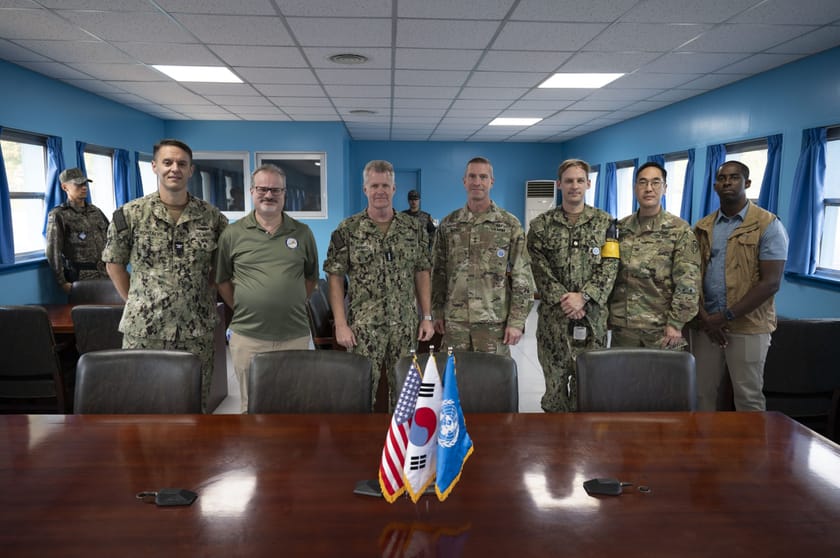
Image from U.S. Navy Petty Officer 1st Class John Bellino via Wikimedia Commons (https://commons.wikimedia.org/wiki/File:CDRUSINDOPACOM_visits_Korean_Demilitarized_Zone_(8686985).jpg). Public Domain as a work of the U.S. federal government.
The views expressed are those of the author and do not reflect the official position of the Irregular Warfare Initiative, Princeton University’s Empirical Studies of Conflict Project, the Modern War Institute at West Point, the official policy or position of the Department of the Army, the Department of Defense, or the U.S. Government.
If you value reading the Irregular Warfare Initiative, please consider supporting our work. And for the best gear, check out the IWI store for mugs, coasters, apparel, and other items.