Editor’s note: This article is part of Project Air Power, which explores and advocates for the totality of air, aviation, and space power in the irregular, hybrid, and gray-zone environments. We invite you to contribute to the discussion, explore the difficult questions, and help influence the future of air and space power. Please contact us at https://irregularwarfare.org/tag/air-power/ if you would like to propose an article, podcast, or event.
The rapid expansion of China’s military forces has attracted considerable attention. The response has generally been symmetrical with others also embarking on acquiring high-end military equipment. US air power’s key operational imperatives are an example, featuring designing the next-generation air dominance fighter, fielding the B-21 next-generation bomber, and upgrading the F-35. Such responses have important deterrence value but can obscure other ways air power can be used.
In the last few years, China has turned to an irregular warfare approach with its increasing use of gray zone air power. Its largest application occurs daily within Japan’s and Taiwan’s air defense identification zones (ADIZ). This use of air power is not conventional but has certainly gained the close attention of Japan and Taiwan.
Worryingly, China is steadily intensifying its use of gray zone air power in terms of the means employed, frequency, and aggressiveness. Focusing on fielding high-end military equipment will not in itself solve this problem. Attention also needs to be given to China’s gray zone strategy with its strengths and weakness when considering possible gray zone counters.
Gray Zone Strategy
Gray zone activities aim to gain others’ deference through their concern over the consequences if the state taking such actions escalates to violence. It is not the actions themselves but the fear of what could happen that is influential. Gray zone actions involve a carefully measured movement toward political objectives while staying below key escalatory thresholds so as to avoid war.
In excluding war but also not being peace, several inferences can be drawn from experiences in employing military forces in both circumstances. Gray zone actions aim to gradually accumulate successes through a series of interdependent actions. This means implementation in a carefully designed campaign plan and control by strategic-level commanders able to allocate and apply significant resources. Moreover, tactical level operations in the gray zone must be tightly controlled to avoid any unintended escalation into war. It’s a form of carefully scripted brinkmanship.
Considering the resources required for such actions, China has an inherent strategic advantage in having vast scale. Chinese Foreign Minister, Yang Jiechi, once famously declared: “China is a big country and you are small countries, and that is a fact.” Beijing exploits this advantage to gradually wear other nations down and into showing deference.
China’s gray zone activities are protracted by design and a seemingly forever drain on other, smaller nations’ resources. Inherent in this drawn-out approach is the need to keep continually ratcheting up the gray zone actions. The nations targeted will be less attentive and less fearful if China’s activities become seen as normal.
Such ratcheting requires some prudence as gray zone operations need to be calibrated to the resilience of the existing peace. Gray zone activities rely on the contemporary peace having sufficient resilience to able to absorb a gray zone shock and bounce back, not a fragile peace that can suddenly shatter and end up in a war.
Gray Zone Air Power
China’s gray zone strategy “way” is to use military and paramilitary means to incessantly intrude into geographic areas of concern to the countries affected, continuously reminding them of China’s presence and the threat it poses. Japan’s ADIZ surrounds the nation but the sensitive area where Chinese aircraft mainly intrude is in the East China Sea. For Taiwan, the pressure points are on the western side of the island’s ADIZ, particularly the median line halfway between Taiwan and mainland China.
In the case of Japan, there are about 600 Chinese military aircraft intrusions annually. Most are twin-engine fighters (such as J-16s and J-10s), often in multiple aircraft formations, with occasional long-range H-6 bombers, Y-8 electronic reconnaissance aircraft, and uncrewed air vehicles. The fighters are at times armed with air-to-air missiles.
In 2013, China created regional anxieties by declaring an ADIZ in international airspace that overlapped Japan’s. Against international law, China then began requiring all ADIZ transiting aircraft not landing in China to comply with certain procedures. In 2024, China further heightened tensions with the stationing of four Peoples Liberation Army (PLA) Navy warships on its ADIZ boundaries. These ships now request all non-Chinese civilian aircraft in the ADIZ to immediately leave and sometimes threaten “defensive emergency measures” if an aircraft fails to comply. This appears another step towards trying to turn international airspace in the East China Sea into China’s territorial airspace with PLA fighter interceptions of transiting civil aircraft possible in the future.
Around Taiwan, China uses its air power in a similar manner although with greater scale and belligerence. After decades of generally avoiding Taiwan’s ADIZ, Chinese aircraft intrusions have recently dramatically increased. In the three years from mid-2020 to mid-2023, there were some 4000 intrusions involving approximately 20 different types of aircraft: fighters, bombers, early warning, and antisubmarine warfare aircraft, with about 10% uncrewed air vehicles. The largest single-day event involved 103 PLA aircraft, 40 of which crossed the median line.
Fighters make up the majority of aircraft crossing the median line with the most common being the J-16, an improved, Chinese-built development of Russia’s Su-27. Considering large aircraft, the Y-8 anti-submarine warfare aircraft is the most prevalent.
PLA aircraft incursions mostly occur in the southwest sector of the ADIZ and often roughly midway, about 100 nautical miles, between Taiwan and the Taiwanese Pratras Islands. To some extent, many of these incursions could be excused as aircrew training as they do not fly toward Taiwan or the Islands but directly into the Pacific. This is not so of the incursions across the median line immediately adjacent to Taiwan. These are clearly designed to send a message, at times clearly spelled out in the media to avoid missing the intent.
Their rate has been rapidly increasing, from 22 in 2020 to 703 incursions in 2023. These incursions are usually shallow, 4-5 miles or so, and sometimes involve only a single aircraft. Nonetheless, their high-speed approach can lead to quick reaction alert aircraft scrambling from Taiwanese airbases.
China continues to ratchet up its actions. During the Fourth Taiwan Straits Crisis in August 2022, 11 ballistic missiles were fired into zones north, east, and south of Taiwan. Four missiles passed over Taiwan at more than 100 kilometers altitude, technically outside Taiwan’s airspace. Five impacted in Japan’s exclusive economic zone.
In late 2023, China started sending balloons into Taiwan’s territorial air space. An estimated 26 had overflown the island at altitudes between 15,000 and 38,000 feet by mid-February 2024. In an instrumental use of law similar to the 2013 ADIZ declaration, in early 2024, China announced it would unilaterally move an earlier mutually agreed civil aircraft flight corridor eastward in the Taiwan Strait to within four nautical miles of the median line. Chinese civilian aircraft making even minor diversions for weather conditions now are likely to intrude across the median line.
Implications
Responding to China’s incursions is taxing for both Japan and Taiwan. Japanese fighters are frequently scrambling to try to intercept Chinese military aircraft penetrating their East China Sea ADIZ. However, Japan is finding it difficult to sustain this air policing posture and is being forced to cut back, creating a vacuum that China might fill and thereby incrementally gain de facto control of much of Japan’s East China Sea ADIZ airspace, particularly that over the Senkaku Islands. Despite the drain on resources, Japan believes it must continuously demonstrate strong determination to maintain its ADIZ and territorial sovereignty.
Taiwan is even more stretched given its limited air capabilities and China’s use of ballistic missiles and balloons. Initially, Taiwan scrambled fighters in response to China’s aircraft incursions but the dramatic increase in 2020 began imposing unsustainable costs. By the end of the year, some 8.7 percent of Taiwan’s defense budget was being spent on responding (this cost also included increased naval tasking). In early 2021, policy changed to emphasize surface-to-air missile system tracking of incoming PLA aircraft rather than fighter aircraft scrambles.
Both Japan and Taiwan are assiduous in publicizing China’s incursions, including by providing records accessible on the internet. This can help mobilize domestic public opinion to support pushback. More ambitiously, some consider that China could also be embarrassed by a more comprehensive global publicizing of its gray zone actions and thus be deterred from continuing them. There is no firm evidence to support this. To the contrary, it may be helpful to China by widely publicizing its power in a manner that helps win deference.
Counter-Gray Zone Guidelines
Countering China’s gray zone efforts is difficult as responding is in itself an outcome China pursues in its quest for others’ deference. Several high-level guidelines are offered.
First, a counter-gray zone campaign is likely to be a drawn-out operation requiring additional personnel, funds and equipment. The level of such support available will shape the counter-gray zone actions taken, their frequency and duration. Gaining and sustaining material support and societal backing will be fundamental to the campaign.
Second, focus on the decision-makers involved. Decision-makers at the various levels controlling a local gray-zone activity will have goals, motivations, and vulnerabilities that may be able to be discerned, understood, and exploited. Strategic level decision-makers in being remote and making long-term, set-and-forget plans, may be less aware of the local idiosyncrasies and dynamics. Operational commanders conscious of the need to avoid escalation may fret that events could spiral out of control. At the tactical level, confusion may be created by acting in unexpected or deceptive ways. Such confusion may reverberate upward, generating uncertainties, upending planning and misleading decision-making. The more the key actors are understood, the more tailored the countermeasures and the more effective they will be.
Third, China’s ADIZ incursions are inherently theatrical and consequently, responses might be designed to concern, confuse, or deceive China’s political and military leadership. An obvious example is to implement a tit-for-tat strategy, reciprocating China’s incursions with symmetry in time and space. Taiwanese aircraft might briefly penetrate the median line about 4-5 miles to the west before turning around. This may raise concerns over escalation but this is improbable as China’s gray zone activities rely on peace holding. Escalation would represent a significant Chinese failure. Nevertheless, any pushback carries risk and needs prudent management.
Fourth, attempt to establish a dedicated hotline between Japan and Taiwan with China to allow military-to-military communication if a gray zone event occurs that threatens escalation. Such efforts might be informed by the US-Russia and the Israel-Russia hotlines established in 2015 to manage risks arising from inflight incidents over Syria. The two hotlines have had mixed success but seem effective as a circuit breaker during crises. China and Japan already have a diplomatic hotline as a further possible model to build on.
Lastly, both Japan and Taiwan have similar problems with China’s gray zone actions. Consequently, they have developed closer linkages. Given China’s steady ratchetting up, conditions seem set for even greater cooperation including exchanging experiences, examining expected future developments, providing air tracking data and possibly coordinated air policing. Such cooperation would inevitably evoke noisy outbursts from China. However, perhaps simply discussing such cooperation would strike a pressure point and send a strong deterrence message to cease gray zone activities and escalation.
Gray zone activities do not involve the violence normally associated with offensive air power. Instead, China is seeking deference and submissiveness from others through implying the possibility of military escalation and bloodshed. The maintenance of the peace, not the winning of a skirmish, shapes gray zone actions. It is a use of air power fundamentally different to conventional thinking and that exploits both China’s advantages and a good understanding of others’ anxieties. It is a form of irregular air warfare but not as often imagined.
Dr Peter Layton is a Visiting Fellow at the Griffith Asia Institute, Griffith University, and a Royal United Services Institute (RUSI) Associate Fellow. He has extensive aviation and defence experience including flying fast jets and maritime patrol, force development, major equipment projects and as a defence attaché. Dr Layton has a doctorate from the University of New South Wales on grand strategy and has lectured on the topic at the Eisenhower School and numerous other institutions. He contributes regularly to the public policy debate on defence and foreign affairs issues and is the author of the book Grand Strategy and co-author of Warfare in the Robotic Age.
The views expressed are those of the author and do not reflect the official position of the Irregular Warfare Initiative, Princeton University’s Empirical Studies of Conflict Project, the Modern War Institute at West Point, or the United States Government.
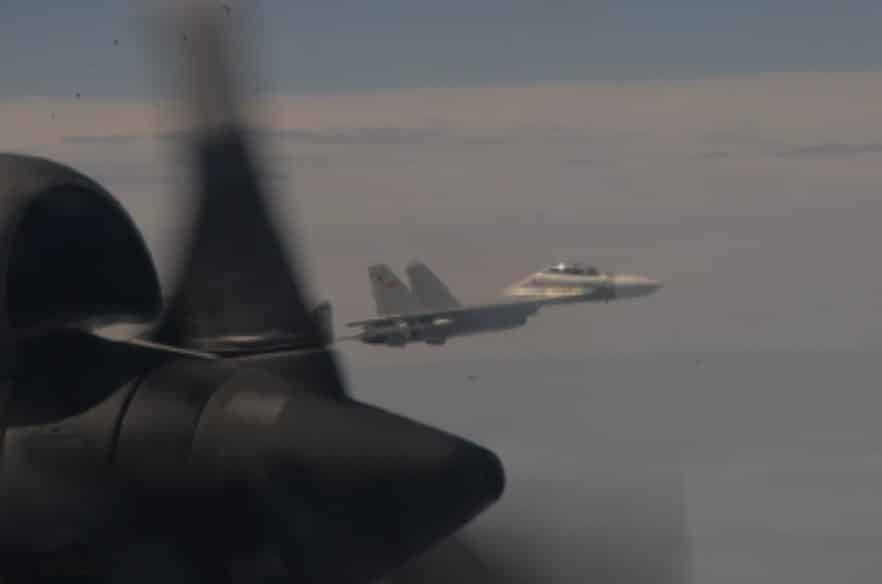
Main image: Images and video newly released by the Department capture a PLA fighter jet in the course of conducting a coercive and risky intercept against a lawfully operating U.S. asset in the East China Sea. Over the course of five hours, four PLA aircraft conducted this intercept, at one point reaching a distance of just 75 feet from the U.S plane. (Office of the Secretary of Defense Public Affairs via DVIDS)
If you value reading the Irregular Warfare Initiative, please consider supporting our work. And for the best gear, check out the IWI store for mugs, coasters, apparel, and other items.