
By James Park
President Trump’srecent bilateral summits with Japan and India underscore a tacit trend: the central role of US allies in the Indo-Pacific region. In particular, evolving US-India ties have significant implications for the rest of the Quadrilateral Dialogue (QUAD) member states and other US alliance structures in the region. These trends reflect the degree to which the Indo-Pacific region has emerged as a key American foreign policy priority, as underscored by a joint statement issued by the QUAD nations in January 2025.
This growing emphasis builds on earlier efforts by QUAD nations to enhance regional security cooperation. In 2022, for example, the QUAD nations launched the Indo-Pacific Maritime Domain Awareness (IPMDA) initiative to unify real-time data processing for all vessels in the region. This would provide increased transparency and accountability. Since its inception in May of that year, however, the IPMDA has remained relatively underdeveloped, despite initial enthusiasm.
The diplomatic challenges surrounding the integration and de-confliction of diverse Maritime Domain Awareness systems and initiatives is the primary reason the QUAD-initiated IPMDA remains largely dormant. Overcoming this hurdle is essential for the IPMDA to fulfill its role in countering grey-zone threats, especially when facing Chinese grey-zone tactics at sea.
Addressing these integration challenges is not merely a technical hurdle—it is a strategic imperative in the face of escalating grey-zone threats from China. To effectively counter China’s maritime tactics—particularly the use of its maritime militia or “little blue men”—the QUAD nations must urgently revitalize and integrate IPMDA into a unified, coordinated framework that can provide real-time visibility, enable rapid legal enforcement capability, and contribute to strategic deterrence across the region. Together, the QUAD can proactively seek ways to counter threats in the Indo-Pacific that challenge the normative and inclusive international order, an order that is underpinned by principles such as freedom of navigation and a rules-based approach to international conduct.
Grey Zone Threats
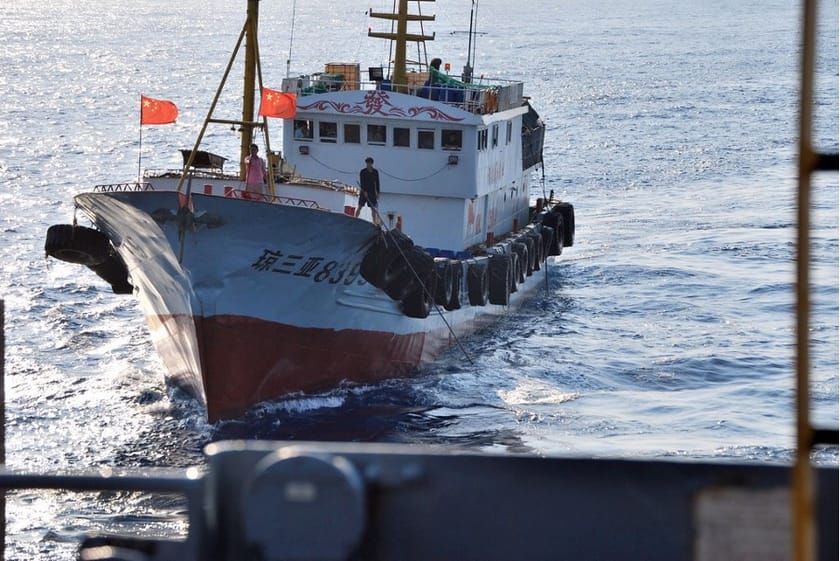
At the forefront of the region’s grey-zone challenges is China’s maritime militia, colloquially known as the “little blue men.” Operating under the guise of civilian fishing vessels, the exact number of vessels in the militia remains unclear. However, participants are drawn from China’s vast fishing fleet, which comprises 21 million fishermen and 439,000 motorboats. The little blue men provide the People’s Liberation Army Navy with deniability while contributing to China’s area-denial efforts against US naval operations and neighboring countries’ forces.
These militias use irregular tactics such as “rafting,” which involves chaining tens or hundreds of ships together to create makeshift maritime outposts for saber-rattling. They also infiltrate other nations’ exclusive economic zones without technically violating international law, as they are not actively exploiting maritime resources. In employing such tactics, these little blue men raise serious concerns under international law and the United Nations Convention on the Law of the Sea. Despite questions of legitimacy, they serve as a key instrument of China’s grey zone strategy: blurring the line between civilian and military actions to gain strategic advantage while avoiding open conflict.
The power of these grey zone tactics is vast. The little blue men can leverage their numbers to swarm and disperse, effectively interdicting US or allied naval vessels who are operating under conventional rules of engagement. For example, these militias can carry out a surprise amphibious action on small rocky shoals and uninhabited islands in the Indo-Pacific, which are crucial for maritime territorial demarcation.
Perhaps more insidious, the little blue men intentionally defy maritime domain awareness methods and international norms by disabling their automatic identification systems (AIS), which allows them to evade detection while raising questions about their true intent. This deliberate evasion creates space for illicit activity that directly undermines the rules-based international order in the Indo-Pacific.
As more Indo-Pacific nations forge small-scale agreements with China, the little blue men may no longer remain “little.” They may become more deeply involved in activities that blur demarcated maritime lines and borders. They could evolve into an even more formidable force, further destabilizing maritime security and exploiting the grey zone beyond their current malign activity. This was exemplified in 2021 by their saber-rattling in swarming the Whitsun Reef, a feature the Philippines claims. Such actions risk irreversibly undermining the inclusive international order in the region that like-minded states have fought hard to secure.
Inadequate Countermeasures
In light of these threats, the United States could recommit to coordinating with allies to develop more effective countermeasures. However, the February 2025 US-India summit may have fallen short of directly addressing the growing threat posed by the little blue men. The bilateral agenda did not prioritize a crucial component: revitalizing the IPMDA to directly meet challenges posed by China. The agenda did, however, include plans to enhance shared airlift capacity for civilian disaster response and improve maritime patrol interoperability.
The US currently holds separate naval exercises with regional maritime powers, including Balikatan with the Philippines, Keen Sword with Japan, and Talisman Sabre with Australia. Improved IPMDA could bolster these and other exercises, each covering vast regions of the Indo-Pacific. IPMDA could do this by providing real-time, visual tracking information for all vessels in regional waters. At a minimum, QUAD states could consider issuing a declaration that the current IPMDA will officially undergo enhancements to more fully address the evolving threats in the Indo-Pacific.
If fully operational, IPMDA could enable participating Indo-Pacific nations to share a common operating picture of all surface vessels in the region, theoretically alerting stakeholders of little blue men activities. However, the system’s current reliance on ships maintaining active AIS signals poses a major limitation—precisely because China’s maritime militia often disables AIS to evade detection. While IPMDA’s use of real-time satellite imagery helps bridge this gap, it is not a panacea. Unmanned aerial systems can further enhance IPMDA’s effectiveness by providing additional data to update the common operating picture more comprehensively and in real time.
Strengthening Maritime Coordination
The real challenge for the IPMDA lies within the QUAD and its partner nations. China’s lack of transparency, coupled with violations of international norms, offers a watershed moment for any upcoming QUAD summits. The IPMDA requires rich, vast, and real-time data from all vessels in the region to function effectively. However, the Indo-Pacific’s sheer size has led to the proliferation of multiple, well-established maritime domain awareness systems with different operational frameworks that require deconfliction to avoid data-process confusion. These include the European Union-backed Critical Maritime Routes Indo-Pacific system, the ASEAN-supported Indo-Pacific Regional Information Sharing Platform, Canada’s Dark Vessel Detection Program, and India’s Information Fusion Center-Indian Ocean Region. These frameworks are already contributing to regional maritime security, albeit separately, further highlighting the need to increase integration.
Unifying MDA systems is more critical than ever. This unification could be a key discussion topic for the next QUAD summit. Some experts argue that China’s campaign to dominate the Indo-Pacific without firing a shot is already underway. Chen Yuhua, a China studies professor at Akita International University, suggested that China would “take US allies out of Washington’s orbit” in an attempt to drive a wedge between the US and its key allies. Beijing has strategically exploited fractures in the internal political dynamics of Indo-Pacific nations, leveraging diplomatic and economic influence to secure port access and own infrastructure. Some of these efforts, particularly in Sri Lanka, Djibouti, and Pakistan, are designed to enhance China’s access to the Indian Ocean. All of this further solidifies China’s regional foothold, enabled by the little blue men.
Conclusion
At this critical juncture, with an upcoming QUAD summit, the QUAD must act decisively to integrate the region’s disparate maritime domain awareness systems into a cohesive, QUAD-led framework. This effort would provide the transparency, interoperability, and enforcement capabilities needed to confront grey-zone threats head-on. China’s little blue men are no longer a peripheral challenge; they represent a sophisticated arm of coercion that exploits ambiguity and fragmentation among like-minded states. Without a unified response, these militias will continue to blur maritime borders, weaken alliances, and erode the rules-based order in the Indo-Pacific. The upcoming QUAD summit is not merely an opportunity, it is a test of resolve.
James JB Park is a Captain (R) of the Republic of Korea Army. He is a 2024 Non-resident James A. Kelly Korea Studies Fellow at the Pacific Forum and an Indo-Pacific Geopolitics Fellow at the Indo-Pacific Studies Center. From 2017 to 2019, Captain Park served as a staffer in Korea’s Presidential Blue House and its Office of National Security (U.S. National Security Council equivalent), where he was a bridge between the Blue House, the White House, and high-profile U.S. officials.
The views expressed are those of the author(s) and do not reflect the official position of the Irregular Warfare Initiative, Princeton University's Empirical Studies of Conflict Project, the Modern War Institute at West Point, or the United States Government.
Image credit: U.S. Navy photo.
If you value reading the Irregular Warfare Initiative, please consider supporting our work. And for the best gear, check out the IWI store for mugs, coasters, apparel, and other items.