“The country must turn to, and not away from, the American way of irregular war.”
—Lieutenant General Charles T. Cleveland, The American Way of Irregular War (2020)
Editor’s Note: This article is a response to “The Last A-Team: Special Forces Aren’t Special Anymore,” and “A New Vision for Special Forces” by Colonel (Retired) Ned Marsh.
The world is changing in ways that significantly affect special operations forces. Population density, megacities, ubiquitous surveillance, drones, and artificial intelligence are reshaping what is possible and how future wars will be fought. All of this raises an old question: what is the role and value of U.S. Army Special Forces (SF) in this shifting environment?
Two answers to this question are debated in Special Forces team rooms and hallways from Fort Bragg to Tampa. The first answer holds that the current force cannot deliver its claimed value proposition of small teams infiltrating near-peer adversaries during large-scale combat operations and must therefore leverage technology to become more lethal and better able to support the joint force across multiple domains. The second answer holds that Special Forces should build partner-nation relationships and networks, state and non-state alike, that can operate where and how unilateral U.S. forces cannot. These are different visions of how Special Forces provide options for decision-makers.
Retired Special Forces Colonel Ned Marsh recently proposed a vision in line with the first answer in a two-part article in these pages. Marsh argued that Special Forces has drifted from relevance and must be fundamentally restructured around an invisible, technically lethal operator. He correctly identifies the symptoms: presence as practiced has not been a strategy; ARSOF 2022 was filed and forgotten after Lieutenant General Cleveland attempted to revamp U.S. Army Special Operations Command (USASOC) from 2012 to 2015; and an enterprise of thirty-six thousand is too large to operate secretly. But he misplaces the source of Special Forces’ enduring value. This article makes the case for the second thesis. The way ahead is not a new concept; it is an older one. Special Forces should move back toward a forward-stationed, persistent presence: small teams and embedded individual advisors who live in key partner nations for years, building the relationships and human networks that unilateral action and high technology cannot. That is a capability the joint force cannot replicate or surge, and preserving it means decentralizing the force into the regions it claims to know rather than consolidating it within the strike enterprise.
The Wrong Domain
That first vision assumes what makes Special Forces special is the technical envelope around the operator. But that describes a conventional formation with better equipment, and the joint force is already pursuing it at scale. If the entire Department of War is chasing the same technologies, where is the spectrum of options? Special Forces optimized for the same missions as everyone else is not a special capability. It is a redundant one. Technology matters, but it should extend the human network, not replace it as the organizing principle of the force.
The alternative is for Special Forces to focus on the human domain. Unconventional warfare and foreign internal defense are not different weapon sets; they are missions conducted through people. Relationships build access. The network is the platform. The partner is the weapon system. Signature management, terrain awareness, and access to denied populations all flow downstream from partners who already live where the United States cannot.
Marsh is correct that a twelve-person team with American biometrics cannot infiltrate Shenzhen. But the issue is that infiltration is the wrong measure. When unconventional warfare in China is dismissed as infeasible, it’s normally framed as the classic U.S. doctrinal construct: a clandestine underground inside the denied space, exactly what the surveillance state is built to detect. The second vision argues that the value of Special Forces does not lie in getting inside the wire, but in influencing the decisions a state makes. The population is not territory to be infiltrated; it is a weapon system that forces choices on a regime.
The question is whether the United States can build networks from outside China that reach inside it and shape Beijing’s calculus. The claim is not that external actors like U.S. Special Forces can manufacture resistance at will; they cannot. However, even the hardest surveillance state contains social fissures, external linkages, and influence pathways.
The evidence is abundant. Despite the most sophisticated control apparatus in history, Freedom House’s China Dissent Monitor recorded a 45% year-over-year rise in internal PRC protests in the third quarter of 2025, marking the sixth straight quarter of increase, all while the regime struggles to contain them. In August 2025, an activist in the United Kingdom remotely triggered an anti-CCP protest in Chongqing before the regime could preempt it. Internal pressure exists, persists, and can be exploited from outside.
The point is not that the United States should or should not wage unconventional warfare against China; that is a policy question. Rather, the idea of the modern surveillance state should not be used as a conceptual barrier to declare resistance and unconventional warfare dead. The hardest target is hard, but it is not impossible.
The decisive question shouldn’t be how SF can “get in” but who SF can leverage there to achieve desired effects? For Special Forces, the answer is always the partner.
Asking the Right Question: Not What, but When
The technology-first vision also rests on a hidden assumption: that the relevant test of Special Forces is their contribution to large-scale combat operations (LSCO) against a peer adversary. Rarely stated openly, this assumption drives much of the current command thinking: the instinct to train for the worst case. A force built to infiltrate Iran, Russia, or China, deliver multidomain fires, and operate clandestinely in surveilled megacities is optimized for the opening hours of a continental war.
But when you ask the wrong question, you get the wrong answer.
The question shouldn’t be what is the Special Forces value proposition? The question should be when are Special Forces most valuable?
Special Forces hold their greatest comparative advantage in the gray-zone steady state: the long competitive status quo below the threshold of armed conflict that adversaries have weaponized while the United States has not. Special Forces are doing that work now across the roughly seventy nations that Marsh himself acknowledges. In the Philippines, the Baltics, and the Indo-Pacific archipelagos, teams build partner capacity, map networks, and identify resistance potential. This is the blue-collar labor of partnership, not a placeholder waiting for a real war. It is the most important work for Special Forces and, once a peer fight begins, it is too late to start.
The SOF Truth that competent special operations forces cannot be created after emergencies applies most acutely to human networks. A relationship sustained for fifteen years cannot be stood up in fifteen days.
The comparative advantage of Special Forces diminishes, not increases, as conflict escalates toward conventional war. In a peer fight, the joint force has armored brigades, carrier strike groups, and long-range fires that dwarf anything a redesigned team produces. What these conventional forces will not have and cannot surge is the pre-existing network inside the contested space, which Special Forces builds in competition and leverages when conflict begins. The fantasy of teams HALOing into a denied area is a distraction from the work that actually pays off.
This is not simply theoretical. In 2003, Task Force Viking, in northern Iraq, fielded three hundred Green Berets partnered with roughly fifty thousand Kurdish Peshmerga. Together, they fixed thirteen Iraqi divisions and secured the north because the 10th Special Forces Group had spent roughly a decade in the region building the Kurdish relationships the campaign rested on. Its commander, Colonel Charles Cleveland, later wrote ARSOF 2022 while serving as the USASOC commander, which prescribed the model he had helped prove. The institution declined, for reasons worth their own essay. Part of the answer is cultural and institutional gravity: surgical strike is easy to brief, career-enhancing, and legible to a conventional Army as obvious value added - in ways the slow, unglamorous work of partnership is not.
Task Force Viking is one example among many: Operation Enduring Freedom-Philippines in Mindanao, Plan Colombia, and the early campaign of the Syrian Democratic Forces. None came from unilateral penetration. All came from partnerships sustained over years by operators who knew the terrain because they lived there.
This is why the charge that presence is not a strategy is only half true, and maintaining presence for its own sake is not enough. Episodic presence—the month-long TDY or six-month rotation that meets a partner for the first time on day three—is busywork dressed as engagement. Persistent presence has a strategic effect. The RAND finding that security cooperation correlates with stability mostly in already-stable states should not be read as an indictment of persistent presence. It is an indictment of episodic engagement masquerading as strategy. The model failed because it was the wrong model, not because the concept of partnership was wrong.
The Answer Is Decentralization, Not Consolidation
Marsh’s prescription, folding a Special Forces group plus Civil Affairs and Psychological Operations companies under Joint Special Operations Command (JSOC), accepts the premise that the global strike complex is where serious special operations live. But JSOC is structurally a surgical-strike enterprise. Folding unconventional warfare into it does not preserve special warfare; it absorbs special warfare into a culture and tempo built for and around exquisite direct action operations.
The structural problem Marsh identifies is real, but it is the opposite of what he diagnoses. The force is not too dispersed; it is too centralized. The model that produces the cultural-fluency gap is five active groups headquartered at large garrisons, deploying episodically into countries where their nominal regional alignment is honored mostly on the briefing slide. No one becomes an old hand on a six-month rotation, just as no one becomes a linguist in a six-month course.
The fix is to permanently station teams in the countries they are meant to know, not at Fort Bragg. That is the model the regiment was built on. The 46th Special Forces Company in Thailand trained Royal Thai units from forward camps from 1966 to 1972, building relationships that still anchor the bilateral SOF partnership today. The 39th Special Forces Detachment in Korea, formerly Det K, has been forward-stationed continuously since 1960, making it the longest-serving Special Forces unit in the world. The Berlin Detachment, Det A, lived in the city from 1956 to 1984, preparing stay-behind networks under a level of cover no rotational team could replicate. And Detachment 26 in Longtan, Taiwan, maintained a continuous 1st Special Forces Group presence from 1960 to 1973, partnering with Republic of China special operations forces. The 1st Group rotational presence on the island since 2024 is a step in the right direction, but six-month rotations are not the historic Det model, which requires permanent assignment in country, not temporary duty. That means changing assignment cycles, command evaluations, family support, language expectations, security rules, and career incentives so that regional expertise is rewarded rather than treated as a temporary utilization tour.
This also addresses the concern about size. Once teams live in their countries for years, the force in any one place is small because it is distributed; the enterprise shrinks as a consequence of decentralization, not as a goal unto itself.
Forward stationing the team is half of the argument. The other half is embedding the individual operator. While a Colonel, Lieutenant General (Retired) Eric Wendt laid out the framework in his 2011 Special Warfare article on the Green Beret Volckmann Program: a career-managed system that would embed individual Green Berets within partner militaries for multi-year tours, building the language proficiency and personal relationships no rotation can produce. The program’s namesake is Russell Volckmann, who, embedded with the Philippine Army in 1941, raised a twenty-two-thousand-man guerrilla force on Luzon because he was already inside the partner force when the war began. The framework survives today as the Global Advisor Program concept. Combined with the Det system at the team level, it is the executable, decentralized model the critics are looking for but not finding.
This prescription does not argue that direct action is bad and unconventional warfare is good. The nation needs surgical strike and special warfare as distinct options, not as a single strike model wearing different SOF patches. That is why the partnership mission cannot survive being folded into the strike enterprise.
First Principles, Not Last Rites
Marsh closes by calling to bury the beret and build what comes next. The line is powerful yet backward. The honest question, unanswered since 1991, is the value proposition of Special Forces. If Special Forces solely exist to infiltrate denied areas during a peer war, then bury the beret; the joint force already owns high-end combat. But if they exist to build partner networks that reach spaces unilateral action cannot, the mission matters more than ever. The bloat Marsh rightly identifies is a command problem, not proof that the force in the field is doing the wrong work. Cutting the operating force to fix a headquarters problem mistakes the patient for the disease.
I respect Colonel Marsh’s service and his decades in Special Forces. But the first principles I describe are not mine to claim, nor were they his to lose. They predate his time in the organization and my four decades in it. The founding fathers of the regiment argued over what SF was for before either of us put on the beret. The argument here is not for something new. It is for something the regiment already knew and then forgot.
The answer is not consolidation. It is decentralization, back toward Cleveland and Wendt’s vision and the model the founders built. Don’t bury the beret. Disperse it. Put it back in the field, with the partners, where it always belonged.
Maurice “Duc” DuClos is a retired U.S. Army Special Forces warrant officer with over 40 years in U.S. SOF. He currently serves as a Guest Lecturer at the Naval Postgraduate School’s Defense Analysis Department. His work focuses on irregular warfare, unconventional warfare theory, and resistance studies.
The views expressed are those of the author and do not reflect the official position of the Irregular Warfare Initiative, the Naval Postgraduate School, the Department of War, or the United States Government.
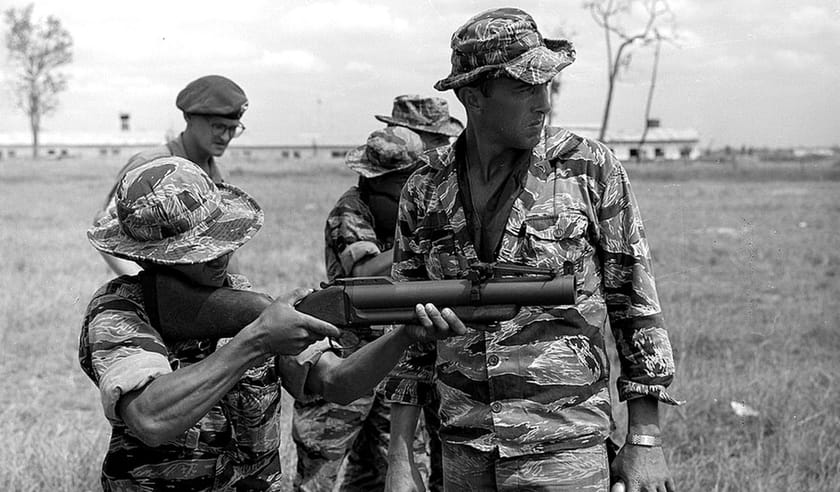
Main image: SSG Alvin J. Rouly instructs a Civilian Irregular Defense Group trainee on the M79 grenade launcher at Camp Trai Trung Sup, Republic of Vietnam, 30 March 1967. Photo by SP5 Robert C. Lafoon, Department of the Army Special Photographic Office, via the U.S. National Archives (111-CCV-423-CC39152). Converted to black and white.
If you value reading the Irregular Warfare Initiative, please consider supporting our work. And for the best gear, check out the IWI store for mugs, coasters, apparel, and other items.