"The problem is not that China operates in a gray zone. The problem is that the free world continues describing warfare in terms China itself does not recognize."
For more than a decade strategists, journalists, and policy makers have relied on the phrase “gray zone” to describe China’s coercive activities below the threshold of armed conflict. The term has become common in military doctrine, academic analysis, and diplomatic discourse. Yet the phrase is strategically flawed. Worse, it is dangerous. It unintentionally legitimizes the very behavior it seeks to describe.
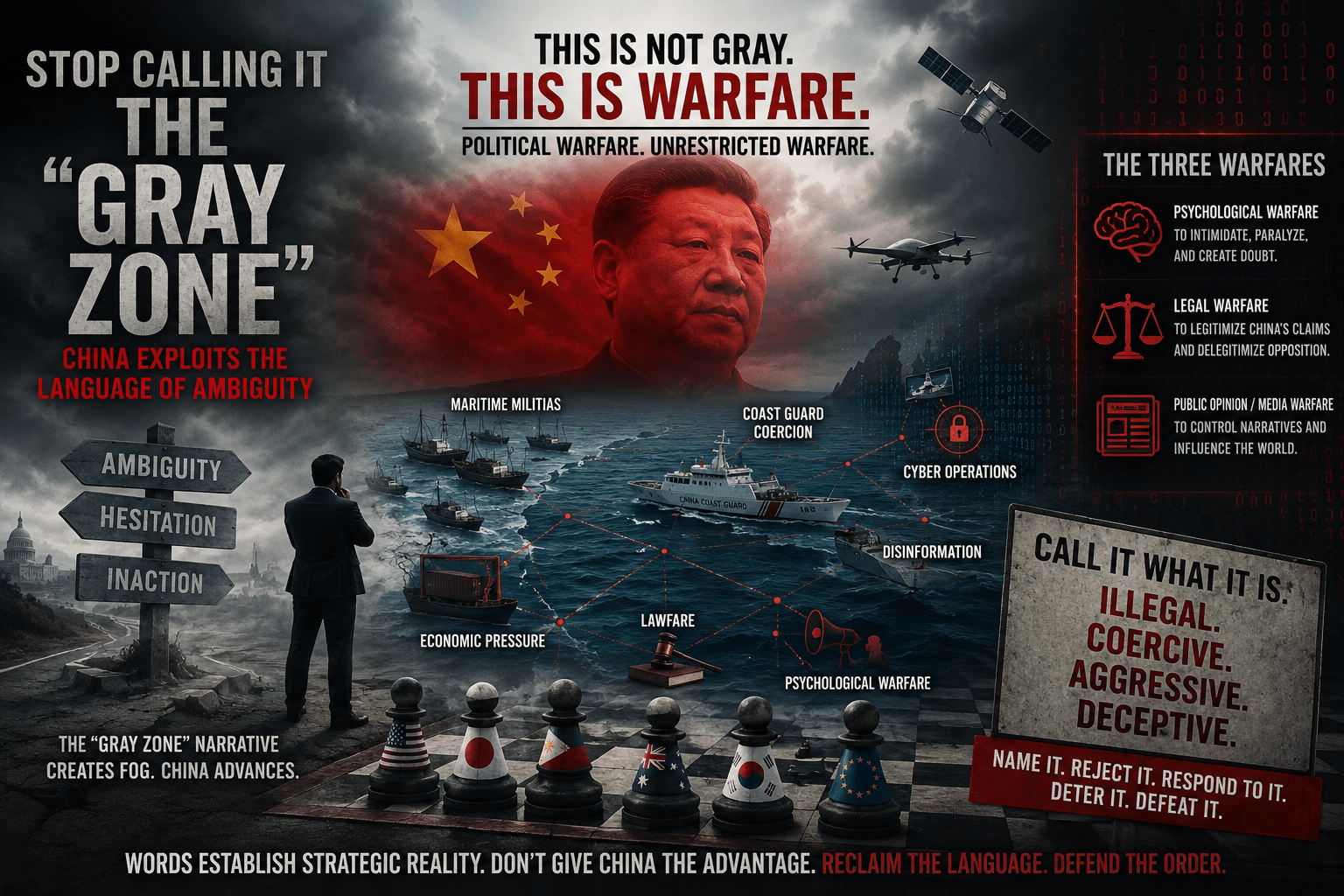
The phrase “gray zone” implies ambiguity. It suggests uncertainty about legality, responsibility, and appropriate response. It creates intellectual fog around activities that are often neither ambiguous nor gray. China’s actions in the South China Sea, around Taiwan and the Taiwan Straits, against the Philippines, particularly in the West Philippine Sea, north to Japan and farter north to The Republic of Korea’s West Sea, and across the free world are deliberate political warfare operations. They are coercive campaigns designed to alter behavior, undermine sovereignty, fracture alliances, and weaken resistance without triggering conventional military retaliation. This is warfare. Political Warfare. It is our fear of using the term that creates ambiguity which cedes the initiate and control to China.
China benefits when democracies call these actions “gray.” Beijing understands that language shapes perception, and perception shapes political will. This is not accidental. It reflects the logic of the Chinese Communist Party’s (CCP) doctrine of Unrestricted Warfare and its concept of the “Three Warfares:” psychological warfare, legal warfare, and public opinion or media warfare.
The United States and its allies should stop using the term “gray zone.” Instead, they should adopt the more precise and strategically useful framework increasingly employed by our Philippine allies: China’s activities are illegal, coercive, aggressive, and deceptive.
That language matters because it strips away the political camouflage China depends upon.
The Strategic Trap of the “Gray Zone”
The “gray zone” concept emerged as analysts struggled to categorize actions that fell between peace and war. China’s use of maritime militias, coercive coast guard operations, cyber intrusions, cutting of undersea cables, economic pressure, disinformation campaigns, and lawfare did not fit neatly within traditional military frameworks.
But the term itself became a strategic concession.
Calling malign activity “gray” creates hesitation. It encourages endless debates over thresholds, escalation ladders, and attribution. It causes democratic governments to ask whether actions are serious enough to warrant response. Meanwhile China advances incrementally.
The CCP does not view these operations as ambiguous. It sees them as continuous political warfare.
From Beijing’s perspective, the battlefield already exists. The objective is not merely territorial acquisition. It is psychological dominance. China seeks to convince opponents that resistance is futile, escalation is dangerous, and accommodation is inevitable.
The U.S. and free world want to avoid war at all costs while the CCP wants to win without fighting.
The “gray zone” narrative helps China achieve precisely that effect.
The phrase also reflects a Western bias toward categorization. American strategists often seek clean distinctions between war and peace, military and civilian activity, coercion and diplomacy. China rejects those distinctions. Unrestricted warfare explicitly embraces the fusion of all instruments of national power. Economic pressure, information operations, maritime harassment, cyber-attacks, legal claims, and diplomatic intimidation are integrated tools of statecraft.
The problem is not that China operates in a gray zone. The problem is that the free world continues describing warfare in terms China itself does not recognize.
It will only get worse. During the Xi-Trump summit of May 2026, China introduced a new concept that it wants to employ for its own legitimacy and great hesitation and restraint among the U.S. and its allies: “constructive strategic stability.” China recognizes that words are battlespace. If China defines stability, U.S. deterrence can be painted as escalation. Taiwan is the focal point. Beijing wants every future U.S. move measured against China’s red line, not against Taiwan’s right to defend itself. The free world should not allow this terminology to be adopted.
Unrestricted Warfare and the Three Warfares
The intellectual roots of this problem lie partly in the PLA’s concept of unrestricted warfare, articulated by PLA Colonels Qiao Liang and Wang Xiangsui in 1999. Their central argument was simple but profound: future conflict would not be confined to military means. All domains could become battlefields.
Financial warfare. Information warfare. Legal warfare. Cyber warfare. Psychological warfare. Media manipulation. Economic coercion.
Everything becomes weaponized.
China’s “Three Warfares” doctrine operationalized this approach. Approved by the CCP and PLA in 2003, it institutionalized three mutually reinforcing lines of effort:
Psychological warfare seeks to shape perceptions and decision-making. The goal is intimidation, paralysis, doubt, and resignation.
Legal warfare seeks to manipulate domestic and international law to legitimize China’s claims while delegitimizing resistance.
Public opinion or media warfare seeks to dominate narratives and influence international audiences.
The “gray zone” framework unintentionally amplifies all three.
Psychologically, it normalizes Chinese coercion as something less than aggression. Legally, it obscures clear violations of sovereignty and international law. In the information space, it reinforces the narrative that the situation is too complex or ambiguous for decisive action.
China could not design a better linguistic shield. The free world has unintentionally allowed China to normalize its malign activities because the of the use of the “gray zone.”
The Philippines Understand the Problem
The Philippines increasingly offers a more sophisticated strategic vocabulary. Manila has moved away from passive descriptions of Chinese behavior and instead labels Chinese actions as illegal, coercive, aggressive, and deceptive.
That language has several advantages.
First, it is morally and legally precise. Chinese harassment of Philippine vessels in the South China Sea is not “gray.” It violates international law, including the 2016 arbitral ruling under the United Nations Convention on the Law of the Sea. Water cannon attacks, ramming incidents, laser targeting, and maritime intimidation are coercive acts.
Second, the Philippine framework creates political clarity. Democracies struggle to mobilize public support against abstract ambiguity. They respond more effectively to clearly identified wrongdoing.
Third, this language imposes reputational costs on China. Beijing invests heavily in portraying itself as a responsible global power. Terms like “illegal” and “aggressive” directly challenge that narrative.
Fourth, the framework strengthens deterrence. Precise language reduces the space for incremental normalization. China relies on salami-slicing tactics because each individual action appears too small to justify major response. But when those actions are consistently described as coercive aggression, the cumulative pattern becomes impossible to ignore.
The Philippines has learned through direct experience that strategic language is itself a battleground.
Washington and the rest of the free world should learn the same lesson.
Why Language Matters in Political Warfare
Some will argue this debate is semantic. It is not.
Political warfare begins with language because language shapes legitimacy.
George Kennan understood this during the Cold War. So did the Soviets. So does the CCP today.
If China can convince the world that its coercive activities exist in a legally and strategically ambiguous “gray zone,” then it reduces the likelihood of coordinated resistance. Ambiguity benefits the aggressor.
This is especially true in democracies where political consensus often depends on clear moral framing. Democracies hesitate in uncertainty. Authoritarian regimes exploit hesitation.
China’s strategy depends on remaining below what Western governments perceive as the threshold of war. But that threshold itself is politically constructed. Beijing manipulates perception to ensure responses remain fragmented and delayed.
The free world must stop helping China manipulate the battlespace vocabulary.
Instead of “gray zone coercion,” officials should say “illegal maritime aggression.”
Instead of “competitive shaping operations,” they should say “coercive political warfare.”
Instead of “hybrid pressure,” they should say “deceptive and coercive CCP operations.”
Words establish strategic reality.
The Need for a New Strategic Lexicon
The United States and its allies need a new lexicon for strategic competition in the Asia-Indo-Pacific. Strategic competition is as ambiguous and imprecise as the “gray zone.” New lexicon should prioritize clarity over abstraction and moral precision over academic ambiguity.
This does not mean reckless escalation. Precision in language can actually strengthen deterrence by clarifying norms and consequences.
Nor does it mean every Chinese action constitutes armed attack. Strategic competition exists across a spectrum. But describing malign actions accurately matters because it shapes the political environment in which responses are formulated.
The Philippines has demonstrated an important lesson. Naming aggression clearly does not provoke instability. It exposes instability already created by the aggressor.
The central question is simple: who benefits when we call coercion “gray”?
The answer is obvious.
China benefits because ambiguity delays resistance. It fragments alliances. It weakens public resolve. It obscures accountability. It normalizes coercion.
The free world should stop granting Beijing that advantage.
The challenge before democracies is not merely operational. It is conceptual. We must stop describing political warfare in the language of uncertainty while our adversaries wage it with strategic clarity.
That begins by retiring the phrase “gray zone” and replacing it with language that exposes what China is actually doing: illegal, coercive, aggressive, and deceptive operations against the free world. This is political warfare.