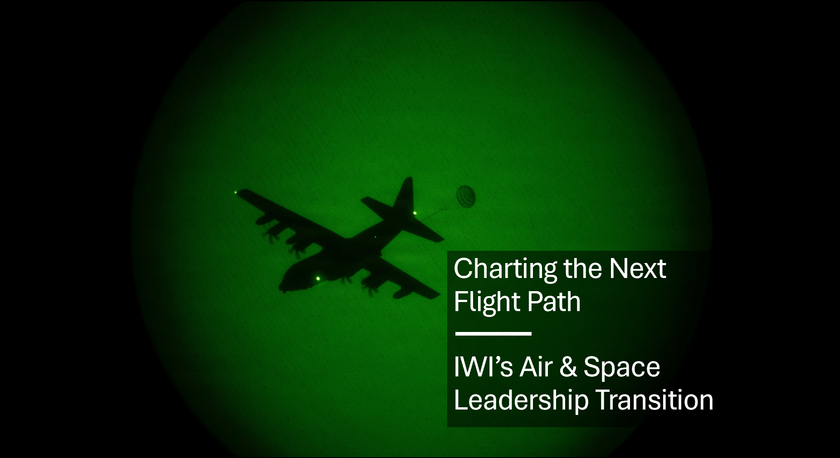
For three years, I’ve watched with excitement as Dr. Kerry Chavez and Dr. Rick “Newt” Newton built and expanded IWI’s Air and Space Power Initiative into the premier forum driving the discussion of the role for air and space power in irregular warfare. It is a great honor to take on leadership of this program moving forward, and I eagerly look forward to both their and your continued contributions to this vital area of international security. Five years after the fall of Kabul, faced with the continuing rise of peer threats and ongoing conflicts in Ukraine and Iran, the debate surrounding the proper role for air and space power across the spectrum of conflict remains at a critical inflection point.
Project Air and Space Power focuses on air- and space-minded approaches to the lower two-thirds of the competition-conflict spectrum, where people, ideas, and hardware combine to face the challenges of democratized violence in a fragile global order. It offers military and civilian leaders, academics, and the private sector an independent forum to explore, research, and debate the challenges of irregular conflict in these domains. In fulfilling our mission to “explore the totality of air, aviation, and space opportunities for air-minded approaches to irregular, hybrid, and gray-zone threats to security and stability,” we hope all those interested in the future of air and space conflict will contribute to our community with whole-of-society approaches addressing the challenges posed by the West’s strategic competitors.
From my days as a cadet, a constant drumbeat from leadership was the rise of China and the need to refocus the military toward that pacing threat. In early 2001 the Rumsfeld Commission cited what it termed a “space Pearl Harbor” as a top threat. That summer, the EP-3 collision incident highlighted growing tension in the pacific. The September 11th terrorist attacks changed that focus for most of my Air Force career, but even as the war on terrorism raged, much of Washington sought disengagement in favor of a pivot to the Pacific. Nevertheless, as successive administrations sought disengagement from ‘forever wars,’ U.S. interests, the strategic environment, and the limitations of conventional forces in contemporary conflicts continued to draw U.S. and allied forces into protracted conflicts.
The desire to move from irregular wars and refocus on peer threats is understandable and largely proper. The military’s first mission must be to protect the nation and the state from existential threats by hostile powers; first by deterring war and then, if necessary, winning decisively in combat. The U.S. Air Force has played a critical role in preserving the long peace through deterrence and credible commitment. However, as the probability of great power war remains low, the prospect of indirect ‘small wars’ remains high.
This begs several core questions: first, how do air and space forces balance the need to deter conflict we cannot afford to lose while maintaining a force capable of executing the campaigns we are most likely to fight? Second, what mentality must guide air- and space-mindedness in this new era of great power competition, which is likely to be defined by irregular campaigns with ambiguous measures of success in the shadow of preparation for major combat operations? These questions represent just the beginning of the conversation Project Air and Space Power seeks to engage.
The Small Wars Dilemma for Air Power
Beginning with the Peace of Westphalia in 1648, the zeitgeist of western war evolved to be state-centric with clear divisions between war, peace, combatants, and non-combatants. In this Westphalian system, war is wielded as a rational policy tool, distinct to the greatest degree possible from human nature’s primordial violence, where operational success in battle generally precedes strategic victory. Yet as technology advanced and lethality increased throughout the 20th century, the rationalist and scientific approach to operations began to dominate western military thought.
Against this backdrop, the aircraft was invented, and air power theory and doctrine emerged. This legacy has to a large degree given military aviation a Jominian perspective emphasizing mass and economy of force through precision, and clear cause-effect relationships between strategic bombing and military outcomes. Air power theorists from Billy Mitchell to John Warden argued that air power’s utility lay in its decisive engagement through direct attack on the enemy’s vital centers, bypassing fielded forces and producing strategic paralysis. And Giulio Douhet saw the threat of overwhelming force as a path to securing lasting peace as “the battlefield will be limited only by the boundaries of the nations at war, and all of their citizens will become combatants, since all of them will be exposed to the aerial offensives of the enemy.”
Operationally, air power was virtually unmatched, but as air power grew to dominate western warfare, the decline of the Westphalian order frayed the connection between operational lethality and strategic success. The erosion of Westphalian norms and the horrifying prospect of total war in the nuclear and missile age reintroduced the West to limited irregular war and challenged core tenets of air power theory.
The air and space domains span the globe and enable rapid movement of operators and equipment, globally integrated intelligence collection and analysis, and precision engagement against high value targets, demonstrating significant advantages in small wars and low intensity conflicts. Through these capabilities, air power acts as a low-cost tool for surveillance, maneuver, and engagement of irregular forces while limiting exposures to threats. Advancements in technology—from precision munitions, to long-loitering drones, to sophisticated globally-integrated intelligence networks—have mitigated many of the challenges associated with air policing. Yet each innovation in-turn has led to counter-innovations in the enduring hider-finder game of air warfare, creating a recurring cycle of strategic frustration as the lure of the potential for standoff air power to solve irregular warfare challenges overtakes the need for integrated strategy.
Despite these advantages, irregular forces have readily adapted to the threat of superior force and turned operational advantages into political disadvantages through exhaustion campaigns and networked political warfare. Air power struggled to achieve strategic results in Vietnam and Afghanistan, and air campaigns in other locations associated with the War on Terrorism produced heavily debated results. While air power defines itself in scientific terms as the ability to apply force at velocity—to project military power through the air domain—air warfare alone has shown limited power in the strategic sense of the ability to make others do one’s will. But despite this record, the allure of standoff precision strike to reduce the risk of U.S. casualties in irregular war has readily appealed to U.S. policymakers and citizens alike.
These challenges have been observed and noted from air warfare’s earliest days, if not readily translated to lessons learned. For example, in 1923, the United Kingdom Naval Review observed that aircraft were at a disadvantage in Iraq and North Africa because they could not occupy territory due to their transitory nature, had limited ability to provide landing grounds to occupy a territory, and ran the risk of indiscriminate slaughter that did not “harmonize with British traditions, and which ethically …prove[d] to be unsound.” Moreover, in analyzing these conflicts against the emerging air theories at the time, the authors noted:
“In civilised [Westphalian/conventional/regular] warfare the object to attain is normally political in nature, and its basis is the moral of the nation…protected by military forces, the movements of which are today governed by fixed communications…[that] can be seriously deranged by aircraft attack, so seriously that complete supremacy in the air may of itself be able to accomplish victory. In uncivilised [irregular] warfare, complete supremacy, so far, has not accomplished victory, because the objective is in nature a social rather than a political one, based on individual likes rather than on any collective national intention.”
As war becomes less a rational instrument of state policy and as the Clausewitzian reality of passion dominates the calculus of warfare, the less decisive military operations become and the more the strengths and weaknesses of air warfare must be re-evaluated.
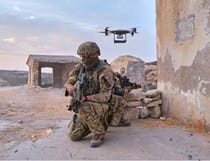
Meanwhile, for much of the world irregular air warfare has grown to become the dominant system of air warfare. In 1998 the Tamil Tigers raised the world’s first guerrilla air force. The Islamic State and other terrorist organizations fielded small armed drones in attacks during the 2010s. A combined-arms approach consisting of drones, sensors, missiles, and precision long-range fires proved decisive in the Second Nagorno-Karabakh war in 2020, ushering in the new age of tactical drone warfare and new challenges for air power in modern war. Combined arms approaches for irregular war today span the globe, from Hamas’ October 2022 terror attacks using paragliders, commercial drones, and homemade rockets coordinated with ground forces, to narcotics groups on the U.S. southern border. As Russia and Ukraine face a mutually denied strategic air environment, small and adaptable air power has emerged to play a critical role in the dynamic operating environment.
The Challenge for Air and Space Power in Modern Warfare
The wars in Ukraine and Iran illustrate modern air warfare’s challenge, both for its utility in conventional conflict as well as its persistent challenges against irregular forces. Air superiority remains a vital component to secure offensive operations against regular forces to avoid the conventional stalemate in Ukraine, but air superiority for manned operations over Iran has proven insufficient to secure victory in that conflict. Strikes against Iran’s nuclear sites in Operation MIDNIGHT HAMMER demonstrated a phenomenal success in range, scope, and scale against deeply buried targets, but debate persists with respect to the long-term strategic impact and the overall effects on Iran’s nuclear program. The re-initiation of conflict in February 2026 featured a successful decapitation strike against Iranian leadership and immediate calls for rapid surrender in the face of overwhelming military force, but three months later strategic success remains elusive despite conventional military superiority.
The air and space domains are rapidly changing, and open to new opportunities and threats not available a generation ago. Rising powers are readily seeking to replicate, or exceed, western capabilities for air warfare at the high end of the spectrum of conflict, and those threats must be deterred and defeated. But adversaries large and small know the roll of the dice they would be taking challenging a force that has regularly demonstrated mastery of the current system of warfare, and the cost all parties would likely endure. Rather than play by the western rules, it would be far wiser to apply an indirect approach on all fronts to challenge the status quo, weaken resolve, and frustrate a U.S. force focused chiefly on a direct operational threat.
To understand the challenges and opportunities for air and space power in irregular war, this project will focus on issues including, but not limited to:
- The new stability-instability paradox: In the nuclear era, scholars observed the phenomenon of the stability-instability paradox leading to strategic stability between great powers but increasing ‘small wars.’ As precision warfare expands and the costs of fifth and sixth generation air warfare increase, the gray zone is increasingly used to challenge resolve and reshape the status quo. How can air and space power balance the imperative to deter the great power conflicts no state can afford to fight, with maintaining capabilities and the resolve to fight the irregular conflicts they are increasingly likely to fight? What tools, and more importantly what ideas, are airmen developing to shape operations in this vital piece of great power competition?
- The paradox of power: With the norms of the international order fraying, overwhelming military strength no longer equates to international power as it once did. How do policymakers, air power enthusiasts, and populations more broadly come to terms with the disconnect between the promise of delivering overwhelming force “anywhere, anytime” and the ability of adversaries to turn their weakness into a strategic advantage? How does air power retain not just operational, but strategic advantage in this environment?
- Special air and space operations: Operation SPIDERWEB demonstrated the vulnerability of strategic assets to a well-executed multi-domain special operation and air-delivered small bombs. At the same time, the growth of private companies offering access to space launch will likely open the door to irregular threats to intelligence, communications, and operations in the space domain. As forces shift focus to exquisite threats from peer competitors, what steps need to be taken to ensure effective special operations and counter-irregular operations in these and similar areas?
- The drone missile age: The Nagorno-Karabakh War, the War in Ukraine, and the Iran Wars among others have demonstrated the growing threat of drone missiles (sometimes called one-way attack drones, suicide drones, or other similar terms). Despite 1990s concerns over the potential proliferation of cruise missiles, missile technology was previously largely limited to state actors. Drone missiles are small, slow moving, and do not deliver a payload comparable to ballistic or cruise missiles, but much like improvised explosive devices they can produce strategic effects through mass, they have the ability to strike soft targets, and they can hold key areas like the Strait of Hormuz at risk. Drones, missiles, and counter-drone/missile technology are profoundly reshaping the tactical battlespace. What is the role of air forces in securing the growing challenges of the air littorals, and to what extent might new doctrines and technologies be challenging Douhet’s observation that offense is the essence of air power?
- Lessons learned, not just observed: Returning from Vietnam, Raven Forward Air Controller (FAC) Greg Wilson was reportedly told "[w]e're trying to purge the Vietnam FAC experience from the fighter corps because we have moved into an era of air combat where the low-threat, low speed, close air support you did in Southeast Asia is no longer valid. And we don't want these habits or these memories in our fighter force." How do we best capture the lessons of Iraq, Afghanistan, Ukraine, Iran, and other irregular conflicts without repeating the cycle of lessons learned and lost?
In the face of daunting challenges from strategic competitors, the sky has no limits for creativity and innovation. In that spirit, Project Air and Space Power continues to inspire discovery from airmen, guardians, industry, academia, and the global community of air and space power enthusiasts. Please join us in helping to shape, influence, and impact air and space power’s future.
If you would like to contribute, contact us at airandspace@irregularwarfare.org
Author Bio
Michael P. Kreuzer leads Project Air and Space Power for the Irregular Warfare Initiative. He is a graduate of the USAF Academy and has served as an intelligence officer, advanced air advisor, strategic planner, and educator. He holds a PhD in International Security from Princeton University in addition to a Master of Public Administration from the University of Alaska Anchorage and a Master of Strategic Intelligence from American Military University. His second book, Air Warfare: An Introduction, is slated for publication by Routledge in Fall 2026. All views are his own and do not reflect that of the U.S. government or any military department.
The views expressed are those of the author(s) and do not reflect the official position of the Irregular Warfare Initiative, Princeton University’s Empirical Studies of Conflict Project, the Modern War Institute at West Point, or the United States Government.
If you value reading the Irregular Warfare Initiative, please consider supporting our work. And for the best gear, check out the IWI store for mugs, coasters, apparel, and other items.
This article is a Focus Area self-published piece, and the content has not undergone standard editorial review. IWI hosts these pieces to facilitate rapid dialogue among practitioners, but the analysis, research, and original thought within the article remain the sole responsibility of the author.