The Strategic Gap
The United States possesses the most capable military in the world. Yet for more than two decades it has repeatedly struggled to translate military superiority into lasting strategic outcomes. We remain unmatched in major combat operations, but our competitors increasingly operate below the threshold of war, exploiting political, informational, economic, and security vulnerabilities in regions critical to American and allied interests.
China, Russia, Iran, and north Korea do not seek direct and decisive military confrontation with the United States. They pursue influence, coercion, political warfare, proxy relationships, and incremental gains. Their objective is not necessarily battlefield victory. It is the gradual erosion of American influence and the weakening of the alliances and partnerships that underpin U.S. strength and the international order.
The United States requires a strategy designed for this environment. It must be global in scope, persistent in execution, and focused on strengthening partners before crises emerge. It must integrate diplomacy, development, intelligence, security assistance, and military advisory efforts into a coherent campaign. Importantly, it must effectively employ Special Operations Forces and their special warfare, irregular warfare, indirect, and influence capabilities as an integral part of a comprehensive advisory approach that operates through, by, and with allies and partners. This requires effective campaigning for global security.
America needs a Global Security Advisory and Assistance Strategy. This is a think piece to explore ways to develop a new strategy based on lessons of the past.
Four documents informed this paper.
1. Army Activities in Underdeveloped Areas Short of Declared War by BG Richard Stilwell (1961)
2. U.S. Overseas Internal Defense Policy (OIDP) (1962) (prepared by an Interdepartmental Committee consisting of Representatives of State (Chair), DOD, JCS, USIA, CIA and AID and approved as policy by National Security Action Memorandum 182 of 24 August 1962)
3. U.S. Political Warfare Policy (Proposed) (2015) (Drafted by D. Robert Worley, modeled on the Overseas Internal Defense Policy of 1962, incorporating material provided by the Kennan Donovan Initiative at Georgetown University.)
4. The Country Team In American Strategy by COL Robert Killibrew (2006)
Together these documents inform concepts for assessments, structure, and strategy necessary to support a Global Security Advisory and Assistance Strategy. A successful comprehensive strategy requires ongoing global assessment and a structure to support campaigning in support of the National Defense Strategy and National Security Strategy.
The Strategic Foundation
This is not a new idea.
In 1961 Brigadier General Richard Stilwell conducted a global strategic assessment. He then argued that the Army could make "signal contributions" to the internal defense of developing nations by improving the effectiveness of indigenous military forces and employing American personnel alongside partner forces to advance security, stability, and development. He viewed military assistance not as a supporting activity but as a strategic instrument of national power. Stilwell recognized three interconnected missions.
First, strengthening partner military institutions to support political stability and economic development.
Second, helping partners counter insurgency, subversion, and internal threats.
Third, building indigenous capabilities that could contribute to broader regional security objectives.
These insights remain remarkably relevant.
Stilwell’s work influenced the development of the U.S. Overseas Internal Defense Policy of 1962.
The proposed U.S. Political Warfare Policy of 2015 reprised and updated the 1962 OIDP. Both documents similarly emphasized that insurgencies, instability, and political violence cannot be solved through military force alone. Internal defense requires political, economic, social, informational, and security measures working together. The problem is fundamentally political, though security forces remain essential to success.
The challenges today are larger than counterinsurgency and counterterrorism. Strategic competition has become global. Adversaries employ political warfare, cyber operations, economic coercion, disinformation, proxy forces, and unconventional warfare. The United States requires a strategy capable of addressing all of these challenges simultaneously.
Security Assistance as Strategic Competition
For decades security assistance has often been treated as a supporting activity managed through bureaucratic processes rather than as an operational instrument of national strategy.
This is a mistake.
Security assistance represents one of the most powerful tools available to the United States. It shapes military institutions, develops long-term relationships, influences strategic decision making, improves interoperability, and creates enduring access and influence.
The true value of security assistance is not measured in weapons delivered or training events completed. It is measured in trust, relationships, access, influence, and capability.
A battalion trained today may become a coalition partner tomorrow.
A young foreign officer educated in an American military school may become a future chief of defense.
An advisory relationship established during peacetime may provide critical access during a crisis or war.
Security assistance is therefore not a supporting effort. It is strategic maneuver.
The Central Role of Special Operations Forces
Special Operations Forces are uniquely suited to play a leading role in this effort.
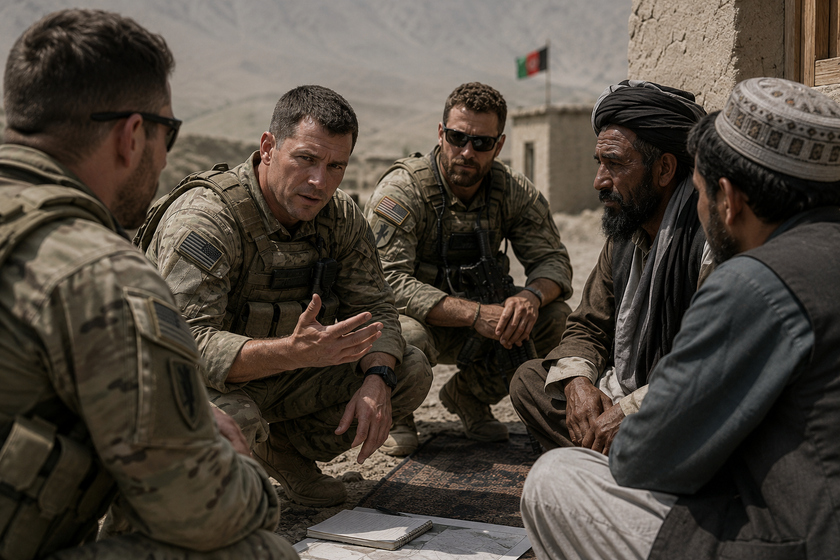
Special Forces were created to work through, by, and with indigenous forces. Their language skills, cultural understanding, advisory expertise, and regional orientation make them ideally suited for persistent engagement in support of campaigning. Psychological Operations forces, with language and cultural expertise, provide the “mass” for influence activities. Civil Affairs units, also with language and cultural skills, provide the governance expertise necessary to assist in countering malign activities that threaten friends, partners, and allies. Together these forces provide the foundation of US Special Warfare capabilities.
Special Warfare offers a framework particularly relevant to contemporary competition. It combines influence, partner development, resistance support, unconventional warfare, foreign internal defense, and political-military engagement into a coherent approach designed to achieve strategic effects indirectly.
However, SOF cannot do this alone.
American doctrine has long recognized that Foreign Internal Defense is not exclusively a Special Operations mission. SOF provides specialized expertise, advisory leadership, and persistent engagement. Conventional forces provide scale, sustainment, presence, and long-term institutional relationships.
The future advisory enterprise must therefore integrate Special Operations Forces, Security Force Assistance formations, conventional forces, interagency partners, and allies into a unified effort.
The objective is not merely partner capacity building.
The objective is strategic influence.
Three Lines of Effort
A Global Security Advisory and Assistance Strategy should consist of three mutually supporting lines of effort.
Line of Effort One: Persistent Security Assistance Through Effective Campaigning
The first line of effort focuses on building capable, resilient, and professional security institutions.
This includes Security Cooperation Offices, Security Assistance Organizations, Military Groups, Joint United States Military Assistance (and Advisory) Groups, Foreign Area Officers, Security Force Assistance units, and Special Operations advisory teams.
These organizations should operate as elements of a continuous campaign rather than episodic activities within organizational and structural stovepipes.
The goal is to strengthen allies, improve interoperability, develop regional access, create trusted networks of military professionals and prepare indigenous forces and host nation units for employment in a range of security activities from peace to war in accordance with the capabilities, history, customs, and traditions of their nations.
Line of Effort Two: Special Warfare and Counter-Unconventional Warfare
The second line of effort focuses on competition below armed conflict.
China, Russia, Iran, and north Korea increasingly employ political warfare, proxy forces, influence operations, coercion, cyber activities, and other forms of unconventional competition.
Countering these threats requires specialized capabilities.
Special Operations Forces and the intelligence community should lead efforts to identify adversary influence networks, strengthen partner resilience, improve resistance capabilities, support civil preparedness, and counter adversary unconventional warfare campaigns.
This mission includes but extends beyond counterterrorism. It is central to strategic competition.
Line of Effort Three: Deterrence and Major Combat Preparation
The third line of effort supports conventional deterrence and warfighting.
Security assistance and advisory efforts help allies build capabilities before crises occur. Joint exercises improve interoperability. Military-to-military relationships facilitate coalition operations. Access agreements create strategic options.
Exercises such as Balikatan, Cobra Gold, Tandem Thrust and many others, demonstrate how long-term engagement builds coalition capacity while strengthening professional relationships.
The objective is straightforward. If deterrence fails, allies and partners should already be prepared to in partnership with U.S. forces.
A Military Component of the Country Team as the Operational Headquarters
The Killebrew study highlights a critical lesson often forgotten by military planners.
Success requires unity of effort at the country level. The relationship between the Ambassador and senior military representative remains the most important relationship in any advisory campaign. Effective country teams focus on field operations, empower initiative, integrate resources, and align military and diplomatic efforts toward common objectives.
The country team should become the operational headquarters for advisory strategy.
Foreign Area Officers, Security Cooperation Offices, Special Operations Forces, Security Force Assistance elements, USAID representatives (when the aid capability is restored), intelligence professionals, and diplomatic personnel should work from a common campaign plan nested within national objectives.
This requires decentralization, initiative, and operational flexibility.
Washington should establish strategic objectives. Country teams should execute political/economic/informational/military campaigns. The Geographic Combatant Commands and Country Teams, as well as Civilian and Defense Agencies, must work together in a mutually supporting and reinforcing manner. Campaign plans in support of national strategies provide the structure and mechanisms to do so.
Organizing for Strategic Effect
The United States already possesses most of the organizational structure required for this strategy.
The challenge is integration.
Security assistance programs remain fragmented. Advisory efforts are episodic. Exercises are often disconnected from broader political objectives. Interagency coordination remains personality dependent.
A Global Security Advisory and Assistance Strategy would provide a unifying framework.
It would integrate Department of State regional priorities, Geographic Combatant Command theater campaigns, country team objectives, security assistance programs, SOF activities, and conventional force engagement into a single strategic approach.
This is not about creating new bureaucracies.
It is about aligning existing institutions, capabilities, and personnel expertise toward common strategic outcomes.
Winning Before War
The United States cannot fight its way to strategic advantage everywhere in the world.
Nor should it try.
The most effective way to prevent war is often to strengthen partners before conflict begins. The most effective way to compete with adversaries is often through influence rather than force. The most effective way to deter aggression is often through resilient alliances rather than unilateral action.
This is the enduring value of the indirect approach of working through, with, and by partners to achieve mutually supporting national security objectives.
A Global Security Advisory and Assistance Strategy would provide a framework for employing Special Operations Forces, conventional forces, diplomats, development professionals, and allies in a continuous campaign of competition. It would strengthen partners, counter adversary influence, improve deterrence, and prepare coalitions for conflict if necessary.
Most importantly, it would allow the United States to achieve strategic effects before crises become wars.
America's greatest strategic advantage has never been the size of its military. It has been its ability to build alliances, develop partners, and create networks of trust that multiply national power.
The future security environment demands that we rediscover that advantage and employ it deliberately.
The objective is simple: win before war.
David Maxwell, executive director of the Korea Regional Review, is a retired U.S. Army Special Forces colonel who has spent more than 30 years in the Asia-Indo-Pacific region. He specializes in Northeast Asian security affairs and irregular, unconventional and political warfare. He is vice president of the Center for Asia Pacific Strategy and a senior fellow at the Global Peace Foundation, where he works on a free and unified Korea. After he retired, he became associate director of the Security Studies Program at Georgetown University. He is on the board of directors of the Committee for Human Rights in North Korea and the OSS Society and is the editor at large for the Small Wars Journal.