While global chaos mounts with lingering conflict in the Middle East, Russia’s war in Ukraine, and shifting U.S. strategic priorities, the risk is not only escalation in active theaters but opportunism elsewhere. Periods of geopolitical distraction create openings for revisionist actors to test boundaries below the threshold of war. On the Korean Peninsula, this dynamic may not emerge through nuclear brinkmanship or conventional confrontation, but through gray zone contestation at sea.
Kim Jong Un’s abandonment of unification as a policy goal creates conditions for the Democratic People’s Republic of Korea (DPRK) to engage in semi-covert maritime boundary revision, with the Yellow (West) Sea as the most likely flashpoint. By leveraging fishing fleets, ambiguous legal claims, and limited shows of force, Pyongyang could attempt to shift the status quo without triggering immediate escalation, thereby creating a crisis that blurs the line between boundary enforcement and armed conflict.
Most analysis of the DPRK threat focuses on the risk of nuclear proliferation, missile capabilities, and a renewed large-scale conflict. However, the policy paradigm shifted in December 2023 when Kim Jong Un formally abandoned unification as a national objective and recognized the Republic of Korea (ROK) as a separate state. This shift elevates a different, more immediate risk: gray zone contestation that, at best, establishes a problematic precedent, and, at worst, triggers an escalation cycle that results in open hostilities.
The area most ripe for this scenario is the West Sea, where maritime boundaries are tenuous, with only a de facto line separating the two sides’ vessels and aircraft. It has been the site for the most acute security crises this century, but now it presents a scenario where North Korea could employ gray zone tactics to push its administrative waters southward into waters that the ROK treats as its sovereign maritime territory. All it would take is a new policy decision in Pyongyang, the deployment of a small number of fishing vessels, and military assets to reshape the status quo.
The West Sea Operational Environment
When the Korean Armistice Agreement ended wartime hostilities, it laid out rules for preserving a cessation of hostilities between the two sides. Among the provisions was the prohibition of military force and the designation of five islands, also named the Northwest Islands, as being under the south-side control: Baengnyeong-do, Daecheong-do, Socheong-do, Yeonpyeong-do, and U-do. While the 1953 Armistice clearly established a land-based boundary line, it failed to create an explicit maritime-based boundary, presumably because there was no immediate threat of naval incidents, and the expectation was that the two countries would reach a political settlement over the following three months. More than 70 years later, the Armistice stipulations remain in place, albeit with updates negotiated between the two sides along the way.
Almost immediately, the need for maritime control measures was evident to the U.S.-led United Nations Command in Korea, which established a “Northern Limit Line” in the West Sea. As the name implies, the intent was to restrict south-side vessels from traveling north of the line, which, given the proximity to DPRK territory, would have placed them in range of coastal artillery and increased the risk of incidents. The Northern Limit Line is depicted in the following graphic:
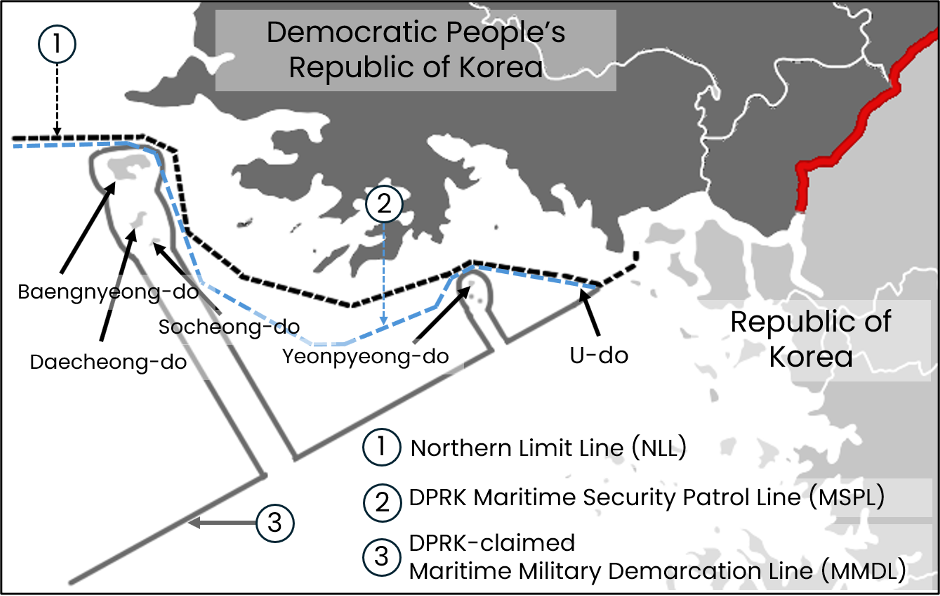
Given the explicit language regarding the five islands in the Armistice Agreement, the DPRK has never contested control of them; however, the Kim-family regime has repeatedly rejected the Northern Limit Line as a maritime boundary. In the late 1990s, the DPRK declared a “Maritime Military Demarcation Line” well south of the Northern Limit Line (NLL) that extends only narrow channels to the island groups. The DPRK has never revised its unilaterally claimed maritime boundary line.
While the DPRK has accepted the NLL as a de facto line of separation, it has also instituted its own “Maritime Security Patrol Line” (MSPL). Importantly, the (North) Korean People’s Army (KPA) does not enforce the MSPL, but it does monitor and respond to any activity north of that line. The MSPL runs slightly south of the NLL and aligns more closely with the median lines recommended by the UN Convention on the Law of the Sea (UNCLOS). Even if the DPRK's preferred line appears more consistent with certain maritime delimitation principles, that does not legitimize unilateral coercive revision of a long-standing status quo absent negotiation or mutual agreement. While accepting the NLL may seem to disadvantage the DPRK, in the Sea of Japan (or “East Sea”) the NLL cedes much more maritime area to the DPRK—a disparity that the Kim regime chooses not to highlight in its maritime claims.
Although the majority of vessels operating near the NLL are Chinese fishing boats, there are DPRK- and ROK-flagged vessels as well. The DPRK does not have a traditional coast guard; instead, the KPA Navy patrols the area and observes it from coastal locations. The DPRK has fishing vessels, and while they are state-managed and KPA-monitored, they tend to be civilian-operated.
On the ROK side, there are fishing crews who operate around the Northwest Islands, but they are restricted from operating near the NLL. Meanwhile, South Korea has Coast Guard and Navy assets patrolling the sea, as well as Marine bases on the island groups. Neither side routinely operates aircraft in the disputed area.
A Hot Bed of Escalatory Transgressions
The West Sea has been the site of the most significant military clashes between the two Koreas in the 21st century. In June 2002, a Korean People’s Army patrol vessel attacked and sank a South Korean naval vessel—the CHAMSURI-357—near Yeonpyeong-do. In March 2010, the KPA surreptitiously torpedoed the ROKS CHEONAN, killing 46 sailors. In November that year, the KPA fired upon Yeonpyeong Island, killing two ROK Marines and two civilians.
While the DPRK disavowed any involvement in the Cheonan incident, in other cases, it claimed that its justification for militarized responses was South Korean violations of its territorial waters. In other words, the DPRK claim was that the NLL is not a valid boundary line and ROK encroachment necessitated self-defense.
These are the incidents that ROK and U.S. forces posture against, but circumstances have changed. Clashes once characterized by overt military force have given way to the emerging risk of deniable, incremental North Korean activities designed to avoid immediate retaliation while still altering the status quo.
Pushing Maritime Boundaries
While the West Sea seemingly remained placid over the past decade, the situation is unstable, and there is a new possibility of malign gray zone actions to revise the existing boundaries in the interest of the DPRK’s new “two-state” policy. In January 2024, Kim Jong Un once again rejected the NLL and alluded to hardening the country’s southern border in subsequent speeches. Since there is no mutually agreed upon maritime boundary over the past seven decades, the situation presents an opening for the DPRK to redefine and enforce one unilaterally.
A foreign policy goal of the Kim regime is to advance its two-state vision. By repeatedly rejecting the NLL, the Kim regime cannot now accept the line or a farther north boundary without it resembling a concession to the ROK. Pushing the boundary all the way to the 1990s-era MMDL claim is unjustifiable under international law and too burdensome to enforce through regular DPRK military presence. However, the Kim regime may view pushing to the MSPL as an achievable goal.
A pathway for contesting the status quo is straightforward. The Kim regime could begin by publishing a map that establishes a maritime border that is more aligned with international standards than the NLL. In practice, this would likely be the MSPL. The DPRK would then flood the area between the NLL and the MSPL with DPRK fishing boats, like China’s use of fishing vessels around the Senkaku Islands in the East China Sea. In these cases, the DPRK may opt to place armed KPA soldiers in civilian attire on the fishing vessels to control the crews and fight back against any ROK response, as necessary. The DPRK could deploy surveillance drones to provide overwatch and record anything that happens during this gray zone operation.
This creates a conundrum for the ROK. If the ROK Coast Guard or Navy attempted to push these boats out, the DPRK could use their behavior as justification for tit-for-tat military responses. If they do not expel the vessels, the DPRK could see their territorial claims recognized as a fait accompli, meaning that they now have administrative control over those waters. The presence of Chinese fishing fleets further complicates attribution and response, increasing the potential risk of miscalculation.
It is also a challenging time for the U.S. military to play an active role in dispute resolution, given its ongoing efforts to manage conflict in the Middle East and Eastern Europe. The U.S. government has a general policy that it will not involve itself in disputes over sovereign territorial and border claims. However, the U.S. maintains alliance obligations and the ROK would assuredly seek U.S. support following any DPRK malfeasance. Further complicating the situation, the U.S.-led United Nations Command is responsible for maintaining the Armistice and mitigating the renewed outbreak of hostilities. This creates a fundamental tension: supporting the ROK risks entanglement in a disputed maritime claim, restraint risks undermining Armistice effectiveness and alliance credibility, and intervention risks stretching U.S. resources in another overseas crisis. While there are military response options, there may not be political will to engage.
How to respond
Like any potential gray zone scenario, the parties at risk must take steps to mitigate incidents and prepare for counter-measures. There are five overlapping requirements.
The first is recognition of the problems. Gray zone activities work best when executed without the target state’s awareness or in unexpected ways. Thus, the ROK and U.S. governments must positively identify the risk of gray zone activities in the West Sea and commit resources towards addressing potential North Korean malign efforts.
The second is operational planning and preparation. The allies should account for this sort of gray zone scenario in their bilateral crisis management memorandum of agreement, crisis management plans, and contingency plans. On the ROK side, operational planners should factor this into their planning at the Joint Chiefs of Staff, Northwest Island Defense Command, 2nd Fleet, and 6th Marine Brigade headquarters. For the U.S. side, planners from Headquarters, U.S. Forces, Korea, United Nations Command, and Combined Forces Command should address this as well.
The third is to employ diversified approaches, namely, the attempt to employ military diplomacy to mitigate incidents. While the DPRK has exhibited no interest in negotiating on maritime boundaries, the U.S.-led United Nations Command maintains military-to-military contacts via its Military Armistice Commission. Consistent efforts to engage with KPA counterparts on West Sea issues are necessary, as well as preparing for employment of Armistice mechanisms if an incident should occur.
The fourth requirement is an active information campaign. This comes before a gray zone incident occurs and intensifies should risk mitigation fail. It is imperative to clarify the risk of DPRK expansionism in the West Sea and the acceptable maritime boundaries, particularly through deliberate information operations. It is also necessary to address potential DPRK justifications—such as potential claims that DPRK-imposed boundaries are more aligned with UNCLOS standards—by highlighting the DPRK’s administrative advantage in the East Sea and publicizing reminders that the UNCLOS standard is negotiated resolution of territorial claims rather than use of force. Failure to take such steps in the information space so cedes initiative to the Kim regime, which can exploit misunderstandings of the situation and begin claiming that the NLL is unfair according to international standards.
If an incident does occur, proactive messaging in the information space to expose DPRK intentions to reform long-standing boundaries and condemn DPRK transgressions will be essential. The ROK government must be prepared to label the DPRK’s behavior in press releases, formal statements, and media engagements. Concurrently, UN Command must employ its own strategic communications related to the command’s attempts to engage the KPA side on the matter, as well as its execution of Armistice-related functions to resolve the situation.
Finally, both the ROK and United States must employ whole-of-government coordination and cooperation in preparation for and response to any gray zone incidents in the West Sea. While it is important for the ROK military to be prepared for potential contestation, if the DPRK side sends fishing vessels into the waters south of the NLL, the Korea Coast Guard should be the lead entity for administrative enforcement. However, they must be prepared for the potential that KPA naval vessels will attempt to intervene, so the Coast Guard should be integrated into deliberate planning efforts with military counterparts while also participating in related allied training and exercises.
At the same time, diplomatic and political level entities must be unified and consistent in their messaging and responses. Gray zone operations exploit any seams available; thus, all relevant stakeholders must remain in lockstep should this scenario play out.
Pyongyang’s Powder Keg
Ultimately, the danger in the West Sea is not a sudden return to large-scale hostilities, but a gradual erosion of the status quo through methods designed to remain below the threshold of war. This is the essence of irregular maritime competition: incremental gains achieved through ambiguity, deniability, and narrative control rather than decisive battle. By leveraging civilian fishing vessels as proxies, the DPRK can advance its claims while complicating responses. At the same time, the enduring legal ambiguity surrounding maritime boundaries provides Pyongyang with a tool to justify its actions and cast doubt on the legitimacy of existing arrangements.
In such an environment, the decisive terrain is not only physical waters but the information space, where narratives of sovereignty, provocation, and restraint will shape international perception and constrain policy choices. If left unaddressed without whole-of-government cooperation, these dynamics risk a scenario that could fundamentally alter the status quo in the West Sea while increasing the likelihood of miscalculation and unintended escalation.
Beyond the immediate dispute, successful DPRK enforcement of a revised maritime boundary would carry implications across the broader Indo-Pacific. For regional actors confronting similar gray zone maritime pressure—including Japan in the East China Sea and the Philippines in the South China Sea—a successful DPRK effort would reinforce perceptions that incremental coercion can alter disputed boundaries without provoking a meaningful international response. Thus, a successful DPRK effort could encourage similar risk-taking elsewhere in the region, undermine confidence in alliance-backed deterrence, and contribute to a regional perception that contested maritime claims can be advanced through persistent pressure rather than negotiation or international adjudication. As such, deliberate measures are necessary to identify this area of risk and take deliberate steps, not just for the sake of peace and stability on the Korean Peninsula, but to avoid problematic templates for territorial disputes elsewhere in the world.
Michael MacArthur Bosack is a seasoned international negotiator and the founder of the Parley Policy Institute. He is the Special Adviser for Government Relations at the Yokosuka Council on Asia-Pacific Studies. Previously, Michael served as the Deputy Secretary of the United Nations Command Military Armistice Commission in Korea and the Deputy Chief of Government Relations at Headquarters, U.S. Forces, Japan. He is a former East-West Center Fellow, a military veteran, and the author of “Negotiate: A Primer for Practitioners.”
The views expressed are those of the authors and do not reflect the official position of the Irregular Warfare Initiative, Princeton University’s Empirical Studies of Conflict Project, the Modern War Institute at West Point, Department of the Army, Department of War, or the United States Government.
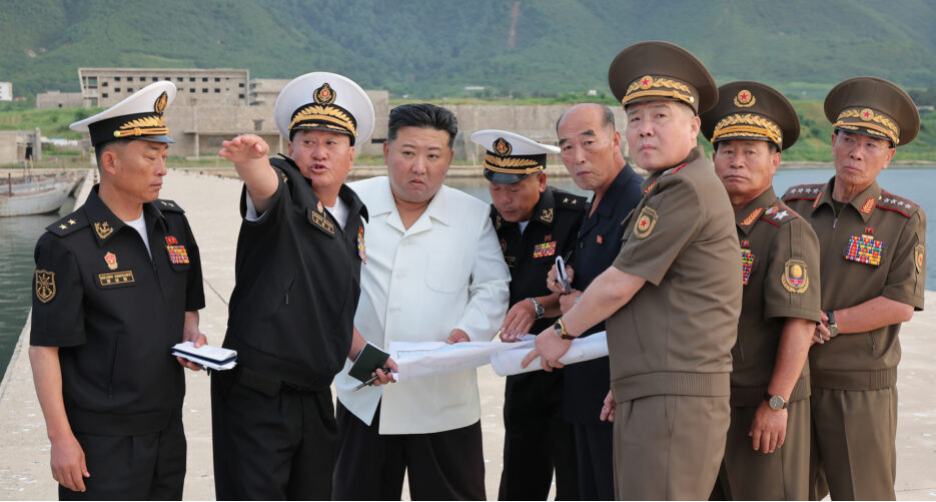
Main image: Kim Jong Un joins naval and military officials at the long-stalled Tapchon Bay naval port project | Image republished with permission from KCNA (Sept. 8, 2024).
If you value reading the Irregular Warfare Initiative, please consider supporting our work. And for the best gear, check out the IWI store for mugs, coasters, apparel, and other items.