Editor’s Note: This article is presented in a question-and-answer format, with the Irregular Warfare Initiative’s Maritime Program’s Christopher D. Booth interviewing Member of Parliament (MP) Colonel Alistair ‘Al’ Carns. This piece has been edited for clarity and readability, as spoken language differs from how text is read on the page.
Q: I really appreciate you speaking with the Irregular Warfare Initiative’s Maritime Program today. Given your heavy schedule, you have an increasingly large public profile at home in the United Kingdom (UK), but also in the US and throughout Europe. Your opinion is in high demand, whether in interviews, as a guest for multiple podcasts, or today at West Point (ed. Carns was visiting the US in late September 2026). I want to provide a quick summary of your background for those of our readers who are not already familiar with your history. So please correct any mistakes or key omissions:
A career Royal Marine officer, you also served in the Special Boat Service, were decorated for heroism in Afghanistan, and were viewed as the rising star in the British military. But days before your promotion to brigadier general, you retired and entered politics because you were so concerned that the military was moving too slowly to address innovation after seeing the war in Ukraine. You were elected as a Member of Parliament and have had a meteoric rise and served as the Parliamentary Undersecretary of State for Veterans and People. Following that, you were the Parliamentary Under-Secretary of State for the Armed Forces. In June of this year, you resigned your ministerial position in protest over the speed of modernization. You were spoken of as a dark horse candidate for prime minister. Somehow, in all of this, you found a trip for a blitz up Mount Everest.
What did I miss?
Al Carns: No, that's spot on. That's a good readout. Like it.
Q: You have said that the war in Ukraine is what alarmed you and energized your thinking such that you blew up the only career you had known and made the dramatic switch to politics in a matter of days. What was it about the war that so impacted your views?
Al Carns: Well, I think first of all it was the ferocity and intensity of it, of where you're seeing on the Avdiivka front 1600 casualties in two weeks on a small section of the battlefield, and then the biggest revelation I had was during the Zaporizhzhia counteroffensive in 2023, observing the ZALA Lancet network, (which is a Russian observation drone-turned-strike drone), start to identify critical armored assets and neutralize them, which reduced the Ukrainians’ ability to breach the Russian’s defensive line. From there, in the following months and years, we've seen a drastic increase in uncrewed systems at every level: land, sea, air, to such an extent that 92 percent of the casualties in Ukraine are from drones. A very small percentage of the remaining casualties comes from small arms, and the rest are from artillery and offensive support.
For the first time in history, we've seen artillery and offensive support be overtaken by a different system that causes more casualties in the battlefield, and that requires a whole rethink on how we look at defense. Do we need people like me that can run for 30 miles with a 60-pound backpack on and can shoot rifles straight? Or do we need people that are technically minded, software engineers, data engineers, drone pilots, good with their thumbs, not necessarily with a trigger finger?
I just thought it was it was the same as someone operating a scythe on a farm to seeing a combine harvester roll past. And my view is we have to we have to change. There are lots of false lessons in Ukraine, but we've got to move fast if we're going to deter the next war by demonstrating we're learning the lessons from this one.
Q: Why do you think your ideas on military modernization have struck such a chord and garnered attention?
Al Carns: Well, I've been saying it since 2024. Now everybody's saying it because it's speeding up. Every year, it's doubling. I went back to Ukraine in late 2024, early 2025, and what I saw blew my mind again, because now they're adding in Artificial intelligence (AI) pixel recognition data, fiber optic drones. Now [drones] can go 37 to 45 kilometers and strike tanks long before they're in view of any other tank or missile system carried by any soldier, and it's just moving at such a [fast] pace.
It's almost incomprehensible. For example, it takes, on average (depending on which course you do), 12 weeks to train a sniper to shoot one bullet 800 meters …to hit one target. I could probably take your average good gamer, who is good at “Call of Duty Three” on his Xbox, and within two weeks train him to kill someone at 37 kilometers with a headset. I could take 10 drones for £100,000 each, and sink any billion-pound warship at sea at 1,000 nautical miles off a mainland. And for the same price of a wheel of an F-35 fighter jet, it could probably strike any strategic target within 2,000 kilometers. “Have we got this right?” And the answer was ‘no’ at the time.
We are seeing it now; Moscow and St. Petersburg being struck. Oil refineries, 2,000 or more miles away from Ukraine, being struck. Ships being sunk in the Black Sea, or in the Mediterranean. If you're a practitioner for 24 years and you practice and understand the art of war, and suddenly someone brings you this new capability that makes delivering your aims and objectives easier, you can see that opportunity. I saw it two years ago. Now everybody can see it, and we've got to bite down on it.
Q: What commonalities do you see across the wars in Ukraine, Gaza, Lebanon, Sudan, and the conflict between Iran and Israel? And where do these conflicts reveal meaningful differences in how modern warfare is being fought?
Al Carns: I think we've got this ink blot at the moment. Like ink dropped on Ukraine, slowly it's seeping beyond the map. I always say that if Ukraine was the teacher that taught us about drones, then Iran's the headmaster. It's hit us with a ruler and told us to listen, because you know up until Iran we weren't listening. And you see Patriot PAC-3 missiles shooting down £20,000 shaheds. More Patriots have been fired in the Middle East in the last six months than fired in Ukraine in the last four years. Hundreds of millions, if not billions of pounds in economic warfare, being lost because we've failed to adapt.
My concern is that if this conflict comes to an end in Ukraine - which is unlikely in the short term - but if it does, Russia has about two million people in its military industrial base, earning high pay and manufacturing nine million drones a year. Ukraine has the same. If the war ends, you've got to sustain that military industrial base, and so you're going to see these systems filtrate all the way into Africa, where you will see really sophisticated capabilities being operated by non-state actors almost on a daily basis, and that gives them unprecedented lethality, and it's very difficult to combat. So I think there's going to be an arms race, in the not-so-distant future. The proliferation of this capability is much the same as we had trying to contain ballistic missile technology. You're seeing bits of it already. You're seeing it in Sudan. You're seeing it in in Africa. You saw it, and you've seen it in Libya, where drones are becoming ever present.
Q: It sounds kind of like when the Russian or Soviet scientists were unemployed at the end of the Cold War, or in Libya when the Qaddafi regime imploded and all the weapons flowed across North Africa, all the way to Iraq, etc.
Al Carns: Exactly that, Chris. Imagine giving non-state actors across Africa a couple of hundred or a couple thousand First-Person View (FPV) drones that can kill anything at 36 kilometers and operate by fiber-optic cables. Assassinations striking military targets; you know? A Hi-Lux with a DShK on the back of it, leaving a base at 25 kilometers, getting struck. If you think about it in our conventional terms, it's giving non-state actors air power, right? Because it gives them reach and lethality.
Q: You saw that initially with Turkey with the Bayraktar drones, but now they're leap years ahead of that?
Al Carns: [Do] you remember [General Valerii] Zaluzhnyi, who was the Ukrainian commander? He gave a great speech saying, “Hey, we need at least a million artillery rounds, or we're not going to break this deadlock, or we need a ‘gunpowder’ moment.”
What is the technological invention that's going to break this stalemate? Well, it's drones. The trouble is that the Ukrainians have developed drones, but the Russians have also got a gunpowder moment and both are moving as fast as possible. I actually think the next leap is going to be AI based on data, where you press the button, that drone launches …it goes to its designated [loiter area] completely disconnected from GPS; finds the target; [neutralizes the target, then] kills itself. They're doing it now. But when they do it en masse, then it'll become a significant force multiplier on the battlefield.
And you're seeing this; you're seeing Hamas, Hezbollah …you're seeing militant groups in Africa picking this up, you've sort of seen the Iranians picking it up. You're seeing China now. I think the statistic is that China produces 300 times more drones than America. Sorry, I think that's just DJI brand [editorial note: confirm that the Chinese company DJI does manufacture roughly 300 times as many drones as the US as reported by the New York Times].
Q: In a classic case of what's old is new again, we're seeing the importance of maritime choke points and key maritime terrain and conflicts around the world. What kind of investments or modernizations are important for the UK and NATO to prepare for maritime conflicts?
Al Carns: I actually think our First Sea Lord, who's the head of our navy, has got this right. And this is about a hybrid navy—manned and unmanned teaming. It's about ensuring that every vessel can probably deliver 10 to 100 unmanned surface vessels, subsurface vessels, and airborne drones that increase your reach, your lethality, and indeed your precision.
So I'm going to be controversial here. Many will disagree with me, but I would argue the utility of a major platform is diminishing because it's too easy to kill. So we need disaggregated fleets of relatively lightly manned platforms that deliver uncrewed systems that do the job for you.
In the past, it was always about putting the soldier, the sailor, or the airman into the field to do the fighting. My view is now about putting the tech into the field to do the fighting for you. And the man, the person, the woman sits back and controls it. We're seeing the Straits of Hormuz now closed with very limited traffic. In excess of 8,000–10,000 ships have failed to get in or out, over the last six or seven months, we're now seeing the Bab el-Mandeb Strait blocked or at least under threat to the major choke points in the world.
Consider that 30% of ammonia comes out of the Middle East. That's a key component for fertilizer. We've had an El Niño summer, [which caused a] really bad harvest globally. When you add in the lack of fertilizer, you then add in the likely poor harvest next year and the food price increase, and then you actually look at instability. The last time we saw instability like this, we saw rising food prices. We saw the Arab Spring rip through the Middle East, and I think we're in for a rough ride over the next 12 to 18 months, specifically based around fuel, but also ammonia and food prices, especially with the Black Sea closed as well.
Q: That's a good point, especially with some of the youth revolutions that we've seen in Bangladesh or Nepal; if you know these places are already tinder-boxes and they have a problem with food, that's not going to be great.
Al Carns: Just all adds up. It's compounding pressure, isn't it?
Q: A regular and long-standing debate in the US Marine Corps is about the future importance of amphibious warfare. As a Royal Marine, how do you see the future of amphibious operations and capability?
Al Carns: This is a great question. Look at the Russian amphibious capability in the Black Sea. Every one of its ships sunk or destroyed. Failed amphibious operations, even diversion. Snake Island, an example of how very quickly people can be pinned down and neutralized. Unless amphibious warfare embraces some of the technology that we're seeing in Ukraine and adapts it to the amphibious space, I think it's going to be very difficult politically and militarily to justify large-scale amphibious operations, even to conduct them.
I used to be the Chief of Staff of the UK Strike Force, so I used to oversee all of our amphibious capability and all of our carrier capability on behalf of the admiral. And now you should be able to observe, identify, strike, and clear enemy beaches 1,000 nautical miles away before you even get there, and if we can adapt the ability to do that, we can then put boots and heavier capability onto the ground.
For example, if you're going to [conduct] an amphibious landing onto, let's say, the Lofoten Islands in Norway, you can you can observe that at close range with thermal cameras, both on the surface and in the air, from 1000 nautical miles away. That gives you a level of certainty that your amphibious landing is going to be successful. The concern is when those amphibious ships then go into the bubble, they can be observed from 1000 nautical miles away. And so, I think as long as we adopt this technology it will still have relevance.
Q: You have worked closely with the US military and have mentioned briefing US military senior leaders on the transformation of warfare right before you left the service. As an outside observer, is there any “tough love” or advice you would give your American colleagues?
Al Carns: I was actually really surprised at how open and interested those generals, admirals, and air force officers were to the insights that we outlined. However, it's very difficult structurally to force change into an organization where your personal relevance is tied to a bit of equipment. We found this in the British military as well. You try telling a tank driver that tanks aren't as relevant as they once were because I can kill them with a £3,000-4,000 drone … at least a mobility kill. Try telling a ship's captain that you can sink him at 1,000 nautical miles if he's been identified. You start to tug at the very purpose and centrality of an individual's role within an organization. The way Ukraine has learned this, is unfortunately they paid in blood, and until winning overtakes the requirement to take profits, very rarely do you innovate fast enough. [Therefore, what] I would say to my American colleagues is, “If you can't reproduce the munitions at the speed required to fight and win an attritional war over years, then don't buy it.” Exquisite irrelevance is no longer the game, and decisiveness when you're fighting major combatant powers such as Russia and others is very difficult to achieve when they've got the manufacturing capability to out produce you.
Q: The investment in the military you're calling for in the UK is similar to efforts in other European capitals, Berlin being a notable example. But given budgetary trade-offs while dealing with stagnant economies, high social overhead, societal disconnect or discontent, and the threat of major employment disruption by AI—all of which is leading to the rise of populist backlash in many countries—notably in the UK (or following the recent Alternative für Deutschland (AFD) victory in a German state election). These populists are frequently pushing a non-interventionist policy and/or a friendlier Kremlin view. How do you convince voters that increased military spending is something that they should support?
Al Carns: This is where I think we've got to have a national conversation with our population, and actually expose to them the threats that we're facing daily, whether that be cyber, espionage, industrial espionage, influence on social media, or state actors working to try and divide our country.
When the US struck Iran in Midnight Hammer over their nuclear capability, they struck a couple of targets just outside Tehran. Overnight, 3% of all pro-Scottish independence media died, and so when you say to people, “I can't believe Iran was interested in sowing division in the UK,” …that's just Iran.
Think of Russia's propaganda budget. Think of other [countries’] propaganda budgets. And so, when we see hatred growing on the left and the right, it's often stoked by external actors to drive division, sow political discord, and remove our ability to act in line with our democratic values. It's one of the biggest threats to democracy at the moment. There's so much amplification of the hate. We've got to protect ourselves. I think we have this national conversation, and we've got to protect ourselves across all of the different spectrums.
Q: Changing topics a little bit, you recently climbed Mount Everest in a record-setting seven days, including travel to and from London to Nepal using some cutting-edge training techniques. Your effort was to raise money and attention to veterans' charities. Do you have any insights or lessons from this experience that you can share with our readers?
Al Carns: Yeah, so a lot of people said, “Hey, you're not going to be able to climb Everest in a week. It's impossible. You need six to eight weeks, minimum three to four weeks maybe.” And so we broke the whole climb down into a mission, everything from logistics to science, to training, to food, to the fastest routes, and just broke it all down like it was a mission on any operation. And then we went after the very best of each bit: the best equipment, the best science, the best capability. And when we put it all together, we we're really lucky with the weather.
We managed to do it, but you know, I'll be really honest that I've done Royal Marine training twice, once as another rank, once as an officer. I've done the Mount Leaders course, which is probably one of the hardest courses in the British military, and then I've done some pretty hard selection courses, and this was one of the hardest things I've done because I had to train in London to climb the highest mountain in the world. And there's not many mountains in London for those that know the city.
I think there's a there's a lesson here [along the lines of] “Never say never.” You can achieve anything you want to if you put your mind to it and actually plan properly for it and prepare.
People say to me, "Oh, I'm going to go on special force selection,” what should I be doing? Is it more squats, more gym work?” I'm like, “No. Put a ruck on your back, go up some mountains, and keep going up mountains.” I had to recreate that in a flat in London. So I had two wooden boxes. I put a heavy backpack on, and I had an oxygen mask on that gave me depleted oxygen for altitude. And I stepped up and down the box for hours on end. Don't get me wrong. It was mind-numbingly, painfully boring, but it was the right preparation for going from sea level to just under 9,000 meters in two days, and not coming away with any injury.
Q: We like to ask guests for book recommendations. Any you could suggest?
Al Carns: One I was just reading was Breakneck: China’s Quest to Engineer the Future. If you want to read a book on unbelievable suffering and toughness, there’s We Die Alone: A World War II Epic of Escape and Endurance. Every parent should read Bounce: Mozart, Federer, Picasso, Beckham, and the Science of Success.
The views expressed are those of the authors and do not reflect the official position of the Irregular Warfare Initiative, Princeton University’s Empirical Studies of Conflict Project, the Modern War Institute at West Point, the Department of the Army, the Department of War, or the United States Government.
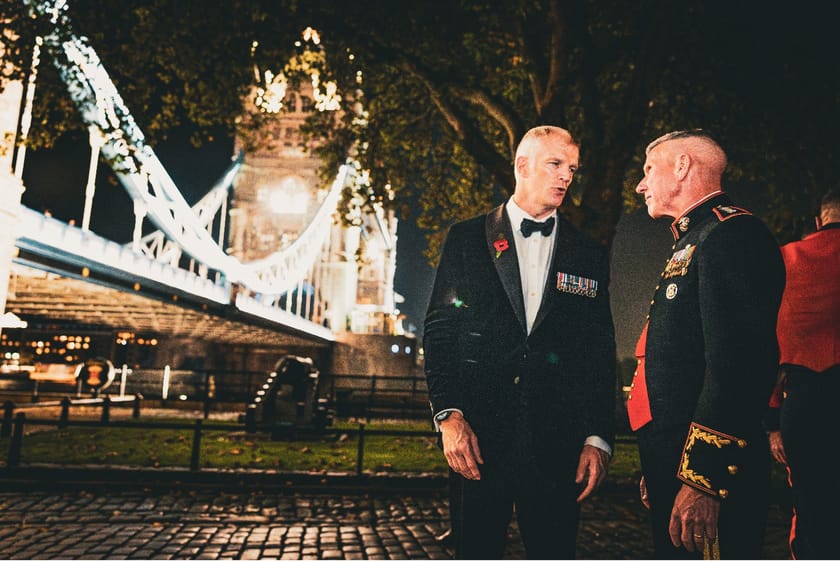
The main image is the 39th Commandant of the U.S. Marine Corps, Gen. Eric M. Smith, speaking with Alistair Carns during the Royal Marines 360th Birthday celebration ceremony at the Tower of London in London, United Kingdom on Oct. 24, 2024. U.S. Marine Corps photo by Staff Sgt. Kelsey Dornfeld taken from Wikimedia Commons.
If you value reading the Irregular Warfare Initiative, please consider supporting our work. And for the best gear, check out the IWI store for mugs, coasters, apparel, and other items.