In August 2021, Afghan National Security Forces collapsed in a mere eleven days following the withdrawal of the United States military. Two decades of training and advising ended without resistance before a materially inferior Taliban force reclaimed power amid an authority vacuum. The principal problem was a cultural misalignment. The coalition was compatible in the desire to build tactical military capability, yet it could not read Afghanistan at the higher level. It misjudged the country's strategic culture, its faith, and its social fabric. Afghanistan had little in common with Western norms, and little wish to adopt them. It was a failure of coherence among ends, ways, and means.
A recurring pattern in irregular warfare is that tactical success often coexists with strategic failure. The stronger side may dominate the fighting yet lose the war by misreading the population whose loyalty ultimately determines victory. In this contest, the state competes with actors pursuing a parallel logic of legitimacy, simultaneously contesting territory and perception. Afghanistan follows this pattern, and its case reveals a variable most analysis leaves out.
“Cognitive coherence” names that missing factor. It is the congruent alignment among military action, institutional discourse, and the population’s perception of legitimacy, calibrated to that population's cultural frameworks and social needs. Put simply, this coherence demands that what a military force does strategically, what it says, and what the population expects should coincide. When these three elements align, the state gains legitimacy and momentum; when they diverge, oppositional actors fill the empty space.
Cognitive coherence adds something a commander can plan and act upon because it turns the diffuse aim of “understanding the population” into a set of measurable and verifiable variables. Do our operations, our strategic communication, and the population’s expectations point in the same direction? If not, where is the gap, and who is filling it?
Situational Awareness and Cultural Intelligence in the Cognitive Domain
Policy already treats legitimacy and political will as objects of irregular warfare. DoD Instruction 3000.07, reissued in September 2025, directs the force to erode those conditions in an adversary and to bolster them in allies and partners. What it does not provide is a way for a planner to assess whether a campaign is achieving them, or to see when that alignment begins to break. Doctrine still treats the cognitive domain as an enabling layer managed alongside kinetic operations, and that hierarchy is usually inverted.
As Clausewitz’s theory of war reminds us, the first and most decisive of all strategic inquiries is to understand what kind of war one is fighting. In conventional warfare, that judgment tends to be primarily geographic and material; in irregular warfare, it becomes fundamentally socio-cultural. A commander who fails to read the population accurately misreads its expectations of authority, its historical memory, and its threshold of legitimacy. Such a commander lacks what U.S. Marine Corps doctrine describes as “culture general” and “operational culture.” Without them, no amount of precise enemy intelligence reveals the character of the war being fought. Theory and doctrine provide frames for reading context and population, yet neither converges on a method for sustained assessment.
That judgment operates on two levels. Situational awareness indicates where one stands and where the enemy is. Cultural awareness explains why the population tolerates that enemy or allows itself to be mobilized by it. Together, they answer the questions operational art depends on. In irregular warfare, cultural awareness weighs more and shapes the outcome of campaigns. The alignment between military tactics and socio-culturally attuned operations has to be measured accurately and continuously.
Afghanistan: Internal Consistency, Cognitive Incoherence
The NATO campaign in Afghanistan provides a compelling illustration of cognitive incoherence. For two decades, coalition operations remained internally consistent with established doctrine and the declared objectives of strengthening governance and defeating the Taliban. Yet they never aligned with the cultural expectations of the Afghan population and its security forces, particularly in Pashtun-majority areas, where the Taliban proved far more effective at cultivating legitimacy.
As David Kilcullen documented in his analysis of insurgent support, a significant portion of those who fought alongside the Taliban did so in response to perceived threats against their community and to violations of customary law. They also resented foreign forces that acted against local norms of honor and authority. Night raids, civilian casualties from airstrikes, and foreign legal frameworks that displaced traditional dispute-resolution mechanisms all bred cognitive incoherence. NATO stayed doctrinally consistent throughout, but it was consistent against the wrong reference frame. Its consistency was with Western liberal values, while Pashtunwali and the population's real expectations went unmet.
The result was a force capable of identifying and eliminating Taliban networks with extraordinary precision, while simultaneously generating new recruits through the cultural friction of its own operations. The August 2021 collapse of the Afghan National Security Forces, trained and advised for twenty years, was the visible endpoint of two decades of cognitive disconnection.
Colombia: Coherence Achieved, 2002–2010
At the turn of the century, many analysts called Colombia a near-failed state. Decades of violence by the communist guerrilla known as the Revolutionary Armed Forces of Colombia (FARC) had exhausted the country. It faced roughly 30,000 homicides and close to 3,000 kidnappings a year, with more than 300 towns whose mayors governed from exile. Kidnappings and bombings had reached the cities, and ordinary people pleaded for security above all else.
The state addressed all failings at once, achieving a high level of cognitive coherence by coordinating narrative with social needs. The shift began with Plan Colombia, signed with the United States in 2000, and deepened with the “Democratic Security” Policy in 2002, aligning military action, strategic communication, and the population's demand for security. Its action was kinetic and territorial. An enlarged force pushed the FARC from population centers and cut its fighters from some 16,000 to 9,000. Its message was clear and measurable, promising order and reporting results the public could track.
The outcome was real strategic progress because the population got what it needed. The “Democratic Security” Policy answered that need operationally with kinetic means, fires, and maneuver. It also communicated its intentions and expected results clearly, with measurable indicators and non-negotiable red lines. Both matched what the population expected and would accept. By 2010, homicides had roughly halved and kidnappings had fallen close to 90%. The population rewarded that alignment with legitimacy, re-electing the government in 2006 with approval near 75%. Action, message, and expectation converged such that the FARC lost territory and standing.
Colombia: Coherence Broken, 2016–2026
The coherence factor began to fracture in 2016. The former configuration gradually eroded as political and institutional priorities drifted away from local realities. The peace accord of that year ended the war with the FARC as a political actor, but the state misread what came next. Decision-makers overlooked that a large share of the rural, peasant, and indigenous communities in territories disconnected from the center still depended on illicit economies the insurgency had sustained for decades.
Beyond that, negotiation proceeded on the premise that the Colombian population would accept certain instances of impunity, an assumption that the October 2016 plebiscite refuted by rejecting what had been agreed. In those abandoned territories, coca, illegal mining, and drug trafficking were the only livelihood many communities had known. New armed groups, offshoots and rivals of the FARC, filled the state vacuum quickly, driven by economics and survival. The state's message of "reintegration" and "territorial peace" no longer matched the reality on the ground.
The rupture deepened with the “Total Peace” policy of 2022. The FARC, like other guerrillas of the period, had begun in the late 1960s as an insurgency claiming to fight for the rural poor, a cause that once gave it a real social base. By 2022 that base was gone. The state nonetheless assumed the FARC and parallel armed groups still held political motivations compatible with institutions and opened ceasefires with many structures at once. It failed to see that most had already mutated into cartels and narco-terrorist organizations with purely economic ends, and that “Total Peace” was negotiating with an interlocutor that no longer existed.
According to the Armed Conflict Location & Event Data project (ACLED), the same groups exploited those windows to recruit, consolidate territory, and grow stronger during the truces. Coca cultivation reached a record of 253,000 hectares in 2023, with a 53% rise in potential cocaine production. Organized armed groups grew by more than 45% between 2022 and 2025, raising the number of Colombians displaced by violence to unprecedented levels. The failure to maintain alignment among strategic objectives, institutional communication, and local perceptions gave rise to an expanding system of criminal governance.
As the Institute for Development and Peace Studies (INDEPAZ) and other sources have documented, irregular groups today issue ID cards, tax local commerce, steer elections, and set the rules of daily life in zones of state vacuum. In areas of active conflict, the state narrative did not match what people lived. Criminal organizations provided services, imposed local order, and built ties with communities the state never reached. Operating inside those communities, the enemy gained cognitive coherence at the local level. Armed groups now assume governance functions of local police, enact curfews, inaugurate schools, and open rural roads, manifesting the power imbalance between these irregular actors and the state.
What This Means for Operational Planners
First, cultural intelligence is a primary planning input, as decisive as terrain or enemy disposition. In Afghanistan, weighing Pashtunwali expectations seriously before launching operations would have revealed foreseeable sources of operational friction. Planners should have identified those risks during problem framing and the intelligence preparation of the operational environment, while there was still time to adapt the campaign approach.
Second, cognitive coherence requires concrete and measurable indicators that complement traditional operational metrics. Casualty counts and territory recovered measure kinetic control while strategic progress stays invisible. Colombia illustrates the value of coherence indicators. The rejection of the 2016 peace plebiscite was an early warning of cognitive rupture, and record coca cultivation and the consolidation of armed groups during the ceasefires confirmed that the gap was widening. Those signals appeared years before violence intensified again.
Operational planners should closely monitor the population’s tolerance for the use of force and the gap between the state’s message and public perception. Concrete assessment can begin with data that already exists, including municipal electoral results, the annual United Nations Office on Drugs and Crime (UNODC) coca survey, and ACLED records of armed-group presence, compared against the territories where the force claims progress. Divergence between these measures is among the earliest signals of cognitive rupture.
Third, misreading the adversary's ends undermines every subsequent decision. From the FARC dissident groups that rejected the 2016 accord to the Total Peace negotiations opened in 2022, the state kept approaching criminal armed organizations as though they were politically motivated insurgents, and that persistent misreading let them reorganize. Before recommending a ceasefire, operational planners must analyze the actors' relationships and tensions through systems-based frameworks such as Relationships, Actors, Functions, and Tensions (RAFT) analysis, complemented by a field-based assessment of the civilian population and its local culture. Those communities possess distinct expectations, sources of legitimacy, and security needs that shape the operational environment. That understanding can fundamentally change the recommendation, determining whether a ceasefire should be pursued, under what conditions, and with what safeguards against adversary adaptation.
Conclusion
Cognitive coherence is a source of strategic advantage, achieved when military action, institutional discourse, and the population's perception of legitimacy converge on a single cultural framework. Afghanistan and Colombia teach the same lesson. A force's internal consistency loses value when it remains detached from the population that decides the conflict. Afghanistan collapsed despite two decades of doctrinal congruence and material superiority. Colombia advanced while the three layers coincided, then retreated once the political calculus drifted from the ground.
Existing concepts explain legitimacy, culture, or information separately. Cognitive coherence integrates these dimensions into a single planning construct. For planners and advisers, this construct turns the diffuse imperative of "understand the population" into a condition that can be systematically assessed and corrected within operational art. Cognitive coherence can be tracked from the initial estimates through observable measures of political behavior, illicit economies, and armed-actor activity, weighed against the gap between institutional messaging and lived reality. This approach can warn of emerging ruptures before adversaries exploit them. In contemporary irregular warfare, enduring advantage will belong to the force that effectively aligns what it does, what it says, and what the population expects of it.
Isnel López-Valencia is a Marine Corps officer of the Colombian Navy with nineteen years of command and operational experience, specializing in counterinsurgency and counterterrorism. He is a graduate of the United States Marine Corps Command and Staff College in Quantico (Master of Military Studies) and a candidate for a Master’s degree in Strategy and Geopolitics at the Superior War College in Bogotá. He is a Nonresident Fellow at the IWI.
The views expressed are those of the authors and do not reflect the official position of the Irregular Warfare Initiative, Princeton University’s Empirical Studies of Conflict Project, the Modern War Institute at West Point, the Department of the Army, the Department of War, or the United States Government.
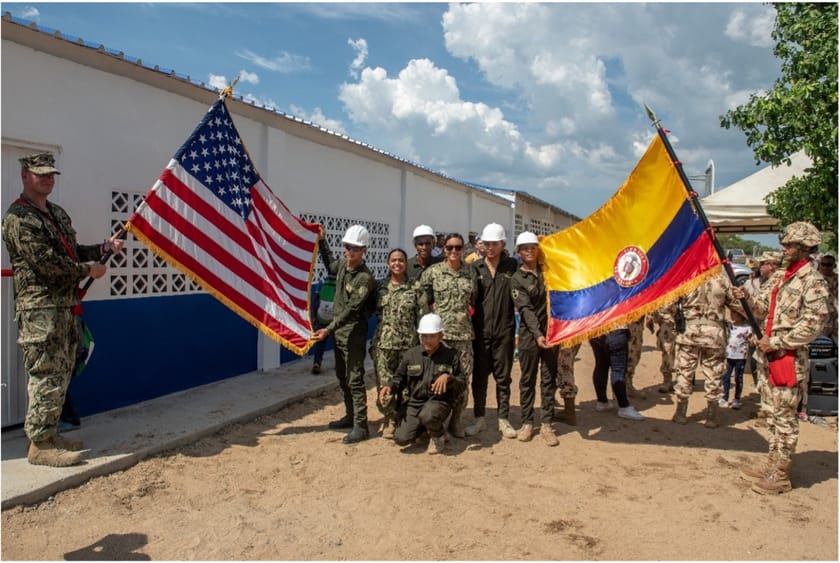
Main image is a U.S. Navy photo by Mass Communication Specialist 1st Class Peter Lewis / Released, VIRIN 190830-N-AZ907-0299.
If you value reading the Irregular Warfare Initiative, please consider supporting our work. And for the best gear, check out the IWI store for mugs, coasters, apparel, and other items.