Editor’s Note: This article from the Irregular Warfare Initiative’s Maritime Program is presented in a question-and-answer format with journalist Bojan Pancevski, facilitated by Christopher Booth and Walker Mills. The interview has been edited for clarity and readability.
Bojan Pancevski is The Wall Street Journal’s chief European political correspondent with almost two decades of experience reporting from Europe and beyond. He is the author of the best-selling “The Nord Stream Conspiracy: The Inside Story of the Explosions That Shook the World,” about one of the largest acts of maritime sabotage in modern history.
Q & A with The Wall Street Journal’s Chief European political correspondent Bojan Pancevski
By Christopher Booth and Walker Mills
Q: You are a long-time investigative journalist, and now author of the definitive book on the Nord Stream attack, The Nord Stream Conspiracy: The Inside Story of the Explosions that Shook the World. What is Nord Stream, what happened to it, and why does it matter?
A: Nord Stream was the world’s largest offshore gas pipeline system, carrying Russian natural gas directly to Germany beneath the Baltic Sea. It was one of Europe’s main arteries for importing energy, and it took 16 years to complete at a cost of around $20 billion.
On September 26, 2022, Nord Stream was hit by a series of underwater explosions. It was one of the most consequential acts of sabotage against critical infrastructure in modern times. The explosions were so powerful that they were picked up by seismic monitoring stations across northern Europe, with the tremors detected nearly 1,000 miles away inside the Arctic Circle. And yet it was carried out by a small team of just seven people, including divers who planted explosives on the pipelines using a leased leisure yacht.
Q: Since the attack, German Federal Prosecutors seem to have cracked the case, and your investigation concludes that this was an operation carried out by a unit of one of the Ukrainian intelligence services. If that’s true, what was their motive?
A: The Ukrainians who orchestrated the attack were veterans of the intelligence community who were serving at the time in an elite special forces unit of the armed forces. They carried out the operation as part of Ukraine’s asymmetric war of defense, with the aim of destroying infrastructure that generated revenues for Vladimir Putin’s war machine. At the time of the attack, roughly a third of the Russian state budget came from energy revenues.
The secondary aim was geopolitical. They wanted to sever the relationship of energy dependency between Russia and Western Europe, particularly Germany, that Nord Stream had come to embody. The plotters regarded the pipelines as a geopolitical instrument through which Putin could make Germany and other parts of Europe dependent on Russian energy. At the start of the full-scale invasion in February 2022, Germany was receiving around 55% of its natural gas and roughly 35% of its oil from Russia.
Q: You make the point in your book that technology enabled a small and well-trained group to carry out a devastating act of sabotage. One quote in particular stands out: “It was a frightening acknowledgement of the new world in which a handful of operatives armed with minimal resources could inflict immeasurable damage on a continent.” Given that context, are you more worried or less worried about technology and hybrid or gray-zone warfare after writing your book?
A: I think the Nord Stream attack heralded an escalation in the era of gray-zone warfare, and the problem is likely to become more acute. Since the attack, we have seen a dramatic increase in sabotage and other covert activity connected to the war in Ukraine, including attacks on dams, railways and other infrastructure, disruption involving airports and aviation, and Russian plots to assassinate Western defense-industry executives.
At the same time, the proliferation of cheap drones at sea and on land has dramatically lowered the cost of attacking highly valuable targets. Defending against that threat is going to become increasingly difficult.
Q: You allege that the Ukrainian team that carried out the sabotage was a mix of security service personnel and civilians. Can you talk about the makeup of the team and why that was important?
A: The Nord Stream sabotage team consisted of three servicemen and four civilian divers. The civilians were all highly experienced, certified diving instructors selected specifically for their technical skills.
That was important because the officers who masterminded the operation could not find enough military combat divers capable of carrying out the required work at depths of more than 80 meters, so they turned to civilians with the necessary expertise instead.
Q: Are you concerned that we may see more attacks on underwater infrastructure? Do you think Western governments are taking the threat seriously enough?
A: I’ve spoken to several officials whose responsibilities include protecting this kind of infrastructure. The Nord Stream attack prompted governments to strengthen security through surveillance drones, underwater sensors and more frequent patrols. But, several of those officials conceded that there is ultimately no foolproof defense against a small, skilled team operating from an inconspicuous civilian vessel.
We have already seen Russian spy ships mapping critical infrastructure belonging to NATO countries, as well as a series of suspicious incidents involving internet cables, power links and pipelines around Europe. The concern is that such activity will intensify as confrontation between Russia and the West continues.
Western governments now take the threat extremely seriously. The problem is physical scale; pipelines and cables can stretch for hundreds or even thousands of miles across the seabed. Protecting every vulnerable point is virtually impossible.
Q: If you were in charge of a NATO country’s military or intelligence services, would you invest more in maritime sabotage capabilities?
A: I most certainly would. The arrival of cheap, scalable technology has created an era in which relatively small operations, including by non-state actors, can threaten extraordinarily valuable infrastructure.
Any serious military or intelligence service therefore needs both the ability to defend against such operations and the capability to conduct unconventional maritime operations of its own. The wars in Ukraine and Iran, together with the broader confrontation between Russia and the West and growing tensions between the United States and China, suggest that this kind of capability will become more, rather than less, important.
The views expressed in this interview do not reflect the official position of the Irregular Warfare Initiative, Princeton University’s Empirical Studies of Conflict Project, the Modern War Institute at West Point, or the United States Government.
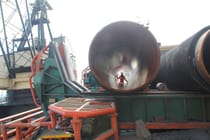
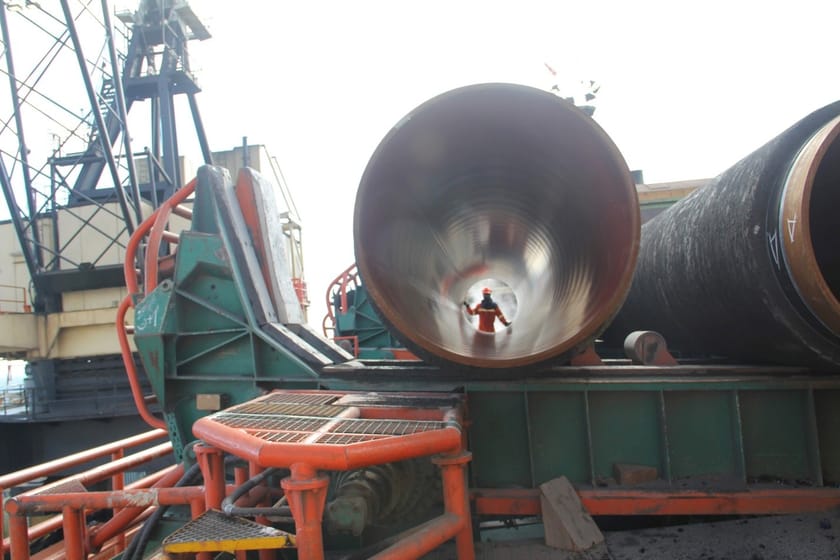
Photo by John Kjorstad, taken aboard the Castoro Sei in the Baltic Sea in 2011 during construction of the Nord Stream 1 pipeline. The image shows a worker inspecting a pipe segment before assembly.
If you value reading the Irregular Warfare Initiative, please consider supporting our work. And for the best gear, check out the IWI store for mugs, coasters, apparel, and other items.