The United States does not need to predict the year China will invade Taiwan. It needs a strategy that convinces Beijing an invasion would fail, regardless of the timeline. Developing one is fundamentally more difficult than surging capabilities to meet an artificial deadline.
In March 2021, Admiral Philip Davidson warned Congress that China could invade Taiwan within six years. The warning made urgent a deteriorating military balance, but a readiness benchmark gradually hardened into a forecast. The U.S. intelligence community now assesses that Chinese leaders have no fixed timetable for an invasion. Capability is not intent.
Once 2027 became the organizing assumption, policymakers started judging programs by whether they could contribute before the window opened. Instead, Washington should pursue distributed deterrence that creates a layered defense and makes Taiwan capable of denying, surviving, and resisting Chinese aggression while reserving U.S. conventional power for missions that provide decisive advantage.
The war with Iran shows how quickly assumptions about an adversary’s intentions can lead to disastrous outcomes: depleted munitions, strained allies, and economic disruption. Washington should apply these lessons to Taiwan without treating 2027 as a forecast. A durable strategy requires deeper magazines and an industrial base able to replenish them; special operations forces working with Taiwan to prepare resistance networks and complicate both an invasion and occupation; and a conventional force positioned for denial. Together, those efforts can make aggression less likely regardless of when Beijing might consider it.
When a Benchmark Becomes a Strategy
The Davidson Window resembles repeated warnings about Iran being only weeks away from a nuclear weapon. The analogy has limits, but both show how a narrow benchmark can become a broader claim about adversary intent.
Warnings about Iran combined several questions concerning production of fissile material, intent to build and deliver a weapon, and whether military action could eliminate Iran’s institutional knowledge and broader policy incentives. The phrase “two months away” created a doomsday clock and narrowed the range of politically acceptable options. The administration maintains that Operation Epic Fury prevented Iran from building a nuclear weapon. Justifying the human and financial cost of war with a superficial claim about capability and intent is shaky ground.
Washington could—and did—launch strikes to get after the capability question, but that did not address the central issue of whether destroying facilities would change Tehran’s decision-calculus. The war has consumed American munitions and widened instability without resolving the incentives underlying Iran’s nuclear ambitions, while Tehran has sought to preserve useful capabilities and broaden the conflict. While Epic Fury as a named operation may have ended, the conflict is far from over. The U.S. and Iran continue to trade strikes, traffic through the Strait of Hormuz remains depressed, and the Houthis have created a new chokepoint for global trade in the Red Sea.
The Davidson Window risks the same confusion between activity and outcome. More missiles, forward forces, and procurement may be necessary, but they do not alone explain how to deter China. The objective is not to meet a date. It is to convince Beijing that it cannot seize Taipei and consolidate its gains at an acceptable cost.
The Limits of American-Delivered Denial
Deterrence by denial seeks enough conventional power to make a Chinese invasion unlikely to succeed. That is the right objective. The problem is the assumption that the United States can produce denial outcomes primarily through overwhelming long-range precision fires, combined with autonomous mass that has yet to be delivered or positioned in theater, during the opening days of war.
Across about two dozen iterations of a Center for Strategic and International Studies war game, U.S. forces expended over 5,000 long-range missiles within three weeks and exhausted preferred anti-ship inventories in the first week of conflict. And those munitions did not prevent lodgment seizure. Taiwan would also be exceptionally difficult to resupply after hostilities began. The systems it requires must therefore be delivered and dispersed before the conflict.
One response is to reserve more for the Indo-Pacific, reduce demands elsewhere, and accelerate procurement. The United States should do all three. Yet the war in Iran has demonstrated that the United States will not remain disciplined in the use of munitions earmarked for a Taiwan scenario, and the war is consuming air-defense and long-range strike stocks faster than industry can replace them. Over seven months of conflict, the United States has expended munitions stocks to the tune of 45% of Precision Strike Missiles, half of Terminal High Altitude Area Defense (THAAD), nearly half of PAC-3, about 30% of Tomahawks, and over 20% of long-range Joint Air-to-Surface Standoff Missiles (JASSM). In addition, the Iran campaign has committed nearly the entire JASSM-Extended Range inventory, which the Department pulled from the Indo-Pacific theater at the end of March. That leaves roughly 425 of a 2,300 prewar inventory available for the rest of the world.
The United States should still replenish stocks, improve access and placement within the first island chain, and expand long-range strike capabilities. But a strategy dependent on immediate U.S. entry in the conflict, sufficient magazine depth, escalation management, and political will rests on too many linked assumptions. Xi only needs to see enough uncertainty to believe he has a viable path to success.
Distribute the Problem China Must Solve
Distributed deterrence is still deterrence by denial, but it spreads the burden beyond American capabilities alone. Taiwan’s conventional forces would remain central, supported by autonomous systems, civil resistance and resilience, cyber capabilities, and special operations forces. U.S. intervention would focus on capabilities Taiwan cannot replicate, including undersea warfare, long-range strike, and disruption of Chinese logistics and command nodes.
Crossing the Taiwan Strait would be only the beginning. China would still have to isolate the island, secure and break out from a lodgment, sustain and reinforce its on-island forces, and seize political control. Taiwan’s limited landing sites and difficult terrain already complicate that campaign. A distributed architecture would magnify those constraints.
Dispersed sensors and communications would preserve awareness and command under attack. Autonomous and unmanned systems would provide mass, while electronic warfare and cyber capabilities would complicate Chinese targeting. U.S. precision weapons could then focus on the command, logistics, sustainment, and air-defense systems that enable invasion. Taiwan’s conventional forces would defend key terrain, while continuity networks preserve governance and intelligence.
The first requirement remains preventing a rapid seizure of Taiwan’s political and military centers. Resistance is not a substitute for conventional defense, but it would deny Beijing confidence that securing a lodgment equates to victory. A successful landing would not translate cleanly into a political fait accompli.
Special Operations are Central to Deterrence
Special operations forces would serve as the connective tissue of this architecture. Distributed deterrence depends on the access, placement, pre-positioning, and preparation of the environment they provide before conventional battle begins. During conflict, those forces would operate inside China’s weapons engagement zone to enable Taiwan’s asymmetric defense, close U.S. and allied kill chains, and maintain information advantage.
Working with Taiwanese military and civil institutions, U.S. and allied special operations forces could develop meshed networks of autonomous systems, provide target-quality data to long-range fires systems, and prepare networks to function after headquarters are destroyed or communications fail.
The Resistance Operating Concept, a framework developed by U.S. and NATO special operations forces describing how to organize resistance networks prior to invasion, places these relationships, authorities, and support networks within a whole-of-government and whole-of-society defense. Taiwan should not plan to lose the conventional fight, but the prospect of a long campaign of resistance rather than a short, sharp war has a deterrent value of its own.
Prepared networks would support intelligence, targeting, information activities, and the potential for resistance through an unconventional warfare campaign. Irregular warfare cannot replace conventional defense, but it can bind conventional, irregular, and technical capabilities into a system that survives disruption. Resistance is most credible when its relationships, logistics, and authorities exist before the first missile is launched.
The Department of Defense has recognized the importance of special operations forces to any strategy of denial. U.S. Special Operations Command is central to the department’s Defense Autonomous Warfare Group (DAWG), focused on delivering low-cost, attritable, unmanned systems at scale. While there is still a disconnect between the requested $54.6 billion and the $1 billion the House appropriated, the establishment of the DAWG demonstrates a commitment to both autonomy and special operations in deterrence. The military services are increasingly recognizing that special operations forces are the linchpin to solve the problem of providing target-quality data to their respective long-range fires units, such as the Marine Littoral Regiment and the Army’s Multi-Domain Task Force.
Building the Industrial Foundation
Distributed deterrence also changes what the industrial base must produce. The United States still needs exquisite long-range weapons, while it also needs replaceable sensors, batteries, unmanned systems, and components that can be modified quickly. The production system must be as adaptable as the operational concept.
Iran and Ukraine offer different lessons. Iran shows how a weaker state can preserve capabilities that deny a stronger power its desired political outcome even after failing to prevent an attack. Ukraine shows the industrial requirement: modern warfare rewards rapid iteration, modular designs, and a constant feedback loop between operators and producers.
Industrial power is the ability to turn materials, labor, and capital into useful capability faster than an enemy can disrupt or counter it. That requires domestic or allied capacity for the power, sensing, communications, guidance, and manufacturing inputs behind autonomous systems. Rare-earth magnets, batteries, chips, and other specialized inputs create critical chokepoints.
A military arsenal dependent on Chinese inputs is not a credible deterrent. Beijing’s restrictions on rare-earth and permanent-magnet exports demonstrate both its leverage and its willingness to use it. China need not destroy American factories if it can cut off the components moving across their production lines.
The Department of Defense should pair investment and enforceable transition requirements with predictable demand, financing, technical data, and qualification pathways. The United States should enforce existing statutory sourcing deadlines while extending restrictions only where it can define the security risk, identify compliant capacity, and establish a feasible transition plan. End-to-end traceability belongs where the loss of a material or component would halt production or compromise a critical function. Waivers should be narrow, temporary, and tied to measurable progress.
Deterring China Beyond 2027
The strongest argument for retaining the Davidson Window is that removing it could encourage complacency. But treating 2027 as an inevitability is not the only way to maintain pressure—it is just the least demanding one. After all, if Beijing is truly following a better-now-than-later logic to its war planning, this moment seems to afford it the best possible chance of success: a weakened United States engaged in an ongoing conflict in the Middle East and facing depleted munitions inventories is less likely to intervene to defend Taiwan. Yet the invasion force has not assembled.
The United States should prepare for conflict in 2027, 2032, 2037, or at a time and in a form Washington has not predicted. A strategy that works only if the forecast is correct is not adequate.
Distributed deterrence would strengthen Taiwan before a crisis, preserve options during one, complicate an invasion, and prevent occupation from producing a quick political victory. Before conflict, special operations forces would build access and placement while Taiwan dispersed weapons, sensors, sustainment, and command functions. During war, Taiwanese forces, autonomous systems, electronic warfare, and focused U.S. strikes would attack the networks enabling invasion. If China gained territory, legitimate governance and prepared resistance would deny durable political control.
The Davidson Window is dangerous not because China poses no threat, but because a useful warning has hardened into false certainty. The United States should not distort its force design or industrial base around one predicted year. It should build a Taiwan defense capable of surviving without immediate American rescue and an industrial system that strengthens over time.
The United States should pursue a strategy and build a defense ecosystem that deters China in 2027 and in every year that follows.
Alex Deep is a retired U.S. Army Special Forces officer and former Chief of Strategy and Analysis at U.S. Special Operations Command. He is now the Chief Strategy Officer at SAGINT, a data infrastructure company providing supply chain provenance as a service, and the Chief Development Officer at the Irregular Warfare Initiative. He also advises investors and emerging companies on defense-market strategy and military applications.
The views expressed are those of the author and do not reflect the official position of the Irregular Warfare Initiative, Princeton University’s Empirical Studies of Conflict Project, the Modern War Institute at West Point, the Department of the Army, the Department of War, or the United States Government.
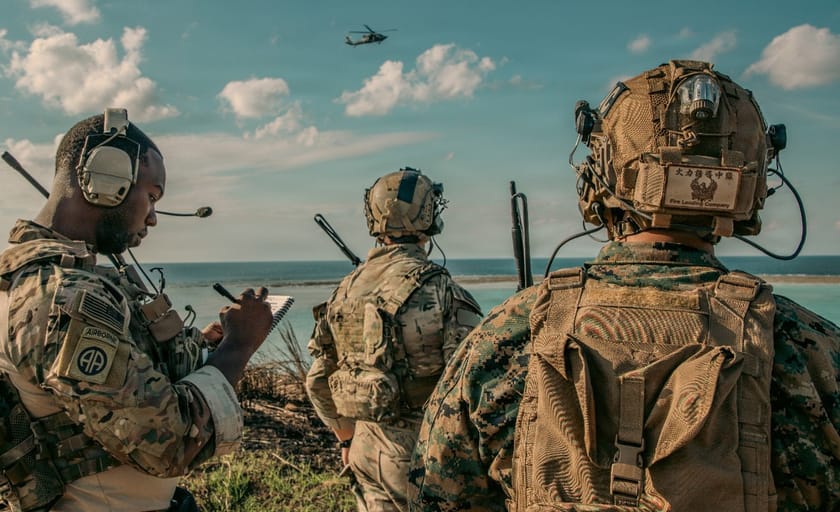
Main Image: 1st SFG(A) conducting a joint tactical air controller with Marines and Airmen in Okinawa, Japan, December 2025, taken from DVIDS.
If you value reading the Irregular Warfare Initiative, please consider supporting our work. And for the best gear, check out the IWI store for mugs, coasters, apparel, and other items.