Recent US and Saudi airstrikes against Iranian proxies in Iraq raise the prospect that another US security partner may soon be enmeshed in a proxy war. What was common during the Cold War, when US security assistance flowed to actors in struggles against rival-supported adversaries, is becoming common again. With the escalation of tensions in the US-Iran, US-China and NATO-Russia rivalries, gray zone activities and other forms of irregular warfare are likely to pick up, as already seen in Iraq, Europe, the South China Sea, and the Sahel.
Examining how proxy wars and instability result from intergroup competition sheds light on emerging vulnerabilities related to US security partnerships. We know that US security assistance is often necessary to deter and defend against threats to American national interests. US over-extensions of support, however, have left many of its partners vulnerable to coercion and subversion from rival states trying to drive a wedge between the US and partners that are not well aligned with Washington. Those vulnerabilities are prone to increase as US support has become less dependable, as seen recently in sudden reallocations away from partners such as Iraq. The US has also struggled to incentivize de-escalation by other incongruent security partners, such as India and Pakistan. Heeding lessons from the Cold War and Global War on Terror (GWOT), the US is overdue to prioritize dependable security assistance for congruent partners and equip them to do more of the work of assisting other would-be US partners that are stranger bedfellows.
Lessons from Past Relationships
According to data that I analyze in Mixed Blessings: International Relationships of Assistance and Conflict, the US has been rather promiscuous in its offers of security assistance. By a conservative estimate, the US has had nearly one hundred security partners by 2010. And the data show that security assistance to partners with incongruent interests tends to attract coercion and subversion from rival states. Most overtly, Russia has used potential NATO expansion as pretext to wage war against Georgia and Ukraine. The data also show that security assistance from great powers like the US disincentivizes effective management of armed conflict with non-state actors. In this vein, the US was less than enthusiastic about its Cold War partners negotiating with communists, and it promoted a no-negotiation-with-terrorism approach by its GWOT partners.
Specific lessons from the Cold War and GWOT are informative. During the Cold War, the US made strange bedfellows in the name of anti-communism, including illiberal governments engaged in violence against leftist movements such as South Africa, El Salvador and South Vietnam, as well as illiberal non-state actors such as the Contras fighting in Nicaragua (based in Honduras), UNITA in Angola, and the Afghan Mujahideen. In many such cases, US security assistance was met by countervailing support from the USSR and its partners. Moreover, many recipients of US support committed human rights violations and spurned productive peace processes.
During the GWOT, the US continued to make strange bedfellows with states in the Middle East, North Africa and South Asia. Washington then found itself flatfooted to support its partners during the Arab Spring, the rise of ISIS, and the collapse of Afghanistan. States that had depended on US security and economic assistance had failed to develop institutions of self-rule that could survive absent the assistance.
Importantly, these challenges of security assistance are not unique to security assistance by the US. Just as authority in US-backed Afghanistan proved hollow, so did Russian and Iranian-backed Syria. With Russian support dwindling as a result of its war in Ukraine and Iranian support dwindling as a result of its multi-front war (via proxies) with Israel, the Assad regime collapsed in a way reminiscent of the Ghani regime in Afghanistan. French security assistance to regimes in the Sahel failed to forestall illiberal coups and growing political violence there in recent years. Even more striking is the collapse of communist regimes in the Eastern Bloc at the end of the Cold War, as the third wave of democratization swept away the hollow regimes that had depended on Soviet support.
A Lens of Intertwined Security Dilemmas
These examples of security assistance failing the recipients are manifestations of a common phenomenon: security assistance may be intended to deter conflict, but it also attracts conflict and other forms of instability. Who your friends are shapes who your enemies are and vice versa.
Security assistance that is intended to bolster a patron’s bloc often alarms rival states, which respond by trying to sabotage the relationship between a supported state and its patron. The incentives here relate to an interplay of the intergroup and intragroup security dilemmas. The intergroup security dilemma is the challenge that arises from group members enhancing their joint security production, but by doing so reduce the perceived security of non-group members. Such a fear featured in debates over whether NATO expansion might needlessly provoke Russia. The intragroup security dilemma (or alliance dilemma) is the challenge that arises from a patron reassuring group members that it will not abandon them, but by doing so incentivize them to act recklessly and ultimately entrap the patron to participate in imprudent conflict. The US policy of strategic ambiguity toward Taiwan is the product of such a challenge. These dilemmas become intertwined when non-group members perceive insecurity from a group’s joint security production and then respond with coercion or subversion to raise fears of abandonment or entrapment, sowing group dysfunction.
Research Findings
In Mixed Blessings, I show that security assistance from great powers can backfire and contribute to higher rates of interstate and intrastate conflict when the patron state is not well aligned with the recipient. Russia’s coercion and subversion against Georgia and Ukraine, partly in hope of driving a wedge between them and NATO as well as a wedge among NATO states, serves as one example.
I also show that incongruence between supported states and their supporters contributes to fewer attempts at negotiation and mediation in intrastate armed conflict. One of the examples of a strange bedfellow that the US kept during the Cold War is South Africa. The Reagan administration struggled to incentivize South Africa to enter fruitful negotiations with opposition parties because factions in Washington pushed for different strategies. In particular, the State Department advocated for constructive engagement that prioritized South Africa’s perception of regional security, while momentum built in Congress to use sanctions to pressure the apartheid government. While the US sent mixed signals, the status quo prevailed.
Security assistance works best when sufficient alignment of interests exists between the supported states and their supporters. Rival states are less prone to try coercion and subversion in such cases because they are less likely to exacerbate the intragroup security dilemma among congruent states that can expect other group members to act in their interest. Moreover, a sufficient alignment of interests is needed for patrons to incentivize recipients of their security assistance to enter peace processes with non-state actors.
Challenges Ahead
With the decline in the liberal international order, what are the implications from a lens of intertwined security dilemmas? There are three reasons to expect that US security partners are increasingly vulnerable to coercion and subversion. Thoughtful strategy, especially through leveraging the tools of irregular warfare, is needed to respond to these challenges.
First, US political dysfunction that has made it harder for the US Congress to make and keep long-term commitments has decreased the long-standing congruence that the US has had with its core allies in North America (Canada and Mexico), Europe (NATO), and the Indo-Pacific (Australia, Japan, Korea, the Philippines and Taiwan). If the executive branch can, at will, implement tariffs on and abandon existing agreements with key US allies without congressional action, then allies and rivals alike are right to conclude that the US is an untrustworthy security partner. Related, political swings in the US have raised specific questions about the reliability of US commitments to key partners. For example, both the Biden and Trump administrations struggled to maintain consistent policies toward another core partner: Israel. As the US-Israel relationship has become increasingly politically charged, support for Israel has become more mercurial. Political expedience tends to detract from policy prudence.
Polarization and dysfunction have opened the door for US rivals to use irregular war tactics of coercion and subversion to begin prying away states from what was a US-led liberal international order. This has included treaty allies vulnerable to rival territorial aggression such as the Baltic NATO states and the Philippines. It also has included allies vulnerable to democratic backsliding and economic dependencies, such as many in Latin America. Moreover, it has included second-order allies (allies of allies) such as members of the Pacific Island Forum. Most violently, Iran’s support for proxies such as Hamas and Hezbollah in their provocations against Israel has generated significant American-Israeli friction and impeded progress toward a US-Israel-Saudi Arabia multilateral partnership.
Second, depleted weapons stocks from the war with Iran could decrease the material ability for the US to effectively aid security partners against rivals attempting coercion and subversion. Taiwan and the Philippines are especially vulnerable to PRC aggression in the Taiwan Strait and the South China Sea; resources that would otherwise be used to deter and defend against China have been diverted from PACOM to CENTCOM. Diminished munition stocks also increase the potential for Russia to attack NATO allies. Moreover, Middle Eastern security partners such as Saudi Arabia, the UAE, Kuwait, Jordan, Bahrain and Qatar are directly in the line of fire from Iranian attacks and lacking sufficient air defense capabilities to prevent missiles and drones from reaching critical infrastructure. They are already exploring contingency options for support from elsewhere, including Russia and China, and could be interested in cutting their own deals with Iran while bucking US calls to hold the line.
Third, a combination of a US containment strategy against China and China’s domination of many critical minerals supply chains has exacerbated the zero-sum nature of security partnerships. US security partners are dissuaded from working with China, but this puts them at an economic disadvantage. China knows this and has begun flexing its export controls and information operations to turn the screws on US partners. That is, a “with us or against us” demand puts US security partners at greater risk for destabilizing actions from China.
In light of these challenges, the US should redouble its efforts to be a reliable security partner. Joint investments in arms development and production, preferential trade agreements, mutual efforts to secure the critical minerals supply chain, and security force assistance are tangible ways the US can stay vested in the security of its partners. A return to reliable partnerships will require Congress to get back in the game of holding the executive branch accountable and ensuring that international commitments are implemented. More immediately, the US needs to address its weapons stockpile challenges, in terms of both inefficient procurement and profligate use, to enhance its dependability as a security partner.
The US also needs to better prioritize its relationships with states that have congruent interests. Making strange bedfellows with incongruent states and expecting them to hold the line against a rival is a recipe for intragroup tensions to be exploited by adversarial blocs. Yet the US could work through relatively interest-aligned states to assist states too incongruent to justify substantial US assistance. Returning to the case of Iraq, which is a relatively incongruent partner, building up the capacity of more congruent Gulf Arab States to support anti-Iranian factions in Iraq is likely to be more fruitful than direct US-Iraq assistance.
Conclusion
The upshot is that security assistance to well aligned states was and is a key tool in maintaining order generally and US interests specifically. Security assistance to poorly aligned states at times has proved disastrous, especially for civilian populations in recipient states enmeshed in proxy wars. Better selection of its security partners, more reliable commitments to the security partners that make the cut, and building partner capacity to support their security partners can do much to hold the line against attempts by China, Russia and Iran to coerce and subvert US-aligned states.
Kyle Beardsley is Professor of Political Science and Public Policy at Duke University. He is the Director of the Triangle Institute for Security Studies and the Co-Director of the International Crisis Behavior data project. His recent book, Mixed Blessings, has been published by Cambridge University Press.
The views expressed are those of the author and do not reflect the official position of the Irregular Warfare Initiative, Princeton University’s Empirical Studies of Conflict Project, the Modern War Institute at West Point, the Department of the Army, the Department of War, or the United States Government.
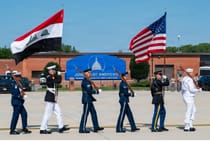
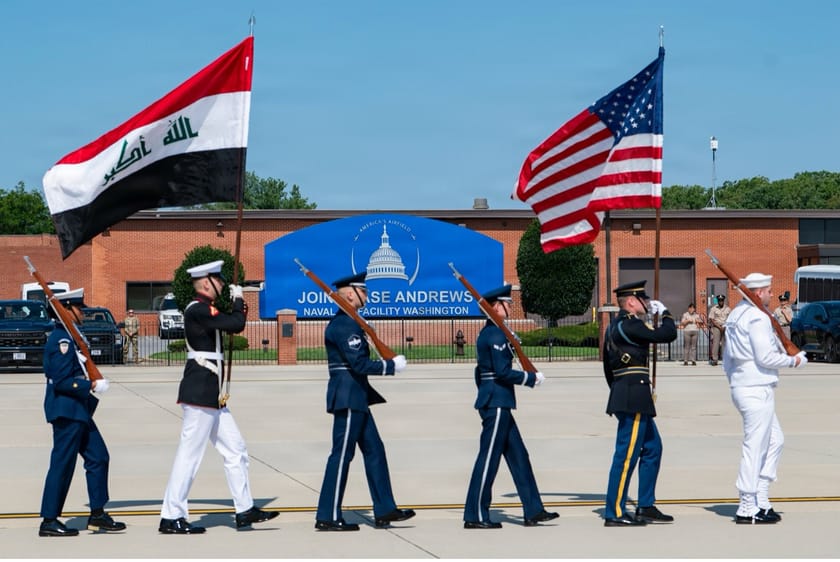
The main image is the Joint Service Honor Guard carrying the Iraqi and United States flags during an official arrival ceremony for Iraqi Prime Minister Ali al-Zaidi at Joint Base Andrews, Maryland. Photo by Tech. Sgt. Sean Evans DVIDs.
If you value reading the Irregular Warfare Initiative, please consider supporting our work. And for the best gear, check out the IWI store for mugs, coasters, apparel, and other items.