
The wars of the current decade have generated a powerful narrative about the future of defense industrial policy. Cheap drones, agile startups, venture-backed innovation, and commercial technology adapted for military use now dominate policy discussions across NATO and beyond. Ukraine’s wartime adaptation and the rise of firms associated with the “New Defense” ecosystem have encouraged governments to rethink long-standing assumptions about how military capabilities should be developed and sustained. As a result, defense industrial strategies increasingly emphasize startup ecosystems, innovation hubs, and mechanisms to attract private capital.
There is much to learn from these developments, but the lessons policymakers appear to be drawing are often incomplete. They offer insights into how governments might accelerate innovation, but they say little about the institutional foundations required to generate military capability at scale and sustaining it over time. Defense markets are fundamentally shaped by government demand. States define requirements, allocate resources, structure incentives, manage complex acquisition programs, and commit to procurement over decades. Supply-side initiatives alone are unlikely to deliver meaningful military effects without those capabilities.
This article argues that contemporary defense industrial thinking rests on two related misinterpretations: one military and one economic. On the military side, policymakers risk overstating the extent to which drones can substitute for more traditional forms of military power. On the economic side, they increasingly treat defense industrial development as an innovation ecosystem problem rather than a challenge of building effective procurement institutions. Together, these assumptions encourage governments to invest in visible and politically attractive initiatives while neglecting the more demanding task of strengthening acquisition organizations and improving the state’s ability to translate budgets into capability. For middle powers operating under severe resource constraints, getting this balance right is particularly relevant.
The Allure of the Drone Revolution
The appeal of these conclusions is easy to understand. Ukraine has demonstrated that relatively inexpensive One-Way Attack drones can perform missions once requiring assets of significant complexity and cost -strike aircraft, precision-guided munitions and the airborne, space, communications and command and control architecture to coordinate them. Ukraine has employed these systems along the front line and deep inside Russian territory, imposing costs disproportionate to its conventional military resources. Iran has demonstrated a comparable dynamic in a different strategic context, threatening Israel, regional partners, and US installations using missiles and drones despite lacking a modern air force.
In both cases, states facing more powerful adversaries have employed drones as asymmetric instruments capable of imposing costs and negating military success. This happens in two ways. Drones can contribute to deterrence by punishment by making aggression costly, and under certain circumstances they can support more limited forms of deterrence by denial, particularly where persistent surveillance, rapid targeting, and attritional effects restrain offensive operations. These are consequential military effects, and their relatively low cost has understandably captured the attention of defense planners worldwide.
The industrial dimension has been reinforced by developments in the United States (as Anthony King has brilliantly shown). Venture-backed firms applying commercially derived technologies to military problems have drawn inspiration from the earlier experience of the space sector. Companies such as SpaceX demonstrated that private equity could generate innovation more rapidly and, in some cases, more efficiently than traditional prime contractors -though SpaceX benefited from a business model combining government demand with substantial commercial revenue streams via Starlink. More recent firms such as Anduril and Shield AI have pursued variants of this approach without the broad commercial markets that made the New Space model financially sustainable.
The policy response has been consistent. For a more systematic understanding, we conducted our own analysis of the defense industrial strategy documents, expanded to those published in the last three years by major powers (US, UK, France, Germany) and middle powers (Brazil, Australia, Turkey, Canada and Sweden). Looking at 24 individual policies across four categories: supply-chain (eg, state grants and R&D financing, SME and startup support, private finance incentives), workforce (eg, training and expansion), exports and international cooperation (eg, incentives and frameworks), and acquisition (eg, faster and simpler regulations, strengthening organization’s capabilities and authorities).
Across both major and middle powers, governments have largely abandoned post-Cold War assumptions centered on efficiency, just-in-time procurement, and minimal stockpiles. Instead, they prioritize industrial resilience, production capacity, and the ability to mobilize during crises, with Ukraine as a common reference point. The most prominent policies across all countries are for supply-chain development, representing over 40% of the total.
As we can see in the bar charts below, major powers have generally combined these initiatives with broader efforts to reform acquisition systems (particularly the US and the UK), while balancing secondary efforts in institution building (workforce and export promotion). Middle powers, by contrast, focus mostly on supply-chain development initiatives, such as: innovation accelerators and SME support frameworks, that substitute for more difficult institutional reforms.
The data also reveals an increasing effort for mobilizing private capital. Major powers, particularly Germany and the UK (and the EU as a whole as well), invest considerable policy effort in reforming financial sector rules -ESG classification, EIB mandates, export credit guarantees, dedicated defense equity vehicles- to unlock private capital that regulatory frameworks had inadvertently excluded. But some middle powers like Canada and Australia are also setting-up their own frameworks for attracting private capital.
What Drones Cannot Do
The drone revolution is real, but its strategic implications are frequently overstated. Inexpensive strike systems have lowered the barriers to offensive punishing action, allowing states with limited conventional capabilities to threaten adversaries in ways once reserved for major powers. They have also allowed for significant denial capability at the tactical level in ground operations.
The economics of strategic defense have changed far less. The capabilities required to deny an adversary control of the air, protect critical infrastructure against sustained attack, project power over contested distances, or prevail in ground operations and sustain gains remain concentrated among a small number of states. Advanced fighter aircraft for defensive and offensive counter-air operations, integrated air and missile defense systems, offensive missile forces, submarines, naval combatants, and the command-and-control architectures needed to coordinate them, continue to demand levels of technological sophistication, industrial depth, and financial investment that few countries can sustain.
This creates an important asymmetry. The barriers to entry for imposing costs have fallen more rapidly than those associated with denying an adversary’s military objectives. It is not yet clear to what extent middle powers will devote all their fiscal space to exploiting the drone advantage, or they will remain on the long-term path of acquiring conventional denial capabilities. Paradoxically, the more they do the former, the more they will deepen their disadvantage with larger, more horizontally diversified military powers. These trends will shape defense industrial efforts and the future of these markets.
The Economics of Defense Markets
The cheapness and attritable quality of drones has led to renewed focus on producing at-scale. But part of the policy discourse has conflated “how to buy” problems with “what to buy”. Much of the current debate implicitly frames defense industrial development as an innovation ecosystem problem: if governments create the right regulatory environment, mobilize venture capital, and support startups, military capability will follow. However, this perspective captures only part of the problem and risks obscuring the more fundamental economic characteristics of defense markets.
Defense markets are politically constructed procurement systems in which governments simultaneously act as customer, regulator, financier, and co-developer of military technologies. Unlike commercial markets, where consumer preferences drive demand, defense demand is generated through political and strategic processes. Governments decide what capabilities are required, establish technical specifications, allocate budgets, determine acquisition timelines, organize tenders, and design and execute contracts. The central challenge is organizing demand to balance efficacy and efficiency.
Now, when looking at defense startups, the barriers they face rarely arise at the early stages of technological development. In the US, venture capital has become increasingly available to firms operating at the intersection of commercial and defense technologies, and investors have shown considerable interest in those segments where barriers are lower for mass producibility: autonomy, artificial intelligence, unmanned systems, missiles, and space technologies. The problem emerges later, when firms attempt to transition from prototype development to sustained production — the gap known within the defense innovation community as the “valley of death”.
Venture capital can finance experimentation and support mature-stage prototype development, but it cannot replace the government’s role as the early risk taker in research and development of concepts and technologies, nor as the ultimate purchaser of military capability. Firms cannot scale manufacturing facilities, expand workforces, or build resilient supply chains without credible expectations regarding future procurement. Therefore, the model of private equity-backed defense startups strains when government contracts take too long to materialize, leading to returns on investments taking more time than what would be acceptable for an alternative commercial project.
This is why recent acquisition reforms in the United States have focused as much on procurement processes as on innovation itself -new acquisition pathways, streamlined requirements generation, and faster contracting- all seeking to shorten the transition between experimentation and operational deployment.
Now, these approaches suit certain categories of military capability well: software-intensive systems, autonomous platforms, some space applications, and selected unmanned technologies. But they are far less consequential for large-scale acquisition programs involving high technological uncertainty, large fixed capital investments, extensive testing requirements, long service lives, and concentrated industrial structures. Advanced combat aircraft, naval vessels, missile defense systems, and elements of the nuclear enterprise conform poorly to commercial innovation models. Different categories of military capability require different institutional arrangements.
But even with these shortcomings, there is a larger challenge of this approach for middle powers, and even most developed economies: the venture capital market only has significant breath and depth in the United States, and it’s not comparable to anywhere else in the world. So, the expectation that venture-backed private investment will alleviate budgetary burden at the developmental stages for middle powers is extremely optimistic.
What Middle Powers Should Do Instead
For middle powers engaged in challenging security dynamics and with limited resources, it’s untenable to pursue every industrial objective simultaneously, nor can they assume that organizational models adopted by major powers will translate to their circumstances. The central question is how to develop the institutional capacity required to convert scarce resources into military capability.
Defense acquisition is the mechanism through which strategic priorities are translated into operational outcomes. States must be able to identify capability requirements, assess technological alternatives, negotiate with suppliers, manage complex programs over long periods, and adapt procurement decisions to changing conditions.
Therefore, for countries operating under permanent scarcity, the first order of business should be to develop institutional capacity for defense acquisition: a stable and qualified technical and contracting workforce, enabled with flexible procurement mechanisms, and stable budget resources. This is usually the most underestimated area of investment.
On a second order, successful defense projects need to obtain social license. In middle powers, achieving it will require maximizing industrial and technological spillovers. One of the most common instruments middle powers have used to develop domestic defense industries is the requirement of industrial offset agreements. The historical record is mixed: many programs have generated maintenance activities with no technological upgrading, and investments have sometimes been dispersed across politically attractive sectors with no clear relationship to strategic priorities. Yet offset effectiveness depends heavily on the institutional capabilities of the states employing them. Governments must define what forms of industrial development they seek, identify realistic pathways through which foreign partnerships can support those objectives, and monitor implementation over time.
Last but not least, middle powers should prioritize the limited number of capability areas in which domestic production offers meaningful strategic advantages -where supply chains are vulnerable during crises, where dependence on foreign providers creates unacceptable risks, or where existing industrial competencies provide a credible foundation for development. For some medium militaries, drones and selected categories of munitions may satisfy these conditions. Advanced combat aircraft or large naval platforms present a different set of challenges, requiring large and stable funding, and industrial infrastructures that typically emerge only over decades.
In any event, countries most likely to succeed in strengthening their defense industrial bases are the ones able to combine openness to cooperate with foreign partners for technological transfers with the patient construction of institutional state capability. For middle powers in particular, the most consequential investments may ultimately be the least visible: procurement organizations capable of managing complex projects over time.
Martin Novella is a researcher focused on defense acquisition and industrial policies from a comparative perspective. He is a former National Director of Defense Industrial Policy at the Ministry of Defense of Argentina, and former Head of operations planning at the Military Fabrications SOE. He is currently Director of anticompetitive concerted practices at the National Competition Authority.
The views expressed are those of the authors and do not reflect the official position of the Irregular Warfare Initiative, Princeton University’s Empirical Studies of Conflict Project, the Modern War Institute at West Point, the Department of the Army, the Department of War, or the United States Government.
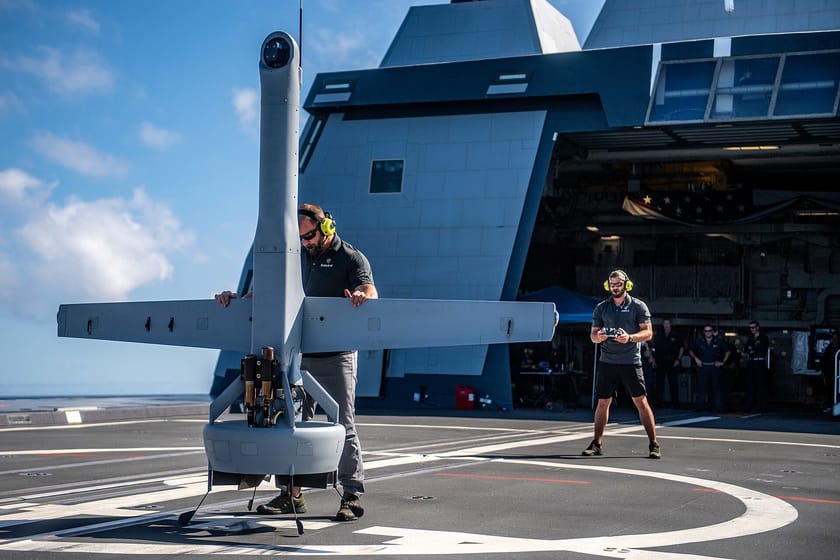
The main image is U.S. contractors prepared the V-BAT 118 drone for its first flight aboard the guided-missile destroyer USS Michael Monsoor on Wikimedia Commons.
If you value reading the Irregular Warfare Initiative, please consider supporting our work. And for the best gear, check out the IWI store for mugs, coasters, apparel, and other items.