The ANSF’s collapse was not a military defeat. It was the final, visible stage of an institutional failure that had been running for two decades.
Following the 2021 Taliban takeover of Afghanistan, one of the major questions Western analysts have spent the last five years debating is: Why did the Afghan National Defense and Security Forces (ANSF) dissolve so quickly and completely in August 2021? The answers offered have frequently focused on declining will to fight; the withdrawal of air support contractor and maintenance support; failure of ANSF logistics; and political abandonment. These are not wrong, but they are incomplete answers proposed by outsiders looking in.
Political abandonment operated at two levels. In 2020, I attended the NATO conference in Brussels during discussions related to the Doha Agreement. What I heard was a complete divergence between what NATO nations were saying publicly and what their actual positions were. More striking was the Afghan delegation itself: senior leaders had nothing to say and accepted the deliberations without resistance. At the domestic level, that dereliction reemerged on August 15, 2021, when President Ghani fled Kabul without warning military commanders. These forms of abandonment revealed the underlying structural failures.
I know this because I served inside it as an officer in the Afghan National Army.
What follows documents three categories of institutional failure I witnessed directly, each one invisible to the metrics advisors were tracking.
NATO’s revised Security Force Assistance (SFA) doctrine, published in August 2025, acknowledges that twenty years of investment in the ANSF proved futile despite massive investment, and calls for lessons to be incorporated into future SFA frameworks. This article offers some of those lessons, drawn not from after-action reports or advisor interviews, but from the experience of an Afghan officer who lived them.
Before the Army Was an Army
I was twelve years old when NATO forces arrived in 2001. The men who became the first Afghan National Army soldiers in 2003 and 2004 had no equipment, no uniforms, and—in some cases—nothing beyond a stick tucked in a belt. A uniformed force slowly materialized. In response, the Taliban reconstituted and renewed their insurgency in Southern Afghanistan by 2006, often from safehouses and madrassas across the Pakistani border. The situation was changing week by week.
What also changed was who was getting rich.
The visible transformation of Afghanistan under NATO investment was real. Infrastructure appeared. Salaries were paid. A class of people emerged who wore government uniforms and drove better vehicles. But all too often, those who entered that class were not determined by merit or need, but rather by connection. If you did not know someone within the system, this transformation did not afford opportunity.
I encountered this the moment I entered service. The Ministry of Defence (MOD) printed approximately 3,000 Military Academy entrance exam forms annually for roughly 300 available slots nationwide. The bulk were distributed to generals, politicians, and senior figures before they reached the public. Seven forms were allocated for my entire province. Merit was rare. Patronage was not.
I obtained my form through a conversation in a dormitory with a third-year cadet who explained how the system actually worked. “Ask every week without stopping,” he said. That is what I did. I sat the exam. By my fourth year at the military academy, I was selected as cadet battalion commander—not through patronage, but through demonstrated performance. The two paths produced officers with fundamentally different relationships to the institution before a single day of service had begun.
Ghost Soldiers and Swapped Rice
My first assignment after graduation in 2013 was as Company Executive Officer in the MOD Security Brigade, based within the MOD compound in Kabul. Within days, I was asked by the Battalion XO to mark soldiers present who were not there. I refused. Ghost soldiers, personnel listed on rosters who existed only on paper, their salaries absorbed elsewhere in the chain, were not a rumor. They were a daily administrative reality I encountered in my first week of service.
Logistics corruption followed the same logic. Our brigade held a standing arrangement with a contractor: seven-kilogram bags of potatoes worth 80 Afghani were swapped for dry fruits worth 20 Afghani. A network that extended upward through the chain of command pocketed the 60-Afghani difference. The contractor had held the same arrangement for the entire five years I served at the brigade, without a single competitive tender. This was not a transaction between a supplier and a unit. It was a protected network. Challenging it meant challenging the people sustaining it. When I refused to participate, I was removed from the company’s supply chain. When surplus food accumulated beyond what the reported soldier count required, I was instructed to hand it to a sergeant to be sold on the informal market. I refused again.
Corruption in these systems is not aberrant behavior. It is the incentive structure. Ghost soldiers and diverted supplies were coordinated arrangements sustained by institutional protection. As IWI’s analysis on SFA assessment has noted that advising missions become performative when partners rehearse for metrics rather than build genuine capability. Officers who complied advanced. Officers who refused were isolated or forced out. The institutional pressure ran entirely in one direction.
What Ranger School Meant, and Didn’t Mean
In 2014, I passed the selection exam for the Infantry Basic Officer Leadership Course at Fort Benning. I performed well enough that U.S. Army leadership offered me a slot at Ranger and Airborne School, and I successfully completed these courses.
I returned to the MOD Security Brigade believing the Ranger tab would open doors that performance alone had not. It did not. Other Afghan officers came back from U.S. and European programs carrying the same expectation. Whether they found recognition or neutralization depended on which unit they returned to and how deeply patronage networks had embedded themselves there. In early 2017, I transferred to the Afghan Special Forces and was posted to Camp Scorpion in Kabul. When I pressed for a combat role, I was told I was unqualified because I had not completed Afghan special forces training, even though soldiers from American Ranger battalions were serving as advisors directly alongside Afghan special forces units at that exact moment.
Institutional considerations trumped operational logic. Advancement within the ANSF was determined through tribal affiliations, regional loyalties, and political patronage in ways that formal rank structures could not override. An officer from the wrong province or political network could hold the right credentials and still find himself outside the circle where real decisions were made.
Imported professional credentials do not disrupt corrupt systems. They expose the gap between formal standards and actual institutional logic, and the system responds by neutralizing the credible officer, not by changing the standard. Producing Ranger-qualified officers inside an institution that punishes performance is individual investment without institutional return.
The Ambulance That Was Locked
On a late afternoon in late 2016, a suicide bomb detonated at the South Gate of the MOD compound in Kabul where my brigade was based. I was in my office on the east side of the compound when the explosion occurred. I ran immediately to the South Gate. I was not the only uniformed officer who responded. But what I witnessed among those who did respond was telling. Some officers were attempting to drag wounded personnel by their legs, pulling them across the ground, visibly more concerned about avoiding contact with blood than with the welfare of the casualties they were supposedly helping. I watched a wounded man look directly at uniformed officers standing nearby and ask for help. They ignored him. I treated the wounded. I was covered in blood. The contrast was not between those who responded and those who did not. It was between those who responded as soldiers and those who responded as men protecting their uniforms.
When the brigade’s first ambulance failed to start, a responder drove a second ambulance to the scene. But when we attempted to access the patient compartment, the rear section where the two patient beds were located, the backdoor was locked. The driver did not have the key. We were standing beside a functioning ambulance with wounded personnel bleeding on the ground and could not open the door to use it. We were later told the rear compartment had been locked by the clinic because soldiers had been regularly using it as a private space to smoke hashish. Civilians with private cars ultimately transported the wounded to the clinic.
Three months later, when I had already transferred to the Afghan Special Forces, another bomb struck the same gate. This time it was followed by a second explosion, a deliberate double-tap strike designed to kill first responders. I was in the northern part of the country on a mission with Special Forces, monitoring the radio when it happened. I knew before the casualty report came in that it would be worse. It was. We lost senior officers.
Between the two attacks, the gate had not been hardened and the security protocols had not been improved. The institutional inertia led directly to casualties.
Tactical training without institutional accountability produces individual capability inside a system designed to ignore it. The ambulance was present; the key was missing. The second bomb hit the same gate three months later. The institution had not changed because nothing inside it compelled change.
The False Report
Within eight months of my transfer to the Afghan Special Forces, it became clear that I was viewed as a threat rather than an asset. I resigned. Fifteen days later, I was offered a combat position if I returned. In early 2018, I was sent to the United States for additional training and refused to go back. The Minister of Defence called me personally, promised things would be different, and asked me to serve my country. I returned because of that promise.
In 2020, I became a Special Forces company commander, the position I had been working toward for years. I believed I had finally found the environment where performance was currency.
An intelligence officer within my unit filed a false complaint against me in June 2020. The circumstances that provoked it reveal precisely how institutional corruption operated. The Minister of Defence had personally tasked me with compiling a confidential list of qualified officers for specific sensitive assignments. Only the Minister and I knew the details of this task. When the intelligence officer learned of my meetings with the Minister, he filed a report to NATO forces claiming I was improperly assigning personnel to unauthorized organizations. The accusation was entirely false. NATO officers interviewed me for several hours. At the conclusion of the interview, they informed me that they had been given a false report and advised me to be careful with the people around me. Before concluding the interview, the NATO officers apologized to me personally. The intent of the report was clear: to neutralize me by destroying the trust between me and our coalition partners at the precise moment I had direct access to the Minister of Defence. I had become enough of a threat to the existing order that my own unit was willing to compromise operational integrity with allied forces rather than allow merit-based reform of personnel assignments to proceed.
In October 2020, my unit was deployed on a mission planned for 48 hours. We completed it successfully. But when we requested extraction, the answer was the same every day for seven days: tomorrow. A promise every night, and an excuse every morning. We were under direct mortar fire in the field. On the seventh day, I went outside the chain of command, finally triggering our extraction. The general who had authorized our deployment had left us for seven days under fire. It was in those seven days that I accepted what I had been resisting for years. The coming collapse of the Afghan Army was not a surprise, it was endpoint of a failure that external metrics were structurally incapable of detecting.
What This Means for Future Partner Force Development
The Afghan military did not collapse because its soldiers lacked courage. Between 2001 and 2021, an estimated 66,000 to 69,000 Afghan military and police were killed in combat. These were not ghost soldiers. These were real men and women who fought and died with extraordinary bravery. For many, military service was also an economic opportunity—the uniform represented a salary and stability that few alternatives could offer. When that contract was betrayed through ghost soldier arrangements and diverted supplies, the institution was not only failing its professional standards. It was failing the men it had recruited on the promise of both.
The courage was never the problem. By 2021, the ANSF faced simultaneous structural failures: decades of internal corruption that had redirected resources and driven out principled officers, and an operational architecture so dependent on U.S. airpower and logistics that when that support was withdrawn, units that had been fighting effectively could not sustain operations. Institutional corruption had actively prevented the ANSF from developing the organic capability that might have absorbed the shock. The institution had learned to perform readiness for external observers rather than build it for itself.
The collapse was not their failure. It was the failure of the system that sent them into battle while simultaneously hollowing itself out from within. It collapsed because the institution they served was too often structurally designed to reward loyalty to individuals rather than to the state or the mission. The institution was the problem.
Twenty years of investment largely failed to alter that structure. NATO’s 2025 revised SFA doctrine calls for lessons to be drawn from the Afghan experience and embedded into future frameworks. The following are four lessons drawn from my experience serving inside the institution itself.
Access is the first battlefield. If registration forms are pre-distributed to political networks before a single exam is written, the pipeline is poisoned before training begins. Merit-based recruitment is a foundational condition, not an aspirational goal.
Corruption is a system, not a behavior. Ghost soldiers and diverted supplies are coordinated arrangements requiring institutional protection to sustain. Advising partners to reduce corruption without restructuring the incentives that make it rational is advisory theater.
Professionalizing individuals without professionalizing institutions creates islands. The determining factor is whether the institution rewards a trained officer’s standard or punishes it.
When capable officers leave, read it as a signal—and when coalition trust is weaponized internally, treat it the same way. Officers who held genuine standards faced a consistent choice: comply, be neutralized, or leave. The false report filed against me to NATO forces represents a category of risk in which internal actors use the coalition relationship as a tool in domestic institutional politics. Both patterns—officer attrition and fabricated coalition reporting—are leading indicators of institutional failure. They deserve the same analytical attention as readiness rates and equipment accountability.
Security Force Assistance Means Building Effective Institutions
I watched Afghanistan’s military be built from nothing. I watched it fill with people who deserved better from the institution they served. I watched the system absorb billions of dollars and return ghost soldiers, locked ambulances, and false reports filed against the officers who tried hardest to serve with integrity.
But these failures did not develop in isolation. They developed inside a strategic environment shaped by a widely held assumption among Afghan political and military elites—that the United States would maintain an indefinite presence. When senior leaders believe external support is permanent, the incentive to build genuine self-sufficiency weakens. Reform is deferred. The expectation of permanence did not cause institutional corruption. But it reduced the pressure to confront it. When the withdrawal came, the institution had neither the internal coherence nor the external support to absorb the shock.
If the United States and its partners are serious about future security force assistance, in any theater, the foundational question must change. It cannot only be: Can we train them to fight? It must also be: Is the institution we are building worth fighting for? And perhaps most importantly: Are we building an institution capable of standing on its own, or one that has learned to perform capability for its patrons while remaining structurally dependent on their presence?
These are not comfortable questions. But they are the ones Afghanistan demands we ask, before the next commitment is made, not after it ends.
An army is only as strong as the institution behind the uniform. Afghanistan proved that the uniform is not the institution.
Yaser Yarghal is a former Afghan Army Major and graduate of US Army Ranger School and Airborne School. He served in the Afghan National Army from initial officer commissioning through Special Forces company command. He is currently based in Edmonton, Alberta, Canada, and is the author of the forthcoming memoir Unsabotaged.
The views expressed are those of the author and do not reflect the official position of the Irregular Warfare Initiative, Princeton University’s Empirical Studies of Conflict Project, the Modern War Institute at West Point, the Department of the Army, the Department of War, or the United States Government.
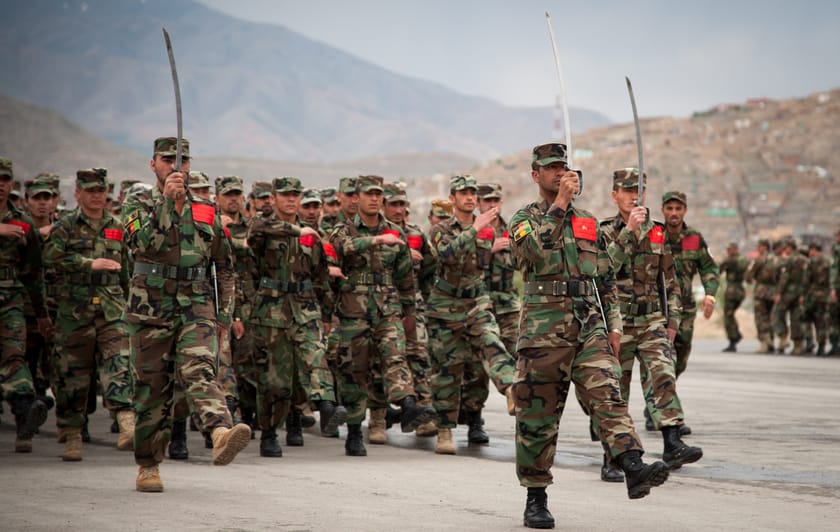
Main image is Afghan National Army cadets practicing drill at the Afghan National Defense University, taken from Wikimedia Commons.
If you value reading the Irregular Warfare Initiative, please consider supporting our work. And for the best gear, check out the IWI store for mugs, coasters, apparel, and other items.



_cadets_practice_drills_on_the_parade_grounds_at_the_Afghan_National_Defense_University_in_Kabul,_Afghanistan,_May_7,_2013_130507-F-OF869-008.jpg?ref=irregularwarfare.org)