When the Iranian security state unleashed its typical playbook of repressive policing and internet blackouts in early 2026, the Islamic Republic aimed to asphyxiate the uprising. To the contrary, IWI interviews from Iraqi Kurdistan reveal a sophisticated Kurdish resistance that maintained its momentum, mobilized through general strikes and satellite-linked sleeper cells.
At the end of December 2025, Iran underwent a major political and social crisis. Triggered by a history of socio-economic grievances, popular uprisings surged within Tehran and rapidly spread across hundreds of cities, reaching the Kurdish regions in the country’s northwest. In Iranian Kurdistan, these demonstrations also became partially co-opted by Kurdish opposition parties. Under the guidance of these political parties, the Kurdish populations seek to obtain independence or autonomy through civil disobedience tactics, such as general strikes. Rather than resorting to armed struggle, the Kurds orchestrated this nonviolent resistance with underground partisans and off-grid communications via Starlink, effectively outmaneuvering the regime’s toolkit of suppression. This localized coalition now acts as the fulcrum for the broader geopolitical chess match between Washington and Tehran.
Iranian Kurdistan and the Protest Movement
Iran’s Kurdish minority, a community of approximately twelve million mostly Sunni people, has a long history of uprisings and attempts at independence from the Iranian central state. Indeed, since the end of the Republic of Mahabad in 1946, the Kurdish minority in Iran has faced a cyclical dynamic of autonomist demands and security interventions by the central state. Under the administration of the Pahlavi dynasty, and later under the Islamic Republic starting in 1979, Kurdish political groups (notably the Democratic Party of Iranian Kurdistan and Komala) have periodically led armed insurrections. In response, successive governments in Tehran have maintained a heavy military presence in these provinces. Archives and reports from international organizations document repressive state actions, including the assassination of Kurdish political leaders in exile during the 1980s and 1990s, as well as a high rate of incarcerations and death sentences targeting activists from this minority. These tensions are also set against a backdrop of socio-economic marginalization and prolonged underinvestment in Kurdish-majority regions.
Historically, Kurdish protest movements often developed separately from major Iranian national uprisings, such as the 1999 student protests or the 2009 Green Movement. Government authorities have regularly characterized these demands as attempts at separatism, which long limited convergence with opposition movements in the rest of the country. However, a structural shift occurred during the protest waves of 2017–2019, and even more markedly during the 2022 movement following the death of Mahsa (Jina) Amini, whose repression has been the subject of international investigations. During these recent events, strikes initiated in Kurdish provinces reverberated in major urban centers, illustrating a growing coalescence between peripheral dissent and the national opposition to the central government. In 2022, the Kurdish city of Saqqez assumed a leading role in the demonstrations of the movement known as "Jin, Jiyan, Azadi" (Woman, Life, Freedom). And during the 2025–2026 wave, the regions of Ilam and Malekshahi joined to extend the movement across all of Iranian Kurdistan (called Rojhelat in Kurdish).
Government repression gradually weakened the initial demonstrations in Tehran, which had primarily been confined to sectors like the bazaar. With the capital secured, the central state shifted its police forces to Ilam and Kermanshah to stifle the remnants of the resistance. The pressure exerted on these western cities provoked an immediate reaction of solidarity. Other cities in Kurdistan responded to the political call issued in January 2026, simultaneously reigniting demonstrations in the capital and other urban areas across the country.
Civil Disobedience Amid a Telecommunications Blackout
The Democratic Party of Iranian Kurdistan (PDKI) had prepared for a new uprising, and had adopted a new strategic mindset to coincide with the latest protests. In an interview conducted prior the latest hostilities, Mostafa Hijri, the Secretary General of the PDKI, explained the group’s strategy: “In the past, we waged a military struggle against the Iranian regime, but we have ended that for the moment. Our main task now is to mobilize our people inside Iran.” Hijri confirmed that an armed uprising would be premature in the current context, with priority going to civil actions. However, he noted that “our parties are exploring all possibilities, and they are discussing possible military agreements between our armed forces.”
In practical terms, the parties helped orchestrate the January 8 strike as an act of civil disobedience. Deprived of any legal existence in Iran and operating from exile (mainly in neighboring Iraqi Kurdistan), PDKI cadres nonetheless maintain cells and sympathizers in many Kurdish localities. These discreet networks carry out several essential missions: mobilization, coordination, intelligence gathering, and action if necessary. In this case, Kurdish leaders activated their clandestine relay networks inside the country: sleeper cells, local cadres of the PDKI, and other parties were enlisted to mobilize merchants and residents to participate. “We saw it during the general strike: local cells served to disseminate instructions and to supervise the shutdown of the towns,” explains the PDKI’s Secretary General. Similarly, in daily demonstrations, seasoned activists are quietly present among the protesters to advise the crowds, avoid unnecessary clashes, and document any abuses. This underground organization, combined with a public show of political unity, achieved broad popular support without any call for violence.
The Iranian government reacted to this mobilization by attacking communication infrastructure. As early as January 8, 2026, authorities plunged nearly the entire country into a total internet blackout. In reality, the decision aimed to destroy the coordination capabilities of the protesters. The regime sought to prevent citizens from organizing locally while simultaneously containing the flow of documented state violence to international media. Iranian internet service providers severed connections with the outside world. Mobile phones retained very limited utility for filtered local calls, but citizens were isolated from the rest of the world. Cybersecurity analysts from Project Ainita and the Outline Foundation found that the blackout constituted a survival tool for the leadership. The government sought to slow the collapse of the system by preventing Iranians from communicating and finalizing the overthrow of the power.
Breaking the Isolation of the Iranian Protest Movement
The Iranian state possesses one of the most restrictive censorship systems in the world: The Internet Filtering Committee, led by the Prosecutor General, and the Supreme Council of Cyberspace. The regime had already used this weapon during the 2019 protests and after the death of Mahsa Amini, while in 2008, the government had managed to block more than 5 million websites. In the face of the current blackout, the Iranian population deployed sophisticated circumvention technologies. The clandestine introduction of Starlink terminals broke the isolation decreed by the state. Citizens installed these satellite dishes on rooftops to establish space-based mesh networks without relying on the national telecommunications infrastructure. This technical breach allowed for the transmission of a limited but decisive number of videos documenting the scale of the protests and the violence of the repression. The Army of the Islamic Republic retaliated by mobilizing electronic warfare units. Military personnel deployed mobile jammers in urban areas, succeeding in stifling and suppressing most acts of civil disobedience organized by Kurdish parties and the Iranian population.
The PDKI and other Kurdish groups were among those who managed to relay eyewitness accounts, photos, and videos of the repression. To do so, they rely on their clandestine channels: evidence of abuses gathered by Kurds on the ground passed discreetly to contacts outside Iran (Kurdish human rights NGOs like Hengaw, representatives abroad, party media outlets, etc.). This information is then authenticated and published, thereby bypassing and undermining the censorship imposed by the Iranian regime.
Importantly, this underground network of exiled Kurdish officials announced a detailed outcome of the January 8 strike. For example, “more than 57 towns and localities” took part, according to PDKI and PJAK (the Iranian branch of the PKK) officials interviewed. Such intelligence would be impossible to obtain without an effective local network. By guiding a segment of the Kurdish population and serving as a conduit to the outside world, the PDKI thus plays an indispensable intermediary role in the current struggle: it transforms popular anger into structured actions, and those actions into messages visible on the international stage.
To amplify the impact of the protest movement, the PDKI and other Kurdish parties rely on their own media channels, combined with a strong presence on social networks. From its exile in Iraqi Kurdistan, the PDKI seeks to produce a continuous flow of news in Persian, Kurdish, and English. This public messaging targets the Iranian public, the diaspora, and the international community. “Our media broadcast is in Persian and Kurdish, and we also use social media in three languages,” notes a PDKI official in charge of information operations. Each statement issued by the Kurdish parties’ Dialogue Center is therefore published and shared in multiple languages. This includes the message released after the January 8 general strike, which praised the “renewed trust of the Kurdish people in their political parties” and the “new momentum” given to the struggle. Similarly, abuses committed by the Pasdaran (Islamic Revolutionary Guard Corps) in Kurdish cities, as well as the arrests of protesters, are reported on the social media platforms of the PDKI and its allies. This media strategy aims to win the information battle in three ways. It reassures protesters inside Iran by showing them that they are not isolated, the broader Iranian public about the plight of the Kurds (which is often ignored by official media), and alerts the international community to the scale of repression.
The Future of Iranian Kurdish Autonomy
Faced with these challenges and following statements by President Donald Trump, there was a serious possibility of an armed uprising in Kurdish areas. However, sources from the PJAK, the PDKI, and the PUK security apparatus informed IWI in March that negotiations with the Americans were deadlocked over two major points: the official political recognition of an autonomous Kurdish region in Iran and the establishment of a no-fly zone to protect it. On the ground, sources remain contradictory, and it has been impossible to confirm or deny this information. Nevertheless, the reactions of the two main Iraqi Kurdish parties, the KDP and the PUK, suggest that they are firmly opposed to this idea for the time being. Both parties have tightened security measures, particularly regarding the press. According to sources interviewed by IWI, they have also requested that Iranian Kurdish parties reduce their media presence to avoid giving Tehran any pretext to bombard Iraqi Kurdish cities. Despite this, Iranian forces continue to regularly shell the bases of Iranian Kurdish fighters entrenched in Iraq, suggesting that the "Kurdish option" is still very much on the table.
Given the persistent fragmentation of the opposition and the asymmetry of power favoring Tehran, the autonomy demands of Iranian Kurds face major structural obstacles. The current security stalemate, crystallized by the ceasefire, tends to freeze positions without offering any prospect of deep institutional reform and only consolidates the central state's authority. In this configuration, the political future of Iranian Kurdistan moves beyond strictly internal dynamics to become part of complex regional geopolitics. The realization of an autonomist project now remains dependent on the conclusion of a comprehensive agreement between the United States and Iran. The pressure of possible preemptive intervention by neighboring powers such as Turkey and Iraq complicate matters further. In the absence of an international realignment, the probability of these aspirations for autonomy remains, in the short term, extremely low.
Interviews for this article were conducted in Iraqi Kurdistan in January and March 2026.
Pierre-Yves Baillet is a French war reporter and IWI non-resident fellow. Holding a Master’s degree from the French Institute of Geopolitics, his research focuses primarily on irregular and hybrid warfare. He has worked in the Balkans, Ukraine, Lebanon, Iraq, Syria, and Colombia.
The views expressed are those of the authors and do not reflect the official position of the Irregular Warfare Initiative, Princeton University’s Empirical Studies of Conflict Project, the Modern War Institute at West Point, Department of the Army, Department of War, or the United States Government.
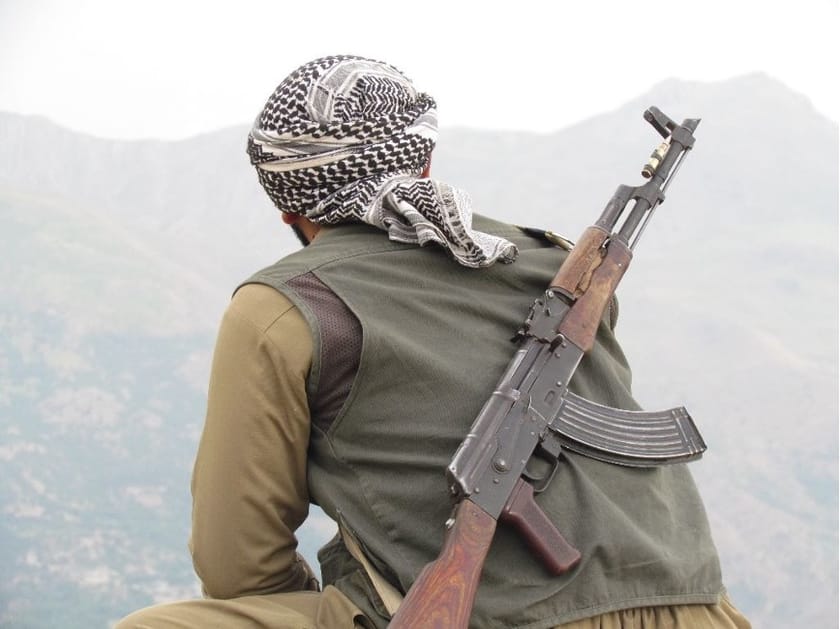
Main image of Kurdish PDKI Peshmerga from Wikimedia Commons.
If you value reading the Irregular Warfare Initiative, please consider supporting our work. And for the best gear, check out the IWI store for mugs, coasters, apparel, and other items.

.jpg?ref=irregularwarfare.org)