Editor's note: This is a Focus Area article intended to facilitate rapid dialogue among practitioners. The analysis, research, and original thought within the article remain the sole responsibility of the author.
The contemporary security environment is crowded with terminology. Policymakers, strategists, and military professionals routinely discuss gray zone competition, hybrid warfare, cognitive warfare, influence operations, strategic competition, and other related concepts. While each term offers some analytical value, the proliferation of terminology often obscures the enduring nature of conflict. Excessive focus on labels can create intellectual paralysis rather than strategic understanding.
The essence is straightforward. Irregular, unconventional, and political warfare are fundamentally about solving, or assisting in solving, complex political-military problems while creating dilemmas for adversaries. They are not primarily defined by the weapons employed, the technologies used, or even the level of violence involved. They are defined by purpose: shaping human behavior, influencing political outcomes, and altering strategic decision-making in ways that advance national objectives.
The Human Domain as the Decisive Terrain
At the center of this framework is the recognition that warfare is ultimately a human endeavor that takes place in what LTG (Ret) Charles Cleveland termed the human domain in 2010. Conventional warfare often focuses on destroying enemy forces, seizing terrain, and imposing military costs. These tasks remain necessary. They are indispensable. Yet irregular, unconventional, and political warfare focus on a different objective. They seek to shape perceptions, alter decisions, strengthen legitimacy, undermine confidence, and affect political outcomes.
This distinction matters because many of America's principal adversaries understand the centrality of the human dimension. China, Russia, Iran, and north Korea all employ forms of political warfare that seek strategic effects without necessarily resorting to large-scale conventional conflict. Their objective is not simply to defeat opposing military forces. It is to shape the political environment in ways that advance their interests while weakening the cohesion, legitimacy, and resilience of their competitors.
Political Warfare as the Strategic Framework
George Kennan's definition remains useful. Political warfare is the employment of all means at a nation's command short of war to achieve national objectives. Political warfare explains the "why" of strategic competition. Irregular warfare provides the military contribution to that competition. Special warfare, or the “missing middle,” provides the specialized SOF contribution to irregular warfare.
This hierarchy matters. Political warfare is the overarching framework. Irregular warfare is the military contribution. Special warfare is the SOF contribution. This relationship prevents conceptual confusion and keeps strategy focused on political outcomes rather than tactical activity.
Unconventional Warfare as Strategic Problem Solving
Unconventional warfare is best understood not merely as a doctrinal category but as a way of thinking. It is fundamentally a method of strategic problem solving. It employs unique, adaptive, and often nonstandard approaches to address political-military problems that cannot be solved through conventional means alone.
More importantly, unconventional warfare seeks to create dilemmas for adversaries. Rather than confronting an opponent directly where that opponent is strongest, it seeks vulnerabilities that can be exploited through indigenous partnerships, influence activities, political leverage, and resistance potential. The objective is not merely to destroy enemy capability. It is to alter the strategic problem itself.
The Two SOF Trinities
The first SOF Trinity describes the core missions: irregular warfare, unconventional warfare, and support to political warfare. These missions place SOF at the center of strategic competition because they focus on influencing conditions before crises emerge and shaping outcomes before conventional military force becomes necessary. They will continue to have significant supporting application through large scale combat operations (LSCO) and then return to primacy during post-conflict and the journey back to stability and peace.
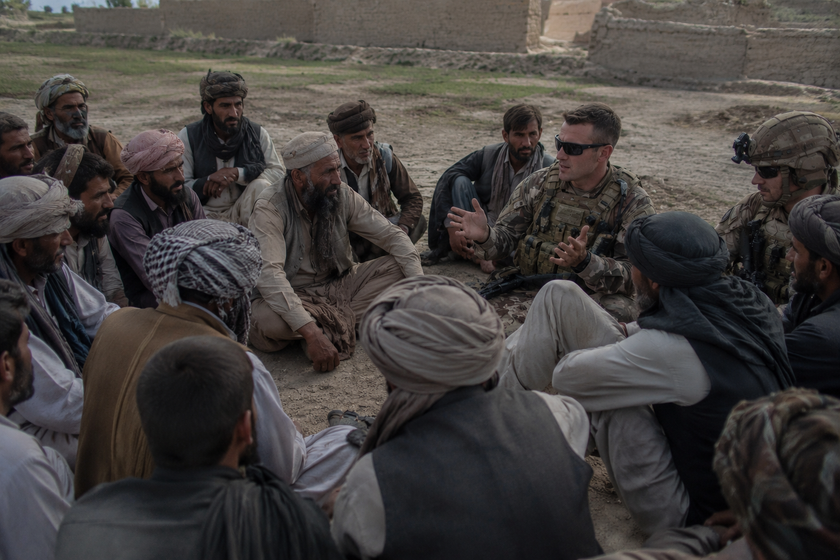
The second SOF Trinity describes SOF's comparative advantages: influence, governance, and support to indigenous forces and populations. These capabilities distinguish SOF from conventional military formations. They are not centered on advanced technology or specialized equipment. They derive from understanding human systems, building trusted relationships, operating within complex political environments, and working effectively through local actors and must be applied across the entire spectrum of conflict from irregular warfare in strategic competition to LSCO to post-conflict stability operations.
Through, With, and By
The essence of special warfare is captured by the phrase "through, with, and by" that was first recognized by the late COL Mark Boyatt. This concept recognizes that enduring political outcomes must ultimately be achieved by the people directly affected. External actors can advise, assist, enable, and accompany. They cannot permanently substitute for local legitimacy and local ownership.
This principle is reflected in the Special Forces motto De Oppresso Liber. While commonly translated as "To Free the Oppressed," a better operational interpretation may be "To Help the Oppressed Free Themselves." The difference is important. It emphasizes empowerment rather than dependency and partnership rather than control.
Grievances, Narrative, and Mobilization
Understanding revolution, resistance, insurgency, terrorism, and civil war is essential to irregular warfare. These phenomena form the ecosystem in which SOF most naturally operate. They are recurring features of human conflict, not historical anomalies. They are driven by grievances, perceptions of injustice, political aspirations, and struggles over legitimacy.
Successful revolutionaries, insurgents, and resistance leaders often exploit "exaggerated grievances communicated well." The grievances may be real, partially real, distorted, or fabricated. What matters is not only their objective validity but their political resonance. The revolutionary understands narrative. The insurgent understands identity. The resistance leader understands legitimacy.
Influence as the Decisive Capability
Influence is not an adjunct to strategy. It is central to strategy. Every action communicates. Every policy sends a signal. Every military operation shapes perception. In political warfare, the psychological dimension often precedes and shapes the kinetic dimension.
The United States often treats influence as a supporting function. Many adversaries treat it as the main effort. That difference matters. Tactical success without influence may not produce strategic success. Military superiority without legitimacy may not produce political victory.
Creating Dilemmas Rather Than Seeking Symmetry
A dilemma forces an adversary to choose among unfavorable options. This is the essence of strategic leverage. Irregular and unconventional warfare do not seek symmetry. They seek asymmetry. They do not attack only forces. They attack strategies, assumptions, relationships, legitimacy, and will.
This is why irregular, unconventional, and political warfare often win through exhaustion rather than maneuver or attrition. They erode the adversary's ability to sustain a course of action. They complicate decision-making. They stretch resources. They impose political costs. They make continuation harder than adaptation.
Implications for Strategic Competition
Strategic competition is not a temporary condition. It is the normal condition of international politics. The United States must remain prepared for conventional war, but it must also become more proficient in political warfare and irregular warfare. The most dangerous threat may be state-on-state war, but the most likely contest is political warfare below the threshold of war.
The question is not whether America will participate in irregular, unconventional, and political warfare. It already is. The real question is whether it will do so deliberately, coherently, and strategically.
Conclusion: Irregular Warfare Thinking
The essence of irregular, unconventional, and political warfare is not violence. It is strategy. It is the application of influence, governance, indigenous capability, and political understanding, and when appropriate, violence, to solve complex political-military problems and create dilemmas for adversaries.
The side that best understands people, legitimacy, grievances, and influence will hold a decisive advantage. The side that can integrate irregular warfare, unconventional warfare, and political warfare into coherent campaigns will be best positioned not merely to fight wars, but to achieve lasting political outcomes.
David Maxwell, executive director of the Korea Regional Review, is a retired U.S. Army Special Forces colonel who has spent more than 30 years in the Asia-Indo-Pacific region. He specializes in Northeast Asian security affairs and irregular, unconventional and political warfare. He is vice president of the Center for Asia Pacific Strategy and a senior fellow at the Global Peace Foundation, where he works on a free and unified Korea. After he retired, he became associate director of the Security Studies Program at Georgetown University. He is on the board of directors of the Committee for Human Rights in North Korea and the OSS Society and is the editor at large for the Small Wars Journal.