Those who want to see US performance improve in execution of population influence campaigns would do well to read The American Way of Irregular War: An Analytic Memoir by retired General Charles Cleveland, with research and cowriting from Daniel Egel. According to the authors, these Population-Centric Conflicts, or PCCs, can occur in political, economic, information, intelligence, and legal realms, and stand in stark contrast to conventional wars between states, which focus on controlling and holding territory using military forces. Cleveland served 37 years in the US Army, primarily in Special Forces, concluding his career by commanding US Army Special Operations Command. By Cleveland’s account, the book emerged from reflection on his career, which led him to conclude that, “… from 1978 to 2015, the United States failed to achieve its strategic objectives in nearly every military campaign in which [he] was involved.”
Cleveland identifies several reasons for these failures through observations about US performance in irregular warfare, or IW, over the course of his career. Central to his critique is his observation that there is no proponent for IW across the US interagency. This observation drives recommendations for congressional review and a call for concerned US citizens to “establish an institution outside government dedicated to understanding American irregular warfare.” To Cleveland, both legislative and public pressure would fuel a change that he describes with his most explicit recommendation: to “reorganize the Executive branch around the security challenges of the 21st century.”
He outlines three options for creating an IW proponent to develop the “concepts, doctrine and canon” required to achieve greater success in PCCs. The first option: create a Cabinet-level organization modeled after the Office of Strategic Services of World War II fame. This organization would have the access and placement within the Executive branch necessary to influence the development of a US whole-of-government campaign for a given PCC. This proposal would therefore maximize the ability of the United States to achieve foreign policy goals by improving interoperability and internal coordination. If this proves untenable, his secondary proposal is to create a separate service within the Department of Defense, designed and built for IW. This would either be a new service, or a smaller service that has a subsidiary relationship with the Army, just as the Marine Corps has with the Navy. His third proposal is to divide US Special Operations Command into two separate four-star commands: one for surgical strike focused on counterterrorism and crisis response, and one for IW focused on these population-centric conflicts.
Cleveland relies on his wide-ranging experience within special operations to form these conclusions. He describes an early deployment to Bolivia to demonstrate the need for an IW proponent, recounting how the lead US Army commander in South America expressed skepticism about the ability of the Department of Defense to win an “inherently unwinnable” counterdrug mission in Bolivia. And indeed, it is difficult to see how combined arms warfare alone could achieve a military “win” for such a campaign. Cleveland suggests that a more mature and fully developed IW doctrine would be able to describe what “winning” and “losing” look like and identify potential whole-of-government campaigns within that constrained civilian environment. This conflict thus was not about dominating territory with military power, but instead about persuading, as frugally and non-violently as possible, a host nation population to reduce the amount of coca produced over extended periods of time.
The book also shows how the absence of an IW proponent is felt in missed opportunities for coordination and interoperability between different US agencies, departments, and services. Referring to his experience in Bolivia once again, Cleveland describes the fractured efforts of the US country team, and how ultimately the Ambassador and the Drug Enforcement Agency were kicked out of the country in 2008 and coca production was legalized, despite substantial amounts of US aid and training. Ideally, a dedicated proponent for IW would have been able to do a better job understanding the challenges and constraints of the local environment, help craft a cost-effective counterdrug strategy, and then aid the country team in a whole-of-government IW effort.
Building on these observations, Cleveland illustrates how the US has struggled in past PCCs to understand the local environment and develop and implement effective campaign plans to create enduring IW effects. Leaning on his experience in Iraq, Cleveland notes that the US struggled to make good policy decisions when confronted with an IW environment like the transition from conventional war to post-Baathist government in Iraq in 2003. He specifically calls out the disastrous US edict to dissolve the Iraqi Army without immediately rebuilding it. This edict created an unemployed population of proud and angry Iraqi soldiers who had lost their economic livelihood and now had powerful reasons to develop a violent insurgency against the coalition presence. An Executive Branch IW proponent would help create sensible campaigns and strategies to avoid such unnecessarily harmful outcomes, Cleveland argues.
Without proponent and mature doctrine, the US military has sometimes gotten in its own way during IW missions, Cleveland writes. He contrasts the US Special Forces' four-month deployment cycle in Bosnia during the 1990s with the more consistent British deployment strategy. These four-month deployments meant that, three times a year, a new US Special Forces commander and unit would arrive largely ignorant of local on-the-ground realities, with a new view of the mission. That unit would then depart at the four-month mark, just as it was starting to understand the local situation and able to operate effectively with other entities and host nation authorities. By contrast, the British had a single commander to provide continuity of effort for this IW mission as units cycled through over a much longer period.
This reviewer observed one period in Afghanistan from 2010 to 2011 in which US Special Forces deliberately coordinated to deploy units back to locations in which they’d already served in order to reduce this “turbulence” and loss of local knowledge. This effort had a profoundly positive effect on US performance, especially for teams conducting the population-centric effort to build local police and governance structures through village stability operations. An IW proponent would help identify and eliminate problems such as lack of continuity in command and deployment patterns that compromise performance.
Cleveland might have strengthened his book by noting prior US successes in PCCs and diagnosing the sources of these successes. El Salvador, where Cleveland deployed several times in the late 1980s to thwart a Soviet-sponsored insurgency, is widely considered a US IW success. American efforts there helped curb and reform governmental abuses and provided sufficient time to develop and implement a political solution that dissolved the insurgency. Cleveland does note this success, but he qualifies it by arguing that the US underestimated both the amount of time and money required for that success: 12 years instead of five, and $6 billion instead of $300 million. The real motivations of the insurgents also eluded American officials, who were surprised when the insurgents agreed to the peace settlement. Cleveland concludes that El Salvador was “strategic success by accident,” lauding a congressional ceiling on the US troop footprint, which forced the host nation to resolve the conflict politically. He might have drawn a parallel here with his own experience while serving as the commander of US Special Operations Command – South during Plan Colombia, where similar congressional limitations minimized a direct US military role and encouraged political reconciliation between the Colombian government and insurgent groups. Instead, this section of his memoir focuses on hostage rescue missions and the effort to create three different IW campaign plans in South America and thus misses an opportunity to reflect on how long-term SOF engagement through Plan Colombia achieved US strategic goals in the country.
This book is intended to spur critical reflection, and then eventually improvement, in the performance of the United States in IW environments. The United States has faced significant challenges over the last 40 years in areas including stability operations, counterdrug campaigns, counterinsurgency, and counterterrorism. Conflict and competition below the threshold of declared war to influence populations will continue to be critically important to our foreign policy and national defense. Members of Congress, commanders, policy makers, and interested civilians should take this book’s recommendations to heart to begin the process of improving the American way of irregular war.
Master Sgt. Brian Nau is a Special Forces Intelligence Sergeant. He has an economics degree from the University of Puget Sound and a Master of Arts degree from American Military University. He has served in Special Forces for 12 years, including a full decade at 1st Special Forces Group, deploying nine times with six combat deployments to Iraq, the Philippines, and Afghanistan. He is completing a manuscript entitled, "The Tale of Two Strategies: Improving the Performance of the U.S. Government in Unstable Places."
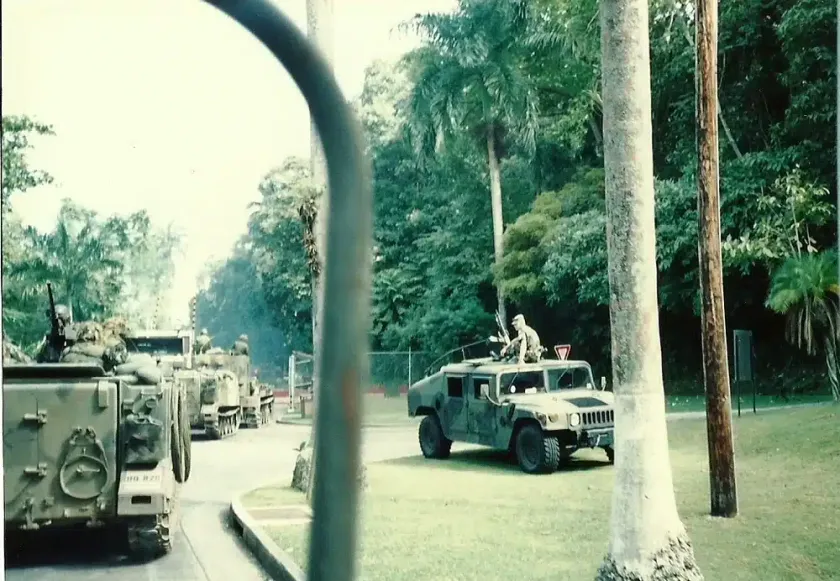
Main image: U.S. Army M113 armored personnel carriers travel on a road in Panama during Operation Just Cause in December 1989. The invasion of Panama began Dec. 20, 1989 when U.S. military forces were called to remove the regime of Manuel Noriega in Panama. (Military archive photo.)