The debate over the future of U.S. Army Special Forces (SF) has increasingly become a debate about its past. Critics argue that decades of counterterrorism, security force assistance, and persistent global engagement have pulled the Special Forces Regiment away from its unconventional warfare roots. Defenders contend those same missions demonstrate its continued strategic relevance. Both perspectives ask whether Special Forces has remained faithful to its origins.
That is an understandable question. But it is also an incomplete one. Military organizations evolve as political priorities, strategic environments, and institutional incentives change. The more useful question is not whether Special Forces remained unchanged, but how sustained strategic demand reshaped what the institution came to value.
This distinction matters because much of the current debate implicitly compares today's force to an idealized version of its Cold War predecessor. Such comparisons often assume that organizational change necessarily reflects institutional decline. Yet high operational demand and institutional drift are often related. Persistent strategic demand may itself reshape an institution by rewarding some competencies, identities, and organizational practices while marginalizing others. The more useful question is therefore not whether Special Forces has remained unchanged, but how decades of strategic utility have transformed the organization itself.
The evolution of Special Forces is best understood through the interaction of strategic demand, bureaucratic incentives, and organizational identity. The force did not simply drift from its original purpose through institutional negligence or cultural decay. Rather, repeated operational demand reinforced particular ways of employing Special Forces while gradually reshaping what the institution understood itself to be. As organizations repeatedly perform certain functions—and are rewarded for doing so—those functions increasingly become their identity.
The Myth of Strategic Purity
Like many elite military organizations, Special Forces has developed a narrative of an earlier era in which its mission appeared clearer and its institutional identity less contested. Such narratives reinforce professional identity, but they also simplify history. As Alfred H. Paddock Jr. demonstrates, Special Forces emerged within the broader concept of special warfare, an approach that integrated unconventional warfare, psychological operations, and political action in support of national objectives rather than treating them as separate enterprises. The Regiment's comparative advantage was never simply infiltration into denied territory. It lay in its ability to operate through indigenous populations, cultivate legitimacy, and influence political environments as much as military ones.
This distinction is important. Even during the Cold War, Special Forces was designed less for independent action deep inside the Soviet Union than for supporting resistance movements in occupied or contested regions. Human access—not geographic penetration—defined its strategic value. Vietnam further reinforced this pattern. Whether advising the Civilian Irregular Defense Group (CIDG), building indigenous networks, or operating alongside local partners, Green Berets worked through political relationships as much as military capabilities.
Recognizing this history does not invalidate contemporary criticism. It does, however, complicate it. The issue is not whether Special Forces possessed a distinctive unconventional warfare identity—it clearly did—but whether that identity can be understood apart from the political purposes it was always intended to serve. Like other military organizations, from its inception, Special Forces existed at the intersection of military capability and political utility. What changed after September 11 was not the existence of that relationship, but the scale and persistence of the demand placed upon it.
Utility and Organizational Meaning
Special Forces did not become globally employed because it failed. It became globally employed because successive administrations found it strategically useful. Following the attacks of September 11, policymakers increasingly sought military options that could achieve political objectives without the costs associated with large conventional deployments. Geographic Combatant Commands demanded forces capable of persistent engagement, regional expertise, and scalable presence. Theater Special Operations Commands emerged not as the cause of this demand, but as institutional mechanisms for managing it.
Special Forces proved uniquely suited to this environment. Its small footprint, decentralized leadership, language capabilities, and ability to work through indigenous partners provided policymakers with flexible options across a broad spectrum of competition. These attributes made the force increasingly valuable in an era defined by counterterrorism, security cooperation, and competition below the threshold of conventional war.
Yet strategic utility carries institutional consequences. Organizations are shaped not only by what they are designed to do but by what they are repeatedly rewarded for doing. As Clifford Geertz observed, institutions create webs of meaning that shape how members understand their roles, while Edgar Schein argues that organizational cultures emerge through repeated patterns of successful adaptation. Over time, activities associated with institutional success become embedded in organizational identity.
Recent research on U.S. Special Operations Command suggests that this process is reinforced through bureaucratic feedback. Cole Livieratos argues that operational activities generate different forms of political and institutional reinforcement depending upon how policymakers perceive their appropriateness and effectiveness. Capabilities that receive consistent positive feedback acquire resources, influence, and organizational prestige, while others gradually become marginalized. Path dependence is therefore not simply about mission selection; it is about institutional identity.
This perspective helps explain what I’ve previously described as meaning creep. The issue is not simply that Special Forces accepted additional missions. Rather, the institutional meaning of success gradually changed. Metrics such as deployments completed, partner engagements conducted, or immediate operational outputs became easier to quantify (and easier to game—see Goodhart’s Law) than long-term political influence, resistance cultivation, or strategic shaping operations below the threshold of armed conflict. As in many modern institutions, what could be measured increasingly displaced what mattered most.
As James Q. Wilson observed, organizations gravitate toward activities whose outputs are visible and demonstrable. Military institutions are no exception. But this doesn’t mean that critics like Ned Marsh are entirely wrong. Many argue that sustained operational demand contributed to institutional drift, and there is considerable merit to that concern. Persistent employment may simultaneously demonstrate an organization's value while reshaping the capabilities it privileges. Strategic demand and institutional distortion are therefore not competing explanations but complementary ones. The more useful question is not whether Special Forces evolved, but how repeated patterns of employment transformed what the institution came to value.
Political Demand and Strategic Relevance
Many activities now criticized as distractions from the unconventional warfare mission emerged directly from broader shifts in American strategy rather than from internal organizational preference. Security cooperation, theater campaigning, partner-force development, and persistent regional engagement reflected successive administrations' desire to compete globally while limiting the political and financial costs of large-scale military intervention. In this environment, Special Forces became an increasingly attractive instrument of statecraft.
Special Forces became a victim not of irrelevance but of relevance. Its expanding role reflected strategic demand more than institutional ambition. Policymakers repeatedly turned to Special Forces because it offered capabilities conventional forces could not easily provide: persistent access, political flexibility, regional expertise, and the ability to operate through local partners. The force's growing employment therefore tells us as much about American strategic preferences as it does about the organization itself.
At the same time, critics correctly note that organizational usefulness can produce unintended consequences. Increased demand does not guarantee strategic effectiveness, nor does it ensure that a force retains the competencies that initially made it valuable. The post-9/11 experience demonstrates that organizations can become indispensable while simultaneously narrowing the range of capabilities they routinely exercise. As Livieratos argues, repeated institutional feedback can privilege some forms of military activity over others, reinforcing patterns of employment that become increasingly difficult to reverse.
This distinction is important because it shifts the debate away from questions of institutional virtue. The rise of Theater Special Operations Commands did not inherently corrupt Special Forces, nor did persistent global employment inevitably erode its unconventional warfare capabilities. Rather, both reflected broader strategic choices about how the United States preferred to compete below the threshold of conventional war. Whether those choices ultimately strengthened or weakened Special Forces remains open to debate. What should be less controversial is that the organization evolved in response to sustained external demand as much as internal preference.
The irony is that many of the same characteristics critics argue Special Forces abandoned—political sensitivity, decentralized leadership, cultural fluency, and long-term engagement—were precisely the qualities that made it attractive to policymakers in the first place. The issue, then, is not whether the force lost its identity, but whether the institutional incentives surrounding its employment gradually redefined what that identity meant in practice.
That distinction leads to the more important question. If today's strategic environment differs fundamentally from the one that produced the post-9/11 force, what kind of irregular warfare organization should the United States build for the future?
Designing an Irregular Warfare Force for Contemporary Competition
The preceding discussion raises a more consequential question than whether Special Forces has remained faithful to its historical identity. If the United States were designing an irregular warfare force today, would it build the same organization inherited from the Cold War?
The answer is almost certainly no. This is not because the traditional strengths of Special Forces have become obsolete. On the contrary, language proficiency, regional expertise, decentralized leadership, and the ability to work through indigenous partners remain indispensable. If anything, strategic competition has increased the value of those competencies.
What has changed is the environment in which those competencies must operate.
Contemporary competition increasingly unfolds across political, informational, cyber, economic, and proxy domains simultaneously. As Michael Mazarr argues, states now pursue strategic objectives through persistent competition below the threshold of conventional war, relying on influence, ambiguity, and incremental advantage rather than decisive military campaigns. Human networks remain central, but they now intersect with digital ecosystems, transnational information flows, cyber operations, and contested narratives of legitimacy.
An irregular warfare force designed for this environment would therefore require more than excellence in unconventional warfare alone. It would need to integrate influence, information, cyber, civil affairs, and partner-force development as mutually reinforcing components of political competition rather than as adjacent specialties organized around separate institutional communities. George Kennan's conception of political warfare—a coordinated use instruments short of war—provides a more appropriate framework than one centered on episodic military employment.
Yet force design is never simply a question of capabilities, but also a question of institutions. As discussed above, these institutional feedback mechanisms reinforce patterns of employment that become increasingly difficult to reverse. New structures alone cannot preserve competencies if evaluation systems, promotion pathways, and operational demand consistently reward different behaviors. Institutions eventually become what they repeatedly recognize as success. For that reason, future irregular warfare reform requires more than redesigning organizations. It requires reconsidering how success itself is defined.
Nostalgia is Not Force Design
Military institutions inherit stories about themselves. Those stories shape identity and purpose, but they can also become constraints when inherited narratives substitute for strategic analysis. Much of the contemporary debate assumes that the central challenge is recovering an earlier identity rooted in unconventional warfare. That perspective captures an important truth: the Regiment's historical strengths remain deeply relevant. Yet it risks overlooking an equally important reality. Organizations are not shaped solely by their origins. They are also shaped by decades of strategic demand, political incentives, and institutional adaptation.
Seen from this perspective, the post-9/11 evolution of Special Forces reflects neither simple institutional decline nor uncomplicated success. It reflects the cumulative consequences of being repeatedly employed because the organization proved exceptionally useful. Strategic utility altered organizational identity—not because leaders abandoned core values, but because repeated patterns of employment gradually redefined what counted as institutional success.
This is why debates over whether Special Forces has "lost its way" are ultimately incomplete. They ask whether the organization remains faithful to a historical ideal without first considering whether that ideal reflects the strategic environment of today. The more important question is not whether Special Forces resembles the force envisioned in 1952. It is whether the United States requires a force capable of competing through human relationships, political influence, legitimacy, and indigenous partnership in an era of persistent competition.
History provides military institutions with purpose. It does not provide them with blueprints. Every generation inherits organizations designed to solve the strategic problems of another era, and every generation must decide what deserves preservation and what demands adaptation.
The debate over Special Forces is therefore larger than Special Forces itself. It is a debate about how military organizations evolve under sustained strategic demand and whether institutions can remain faithful to enduring purposes while adapting to changing strategic realities.
Force design should begin not with nostalgia, but with strategy. Everything else follows from that choice.
Siamak Tundra Naficy is a Senior Lecturer in the Department of Defense Analysis at the Naval Postgraduate School. An anthropologist by training, he brings an interdisciplinary perspective to the study of strategic culture, conflict resilience, and the human dimensions of security. He has published in the Small Wars Journal (SWJ), Joint Special Operations University (JSOU), Modern War Institute (MWI), War on the Rocks, Responsible Statecraft, RealClearDefense, and elsewhere. The views expressed are his own and do not represent those of the Department of Defense, the U.S. Navy, the U.S. Army, or the Naval Postgraduate School.
The views expressed are those of the author and do not reflect the official position of the Irregular Warfare Initiative, Princeton University’s Empirical Studies of Conflict Project, the Modern War Institute at West Point, Department of the Army, Department of War, or the United States Government.
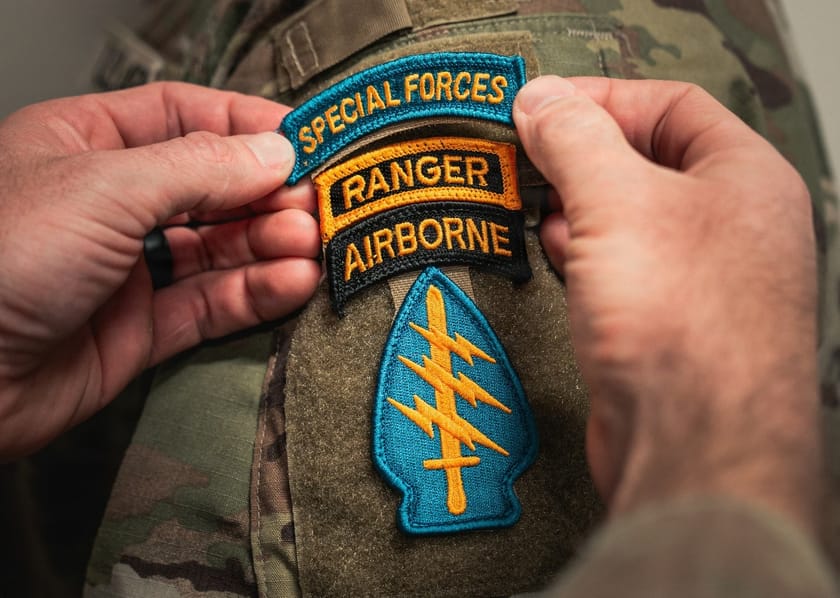
Main image is a soldier being awarded the Special Forces tab taken from DVIDS
If you value reading the Irregular Warfare Initiative, please consider supporting our work. And for the best gear, check out the IWI store for mugs, coasters, apparel, and other items.