Physicists can’t agree on what time is. In a December 2025 article for BBC Science Focus, theoretical physicist Jim Al-Khalili described three definitions of time that do not work together. In equations that describe motion and decay, time is coordinate time. It’s a mathematical label with an assigned value. In Einstein's theory of relativity, time is a fourth dimension of spacetime. There, past, present, and future all exist and are equally real, just like every point in space is. In thermodynamics, time is a direction. It represents an arrow pointing toward increasing entropy. It’s where ice melts, and balls roll downhill. Interestingly, every fundamental equation in physics still works if time runs backward. Al-Khalili calls this conflict between time as a quantum parameter and time as a relativistic dimension “the first problem of physical time.” The second conflict is between reversible equations and irreversible experience.
The proposed solutions to these problems are stranger than the problems themselves. In 1967, John Wheeler and Bryce DeWitt wrote an equation for the quantum state of the entire universe that contains no time variable at all. In 1983, Don Page and William Wootters suggested recovering time through quantum entanglement. Their idea was to divide a timeless universe into a clock and everything else. An observer who was inside “everything else” experiences time passing as they read the clock. But from outside the universe nothing flows. When quantum superposition meets relativity, the causal order between two events can no longer be fixed. This opens a debate over retrocausality, the idea that the future can act on the past. Al-Khalili suggests that time may turn out to be several things at once, each with different properties depending on how one uses it.
Quantum gravity does not explain insurgency. Anyone who uses entanglement to make claims about human cognition has made a category error. But the physicists' problem discussed above does raise a question that irregular warfare practitioners neglect. Our influence models treat political time as a sequence: an event occurs, messages compete to explain it, perceptions form, people intervene, attitudes shift, and behavior follows. The issue is that populations do not actually experience conflict like this, despite our models. People remember the past, interpret the present, and project the future at the same time. The simultaneity of past, present, and future time inside an individual’s or a group’s brain, which projects what they will do next, is extremely important. In fact, it is the most important lesson to be learned from this entire paper.
What does this mean in real-life terms? Consider this scenario. In August 2022, after then-Speaker of the House Nancy Pelosi visited Taipei, the People's Liberation Army (PLA) surrounded the island of Taiwan with live-fire drills. Since then, Beijing has run named exercises at various intervals, including Joint Sword-2024A in May 2024, Joint Sword-2024B in October 2024, and Strait Thunder-2025A in April 2025. Each one of these exercises produces observable facts. Ships deploy, aircraft cross the median line, and Taiwan’s Ministry of National Defense publishes a record of the events to the world.
The citizens of Taiwan do not receive these facts in isolation. An older resident may see the drill through the lens of the 1995–96 Taiwan Strait Crisis. At that time, the PLA fired missiles into waters off Keelung and Kaohsiung, and Washington sent two carrier battle groups to the region. Others may place the current drills in the context of the Chinese Civil War, the lifting of martial law in 1987, or their own family's crossing of the Strait. Younger Taiwanese, raised after democratization, read the same drill through a different set of memories. Every one of these citizens watched the same PLA exercise. Each brought a different past to it, and that past shapes what each will do next.
The PLA exercise should force us to ask what the drill is: routine signaling, rehearsal for a blockade, rehearsal for an invasion, or dramatic theater for a domestic audience back in Beijing. After that should come a question that drives behavior: what happens next? One citizen concludes that each exercise brings an actual attack closer. Another concludes that Beijing has run these drills repeatedly without attacking and will continue to do so. The event is the same for both of these people. The trajectory each person operationalizes is different.
Influence is competition over this trajectory. Memory supplies the past, interpretation supplies the present, and expectation supplies the future. Together, these things produce a judgment about where events are heading. In irregular warfare, this judgment carries more weight than the number of Freedom of Navigation Operations (FONOPs) sent through the Strait each year.
Now imagine two actors in a contested district. One holds 80 percent of the effective power but appears to be losing ground. The other holds 20 percent and appears to be gaining. A villager deciding whether to inform, supply, hide, resist, or hedge will not base her decision on the current 80–20 split. She will ask who controls the district six months from now. Helping the resistance is dangerous for her if the government survives. Helping the occupier is dangerous for her if the resistance wins. Neutrality is equally dangerous for her the moment either side demands commitment. Waiting becomes a dangerous political act. She will act on what she believes will be true. A saying often attributed to Taliban fighters, “You have the watches, but we have the time,” compresses the whole problem quite fittingly.
Afghanistan in 2021 provides clear evidence of this trajectory. The Special Inspector General for Afghanistan Reconstruction (SIGAR) found that the single most important factor in the collapse of the Afghan National Defense and Security Forces (ANDSF) was, “the U.S. decision to withdraw military forces and contractors from Afghanistan through signing the U.S.-Taliban agreement in February 2020 under the Trump administration, followed by President Biden’s withdrawal announcement in April 2021.” Afghan commanders told SIGAR that after Doha, soldiers went into survival mode and became open to other deals on the ground They knew at that moment they were not the winners. For them, proof of this was real and immediate. U.S. airstrikes fell from 7,423 in 2019 to 1,631 in 2020. By August 15, 2021, when the Taliban entered Kabul, the question of who owned the future had already been determined in thousands of individual calculations. For the majority of these soldiers, local deals, surrenders, and abandoned posts followed quickly.
Interestingly, expectations about the future may also rewrite the past, which in turn affects the new future, and the cycle continues. Al-Khalili's discussion of retro causality is in physics, so it is useful here as an analogy only. Still, a helpful cognitive version exists. In our next scenario, China runs a large exercise in 2027, and nothing follows. If an attack comes in 2029, Taiwanese citizens will remember the 2027 drill as preparation they failed to recognize. If relations improve instead, they will remember it as another act of coercion that went nowhere. The event itself does not change, but its meaning does. Victories look inevitable only after they happen. Defeats cause us to look backward and see all of those warning signs that “should have been obvious.” With this in mind, political violence gets remembered as crime or as resistance, depending on who wins. Competition over the future is therefore also competition over the meaning of the past to those with a stake in the game.
The ongoing conflict in Burma demonstrates this idea from two different sides of the same temporal coin. On October 27, 2023, the Three Brotherhood Alliance, made up of the Myanmar National Democratic Alliance Army (MNDAA), the Ta'ang National Liberation Army (TNLA), and the Arakan Army (AA), launched Operation 1027 in northern Shan State. In August 2024, the MNDAA captured Lashio along with the Myanmar junta’s Northeastern Regional Military Command headquarters. For the first time since the 2021 coup, a regional military command had fallen. This event changed how people inside and outside Burma judged the conflict’s trajectory. Defections rose, diaspora support grew, and foreign governments began to question the junta's chances of survival. Then Beijing intervened.
China brokered talks in Kunming in January 2025. Under Chinese pressure, the MNDAA agreed to withdraw from Lashio. Junta forces re-entered the city on April 22, 2025. They did so without a fight, alongside a Chinese ceasefire monitoring team. The junta did not recapture the city by force. What changed on the ground was the population's estimate of what the resistance could hold once Beijing intervened. The August 2024 capture of the city by the resistance now carries two different meanings, depending on the observer. Some will see it as the furthest the resistance ever advanced before it began losing ground. Others will see it as proof that the regime can be broken. As of this writing, the war continues, and the prevailing meaning depends on what happens next.
Occupation and resistance are contests over the definition of time. The occupier’s message is that the war is over, the old order is gone, resistance is futile, and the new government structure is the only legitimate one. The resistance, on the other hand, reinforces the narrative that the fight continues, that the occupation is temporary and illegitimate, and that the political future remains open. This explains why an occupier can hold every conventional measure of power, including ministries, ports, airports, telecommunications, police stations, and major cities, and still be politically insecure. A resistance movement with almost none of those assets can remain strategically relevant, because controlling the present does not mean controlling the expected future.
Momentum follows the same logic. It can exist in people's minds before it exists on the ground. Consider a resistance movement that survives its first year. Or, in the case of Ukraine in 2022, its first two weeks. The resistance conducts an operation, then another; it issues messages, absorbs a second armed group, and begins drawing attention from foreign governments. No single event so far threatens the occupying force, but the sequence does. Once people conclude that the movement is growing, they act on that belief before any actual growth has occurred. More people decide to pass intelligence to the resistance. Fence-sitters start hedging their bets. Collaborators reconsider their positions and what those positions mean to their grandchildren. Diaspora communities send more money, foreign volunteers appear, and governments around the world reassess whether the movement is viable. The perception of momentum produces momentum. The reverse also holds. A side that remains dominant but suffers a string of visible setbacks can trigger a spiral of expected decline that accelerates its actual decline.
This temporal congruence matters for cognitive warfare because a population's sense of time should be part of the targeting process. An actor can manipulate the past through selective history, grievance narratives, and the erasure of inconvenient events. It can manipulate the present through censorship, disinformation, saturation, and framing. It can manipulate the future through threats, promises, displays of resolve, and manufactured inevitability. None of these things work sequentially. They form a causal loop in which memory shapes interpretation, interpretation shapes expectation, and expectation reshapes memory. Behavior comes out of all three at the same time. This also means that intervening at different nodes in the causal loop can alter its trajectory.
All things considered so far, the concept of inevitability becomes a most powerful weapon. Political actors work hard to convince populations that history has already chosen a winner. Depending on which side is influencing, the message may be that reunification is historically inevitable, or the Americans will leave, the international community will abandon you, the occupation cannot last, the occupier will never represent the legitimate government, or the revolution cannot be stopped. These are statements about the inevitable future, but their purpose is to change behavior today. A population convinced that an outcome is coming tomorrow will start accommodating it now. This makes beliefs about the future a source of present-day power. Beijing's message to Taiwan today relies heavily on this concept, like the Taliban’s message to Afghan soldiers after Doha.
For security practitioners, this fundamentally changes what influence assessments should measure. Checking whether a target audience received or believed a message is insufficient. Instead, assessments must capture the population’s perceived trajectory. This is easier said than done, but there are some starting questions to help paint the right picture. What does the population believe happened? What does it believe is happening now? What does it expect next? Which actors does it see as gaining or losing strength? Which conditions does it treat as temporary, and which as permanent? Which outcome does it consider inevitable? This is all meant to determine which side it believes owns the future. Polling and sentiment analysis that capture only current approval of a government, or current fear of an adversary, for example, will miss the variable that drives future defections, collaboration, and resistance.
Military planners think in terms of physical terrain and, increasingly, in human, informational, and cognitive terrain. We must add temporal terrain to the matrix. This does not mean physical time in Al-Khalili's sense. It means the socially constructed relationship among a population's collective memory, its reading of the present, and its expected future. Controlling temporal terrain means shaping where a population believes it has been, where it stands now, and where events are carrying it. Time - in this very special sense - is a strategic resource that every party fights over, or should be fighting over if it hopes to prevail.
Al-Khalili suggests that time may be several things at once, with properties that depend on how it is understood. Populations experience political time in a comparable way. Political time is a remembered past, an interpreted present, and an imagined future held simultaneously. The trajectory those three produce helps decide whether people resist, collaborate, accommodate, hedge, flee, wait, or fight. Controlling what a population believes about the present is power. Convincing it that your side represents the future is exponentially greater power.
Disclaimer: The views expressed here are the author’s alone and do not reflect the official policy or position of the U.S. Government or the Department of War.
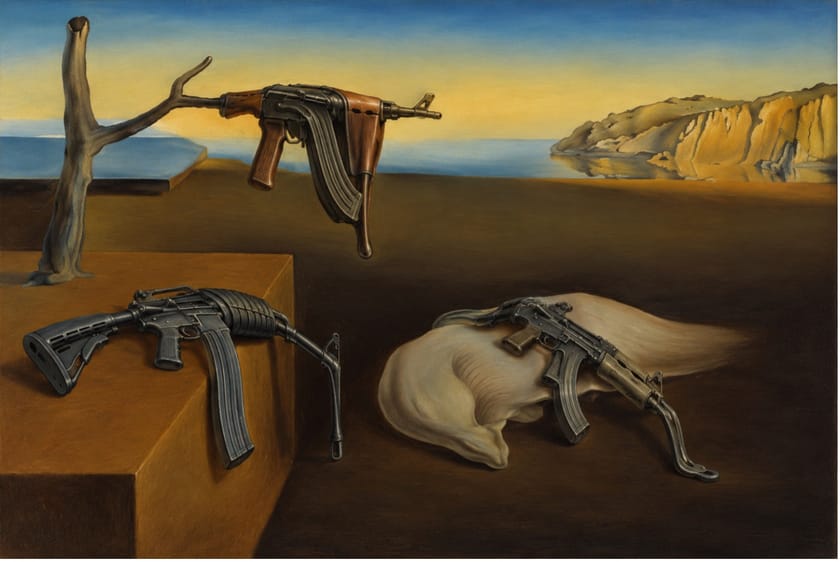
Cover graphic created by ChatGPT.
Jeremiah “Lumpy” Lumbaca, PhD, is a retired US Army Green Beret officer and current professor of irregular warfare, counterterrorism, resistance, and special operations with the Department of War. He is a 2026 Non-Resident Fellow with the Irregular Warfare Initiative (IWI) in partnership with Princeton’s Empirical Studies of Conflict Project and the Modern War Institute (MWI) at West Point. Lumpy can be found on X/Twitter @LumpyAsia