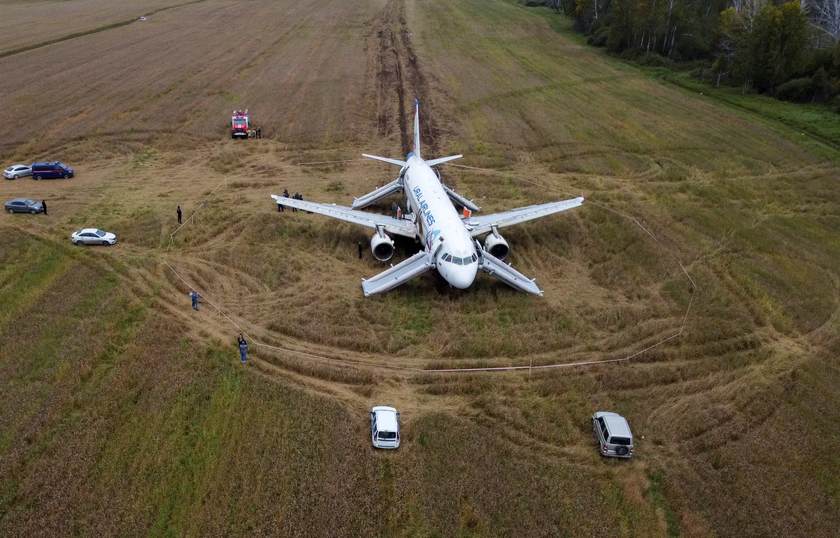
When a Russian Airbus A320 made an emergency landing in a Siberian wheat field in 2023, it provided a striking visual of aerospace sanctions in practice. Ural Airlines publicly attributed the incident to a hydraulic failure, but the driver was likely crippling aerospace sanctions. Western sanctions choked off the flow of replacement parts and certified maintenance to Russia’s commercial fleet, leaving operators dependent on the grey-market. Over time, aviation sanctions compound as spare parts go out of stock, inspections go overdue, and economic connectivity falters.
Take the case of Iran. Decades of sanctions resulted in the fatal May 2024 helicopter crash that killed Iranian President Ebrahim Raisi. This case illustrates the ultimate cost of long-term material denial. Raisi was flying in a US made Bell 212 from the Shah era. Decades of American sanctions severed Iran’s access to manufacturer support, technical manuals, and supply chains. Whether forcing an airliner into a wheat field or grounding state leaders, aerospace restrictions demonstrate a fundamental geopolitical reality: denying material and legal access in the skies directly erodes a nation's national power and internal stability.
The aerospace sector is widely viewed as a national crown jewel. Aerospace serves not just as a symbol of technological prestige, but as the primary engine for global economic integration. Air transport supports $4.1 trillion in economic activity and carries more than a third of all international trade by value. The sector is a vital gateway for foreign direct investment, tourism, and high-value supply chains. Because a nation's broader productivity is so deeply tethered to this connectivity, disrupting its ability to maintain a functional fleet can hit harder than other forms of sanctions.
Supply Chain & Regulatory Leverage
This systemic vulnerability stems from the extreme concentration of global aerospace manufacturing and regulatory authority. A modern commercial jet requires approximately 2.3 million individual parts and tens of thousands of highly specialized components. These are primarily produced in the United States, France, Germany, and the United Kingdom. While adversaries can manufacture basic airframe elements, building high-performance turbofan engines or advanced flight-control systems remains virtually impossible without Western technology. Without access to these suppliers, targeted states are forced to ground their fleets or operate under the compounding risk of using uncertified parts.
This physical supply bottleneck is reinforced by a legal and regulatory framework that dictates global airspace access. At the top sits the International Civil Aviation Organization (ICAO), the UN agency that establishes baseline global aviation standards under the Chicago Convention. However, the operational teeth of this system belong to key Western regulatory bodies like the US Federal Aviation Administration (FAA) and the European Union Aviation Safety Agency (EASA). Because more than a hundred countries directly align their national regulations with FAA and EASA, compliance with these Western agencies is effectively required for international flight. As a result, Western regulators hold structural authority over which aircraft are deemed airworthy and permitted to fly across global airspace.
Statecraft Around the World
The decades-long trajectory of Iran Air’s Boeing 747 fleet offers a vivid case study in how sustained sanctions freeze technological progress and force risky operational improvisation. Before the 1979 revolution, Iran Air was a premier global carrier. Following the revolution and subsequent US embargoes, access to Boeing support, technical updates, and replacement parts was cut off. Rather than retiring the fleet, Iranian engineers spent over three decades keeping these massive aircraft flying through cannibalization, reverse-engineering of mechanical components, and clandestine procurement networks.
By 2014, Iran Air’s last passenger Boeing 747-100B was the only active operational model of its kind anywhere in the world and retired nearly thirty-five years after delivery. While this longevity showcased Iran’s engineering innovation, it came at a price. More than half of Iran’s total commercial air fleet remains permanently grounded due to engine scarcity, and flight safety has steadily eroded.
Russia’s experience demonstrates how rapidly these same mechanisms can degrade a major power that appears modern on the surface. Operating a fleet composed of Western-leased Boeing and Airbus airframes, Russian carriers were abruptly cut off from technical services and certified replacement components following the invasion of Ukraine. Despite years of state mandates prioritizing domestic aerospace sovereignty, Russian airlines were forced to cannibalize grounded aircraft which severed the traceable chain of custody required for international safety compliance.
No image better captures the dynamics of aeronautical statecraft than current geopolitics. While Vladimir Putin must fly abroad in a domestically produced and aging Ilyushin Il-96 to project self-reliance, Xi Jinping still travels the globe aboard an American-made Boeing 747. China’s state-backed Commercial Aircraft Corporation designed the C919 to challenge the Boeing-Airbus duopoly. Yet, the aircraft remains unable to expand into Western markets. Its expansion is blocked by its continued reliance on Western engines and avionics and the hurdle of securing Western airworthiness certification.
Even non-Western aerospace powerhouses are bound by these constraints. Brazil’s Embraer, despite being the world’s third-largest aircraft manufacturer, relies so heavily on Western engines, avionics, and financing that it is prevented from supplying sanctioned states without jeopardizing its own access to global markets.
Risks for Policymakers
Despite its potency, aeronautical statecraft carries significant strategic risks that demand careful calibration. Pushing aerospace sanctions too far incentivizes rivals, particularly China, to build parallel, fully insulated supply chains and sovereign regulatory regimes, accelerating global economic decoupling and threatening Western market dominance over the long term.
Furthermore, strict embargoes risk economic blowback against Western industrial bases. Major aerospace manufacturers rely heavily on international market access and globalized inputs. Boeing, for instance, historically depended on Russian state suppliers for specialized titanium components. And as demonstrated by the hundreds of millions of dollars in aviation components that continued to flow into Russia through third-party countries following the 2022 restrictions, enforcement across globalized supply webs remains a constant struggle.
Ultimately, controlling access to aviation hardware and international airspace provides Western nations with a precise tool for economic coercion. By exploiting the reach of aerospace, policymakers can weaken an adversary's mobility and economic vitality without resorting to armed conflict. However, these measures must be applied strategically rather than recklessly. Overreliance on aerospace sanctions risks damaging Western firms and incentivizing rival powers to construct alternative ecosystems that permanently bypass aeronautical leverage.
Peter Burns is the Executive Director of the Irregular Warfare Initiative. He is a U.S. military officer and business operator with experience in aviation, technology, and entrepreneurship. He holds graduate degrees in business administration and international relations.