Introduction
The modern Special Operations Forces (SOF) leader operating in an Irregular Warfare (IW) environment cannot rely on command authority alone. As demonstrated in the Guerrilla Leader Theory, succeeding within the human domain requires leaders to recognize that in ambiguous spaces, influence replaces directives. This shift demands a radical reevaluation of how SOF leaders exercise judgment when strategic significance and environmental complexity collide.
IW environments place unique cognitive demands on SOF leaders that cannot be met by traditional military decision-making models alone. Unlike conventional warfare, where decision advantage often derives from speed, mass, and hierarchical clarity, IW is defined by ambiguity, contested legitimacy, relational power, and prolonged competition below the threshold of armed conflict. In IW environments, success depends less on tactical brilliance than on sustained judgment exercised across political, social, cultural, and informational domains.
SOF leaders routinely advise partner forces, engage local populations, and operate within complex adaptive systems where influence often matters more than authority. Decisions made at the team level under conditions of uncertainty can generate consequences that extend well beyond their immediate tactical effects. As a result, judgment becomes a decisive capability in IW.
Traditional military leadership education emphasizes decisiveness, command presence, and transformational leadership. While valuable in conventional formations, these traits can undermine legitimacy and trust when applied uncritically in partner-force leadership environments where leadership is relational and negotiated.
This article argues that judgment in the SOF profession is not synonymous with decisiveness or analysis alone but instead reflects a leader's ability to adapt decision-making styles to the strategic significance and complexity of a given situation. To explain this adaptive requirement, the article introduces the SOF Judgment Model, a typological framework that connects decision-making preferences to environmental demands. Operational examples drawn from SOF practice illustrate how decision-making approaches align with environmental demands.
From “Great Man” Leadership to Relational Influence
Historically, the study of military leadership focused on the dynamic decisions of exceptional commanders, often attributing success to singular individuals rather than to the collective and contextual nature of decision-making. This perspective is particularly limiting in IW, where success depends on leveraging human-centric qualities and relationships across alliances and partnerships, rather than heroic command decisions. For SOF leaders operating in such partner-centric environments, leadership is shaped as much by context and interaction as by individual capability.
Relational leadership theory provides a more useful lens for understanding SOF leadership in IW environments. Rather than focusing on individual charisma or authority, relational leadership emphasizes leadership as a social process that emerges through interaction, shared meaning, and mutual influence. In partner-force environments, often cross-cultural and politically fragmented, SOF leaders succeed less by directing action than by shaping relationships that enable collective decision-making.
This relational reality is further complicated by the emergence of super-empowered populations and non-state actors who leverage cheap technology, information access, and social networks to contest stronger military forces. In such environments, leadership decisions reverberate through social systems in unpredictable ways. Tactical success achieved without relational legitimacy can quickly translate into strategic failure. As a result, judgment, defined as the ability to select an appropriate decision-making approach rather than merely a correct answer, becomes central to SOF effectiveness.
Existing leadership theories explain how leaders influence others, motivate organizations, and build relationships, but they provide less guidance on how SOF leaders should adapt decision-making approaches across varying levels of strategic significance and environmental complexity. This gap is particularly important in IW, where tactical decisions often generate strategic effects and where leaders must continually adjust their decision-making style to match changing operational conditions.
Judgment as a SOF-Peculiar Competency
Judgment in the SOF profession differs from conventional military decision-making because it is exercised within irregular, relational, and politically saturated environments, where authority is negotiated rather than imposed. Unlike leaders in conventional formations, who operate within clearly defined command hierarchies, mission parameters, and temporal boundaries, SOF leaders frequently operate without clear ownership of the environment, the mission, or the outcome.
SOF-peculiar judgment reflects the ability to navigate competing imperatives that often conflict rather than align: tactical effectiveness versus strategic legitimacy; speed of action versus durability of relationships; U.S. objectives versus partner priorities; and mission success versus long-term influence. In partner-force leadership contexts, SOF leaders rarely control outcomes directly. Instead, they shape decisions through influence, trust, and credibility built over time.
SOF leaders exercise judgment under conditions of partial information, cultural asymmetry, and extended time horizons. Decisions that appear tactically sound may produce strategic harm if they erode partner confidence or population support. Conversely, actions that appear slow or indecisive may ultimately enable strategic success. Effective judgment, therefore, requires leaders to adapt not only what decisions they make, but how they make them.
The SOF Judgment Model
Research on executive decision-making suggests that leaders develop habitual preferences for particular decision-making styles. At one end of the spectrum, instinctive decision-making relies on experience, intuition, and rapid satisficing under time pressure. At the other end, integrative (or collaborative) decision-making emphasizes information gathering, synthesis, and optimization. Neither style is inherently superior as each style relies on leader who remain adaptable to varying specific conditions.
- Instinctive Decision-Making: A rapid, intuitive process that relies on a leader's accumulated experience and subconscious pattern recognition. It is most appropriate for time-constrained scenarios where the leader possesses a deep reservoir of relevant expertise. This style prioritizes speed and decisiveness.
- Integrative Decision-Making: A deliberate, analytical, and often collaborative process. It involves the systematic gathering of information from diverse sources, the synthesis of competing perspectives, and a methodical evaluation of potential courses of action. This style is essential for novel situations with high stakes and far-reaching consequences, prioritizing thoroughness and risk mitigation.
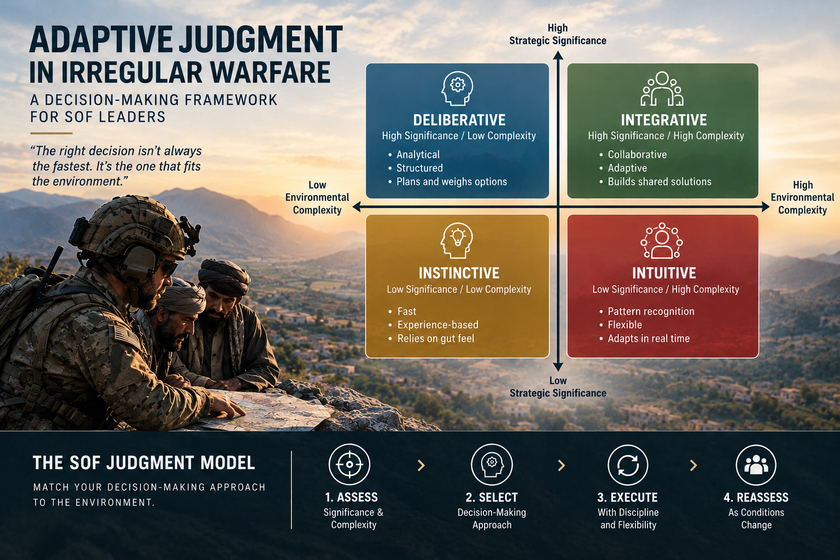
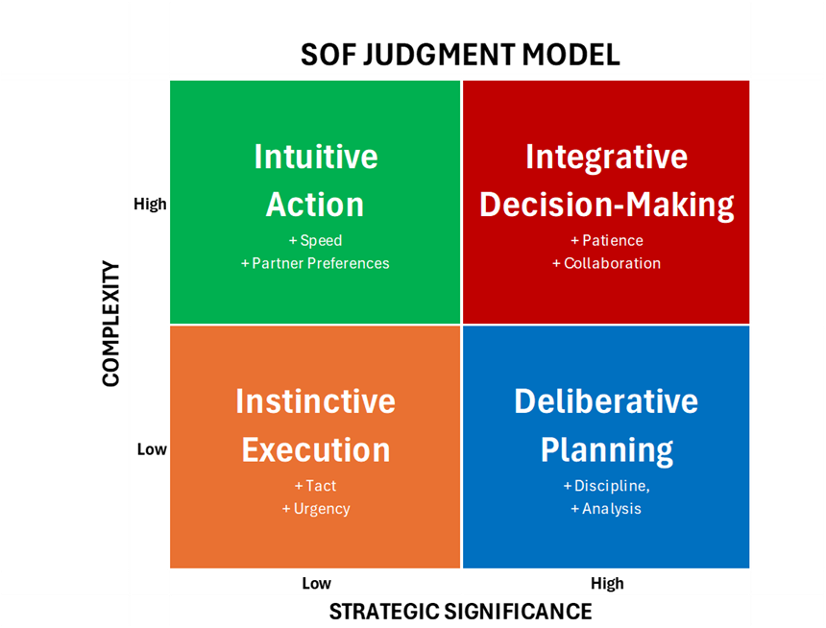
The SOF Judgment Model integrates these decision-making preferences with two contextual variables: strategic significance and environmental complexity. Strategic significance reflects the degree to which a decision carries long-term political or strategic consequences, while complexity reflects the number of interacting actors, feedback loops, and uncertainties involved. To operate effectively, SOF leaders must continuously diagnose their environment and shift between these four modes of decision-making:
1. Deliberative Decision-Making (High Significance, Low Complexity)
In environments where strategic stakes are immense, but variables are relatively stable and understood, leaders must rely on disciplined analysis. Here, the operating picture is clear enough to support traditional military planning processes. Because the risk of strategic fallout is severe, precision is prioritized over speed. SOF leaders should enforce rigorous risk assessment, adherence to policy, and structured deliberation, leveraging the stability of the environment to optimize their outcomes.
2. Integrative Decision-Making (High Significance, High Complexity)
This is the most demanding cognitive space in IW. When both strategic consequences and environmental ambiguity are at their peak, unilateral action is a liability. Leaders cannot simply "plan" their way out of wicked problems, nor can they rely on gut instinct. Instead, they must synthesize competing information streams, relying heavily on relational influence and collective decision-making. Success requires patience, active collaboration with partner forces, and the continuous integration of interagency perspectives to navigate spaces where standard operating procedures fail.
3. Intuitive Decision-Making (Low Significance, High Complexity)
When operating in highly ambiguous or rapidly shifting environments where the immediate strategic impact is low, leaders must rely on seasoned intuition rather than exhaustive planning. These situations often involve nuanced cultural dynamics, localized friction, or incomplete information. Leaders should leverage their experiential learning—and crucially, the localized knowledge of their partner forces—to make rapid, adaptable decisions. In this quadrant, flexibility and maintaining momentum take precedence over finding a perfect, analytically derived solution.
4. Instinctive Decision-Making (Low Significance, Low Complexity)
In routine, low-risk scenarios with clear parameters, over-analysis often leads to paralysis. Here, leaders must lean heavily on ingrained training, battle drills, and standard operating procedures. The goal is sheer efficiency. Because the strategic consequences of an error are minimal, leaders must trust their baseline tactical instincts and ruthlessly empower subordinates to execute, preventing administrative bottlenecks in the decision cycle.
The greatest risk to judgment is a mismatch between a leader’s chosen style and the environment. Using an instinctive approach in a high-significance, high-complexity situation can lead to catastrophic strategic failure. Conversely, demanding integrative, collaborative processes for a low-significance, low-complexity task creates analysis paralysis and cedes the initiative. True judgment is found in the discipline of self-awareness and the ability to adapt one’s preferred style to the existing context rather than succumbing to the force of habit.
Applying the SOF Judgment Model
The SOF Judgment Model is best understood through operational examples that illustrate how decision-making approaches align or misalign with strategic significance and environmental complexity.
Routine Foreign Internal Defense (FID) Mission: Low Strategic Significance / Low Complexity
A Special Forces detachment conducting a short-duration training mission with an established partner force often operates in an environment characterized by clear objectives, limited stakeholders, and relatively predictable outcomes. Tactical decisions occur within a familiar operational framework and typically carry limited strategic consequences. Under these conditions, instinctive decision-making based on experience and pattern recognition is generally appropriate.
Community Engagement with Village Elders: Low Strategic Significance / High Complexity
A SOF team conducting routine engagement with multiple village elders may encounter an environment characterized by competing local interests, informal power structures, historical grievances, and complex social relationships. Although the engagement carries limited strategic significance, the social environment remains highly complex, requiring leaders to leverage intuitive actions to remain attentive to local dynamics.
The Bin Laden Raid: High Strategic Significance / Low Complexity
Operation Neptune Spear presented decision-makers with a mission of extraordinary strategic significance. The potential consequences of success or failure extended well beyond the tactical objective, carrying implications for U.S. credibility, counterterrorism strategy, and relations with Pakistan. Although politically sensitive, the operational problem itself remained comparatively well-defined and focused on a single target. Deliberate planning with focus on strategic risks and political consequences helps ensure decisions reflect the significance of potential outcomes.
Village Stability Operations (VSO): High Strategic Significance / High Complexity
Village Stability Operations in Afghanistan represent an example of both high strategic significance and high complexity. SOF leaders operating in these environments simultaneously navigated tribal dynamics, local governance structures, partner-force relationships, host-nation politics, coalition priorities, and insurgent influence. Decisions made at the village level could influence legitimacy, partner relationships, and broader campaign objectives. Because cause-and-effect relationships were often unclear, effective leaders relied on integrative decision-making to incorporate diverse perspectives and continuously reassessed assumptions.
Conclusion
A review of the SOF Judgment Model demonstrates that decision-making preferences alone do not equate to effective judgment. While instinctive and integrative approaches each align naturally with different levels of strategic significance, neither approach operates independently of complexity or time. This reality requires SOF leaders in IW environments to exercise judgment based on a leader’s ability to recognize how strategic significance and operational complexity interact to shape adaptive decision-making behavior accordingly, specifically as operational complexity prevents judgment from being reduced to a single preferred style.
Lastly, if adaptive judgment is central to achieving successful outcomes in IW, then SOF organizations must deliberately cultivate human-centric skills through Professional Military Education focused on combining the decisiveness required of traditional war with the cognitive flexibility and relationship building necessary for thriving in human-centric conflict. Likewise, leader evaluations must recognize and reward those demonstrating the ability to adapt their decision-making preferences rather than focusing on demonstrating “Great Man” confidence or tactical efficiency. As conflict increasingly occurs below the threshold of armed conflict, the ability to exercise adaptive judgment will remain a decisive advantage for SOF leaders.
Disclaimer: The views expressed are those of the author and do not reflect the official position of the United States Government, the Department of War, or the Department of the Army.
Cover graphic created by ChatGPT.
Dr. Joseph Long is the Director of IWI’s SOF Program. He is a retired U.S. Army Special Forces officer and leadership scholar currently serving as Deputy Division Chief of the Department of the Army G-3/5/7 Special Operations Division (G3 SOD) in support of the United States Army Special Operations Command (USASOC). Dr. Long is a former professor of leadership and ethics at the Joint Special Operations University, and his research focuses on leadership, ethics, and partner force development in highly complex Irregular Warfare environments.