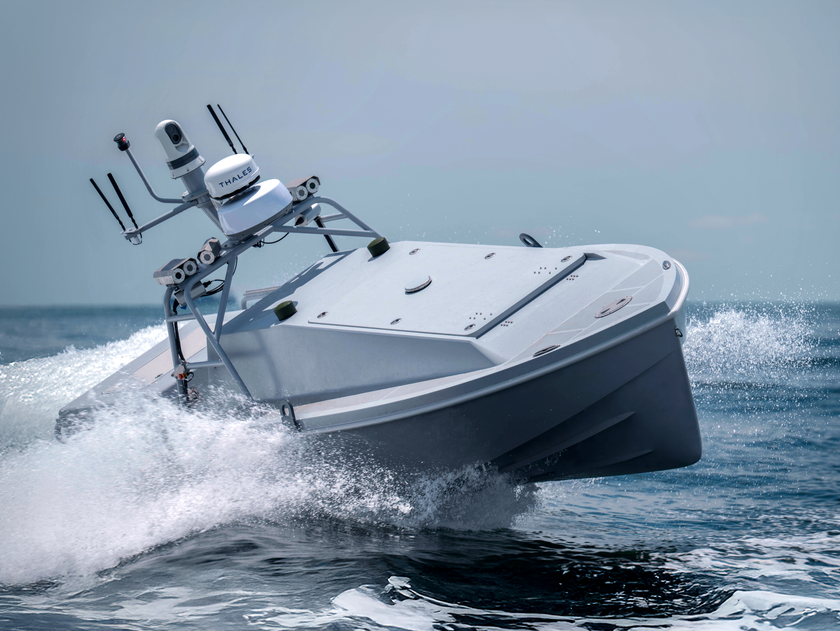
On June 8, a Saronic Corsair autonomous surface vessel located and recovered the crew of an Apache helicopter after it went down off the coast of Oman, the first time an ASV was utilized in an active combat rescue mission.
On May 11, Vib Altekar, Co-Founder and CTO of Saronic Technologies, joined IWI Fellow, Melissa Graves, and IWI’s Emerging Technology Program Deputy Director, Hugh Harsono, to discuss maritime autonomy, the future of autonomous surface vessels, and their implications for national security. The conversation explores how emerging maritime technologies are reshaping irregular warfare, the challenges of operating autonomous systems at sea, and how partnerships between government and private companies are transforming defense technology and strategic competition. Listen below.
The transcript below has been edited for readability while preserving substance.
Melissa Graves: Hello, and welcome to the IWI podcast, Emerging Technology Virtual Q&A. I'm Melissa Graves. I am an IWI Fellow, and I'm joined today by Hugh Harsono.
Hugh Harsono: Hi, I'm Hugh Harsono. I'm a Deputy Program Director at IWI, and also a Fellow.
Melissa: Great. Today's conversation is with Vib Altekar. He is a co-founder and Chief Technology Officer of Saronic Technologies. Saronic is a company working at the frontier of maritime autonomy, and that makes him an ideal guest for this conversation, because autonomy at sea is not just about new platforms, as a lot of our listeners will know, it's about presence and persistence and sensing and logistics, and as we talk about these issues today, we're kind of focused on a couple of questions that are driving these conversations. The first is, How are these technologies going to reshape irregular warfare, and also we're really interested today to hear about what Washington and Silicon Valley may misunderstand about one another. So Vib, welcome to the podcast.
Vib Altekar: Yeah, thanks for having me.
Melissa: It's our pleasure. Before we get into the technology, I would love to start with your path. Did you always imagine yourself working on national security technology, or did your move into defense tech surprise you?
Vib: Yeah, I actually grew up in Silicon Valley, you know, my parents immigrated here during the semiconductor boom, and so naturally my initial reaction was to never touch anything in software or semiconductors. I ended up going to university to study chemical engineering, to go into energy, ended up switching my major halfway through to electrical engineering–still with a focus on energy–but ended up getting dragged into a lot of the early investments at the intersection of software and hardware for self-driving cars. So I was uniquely interested in that space during that kind of period of time where the investment was skyrocketing, and one of the things that really reshaped some of my views was spending a little bit of time in venture capital. I spent some time at some startups during internships. Ended up going to 8VC after graduation, which, you know, a couple of the things that really opened my eyes to kind of where the capital markets focus their time, and what ends up becoming the downstream implications of capital access in industries that sometimes are overserved and a lot of times underserved, and I think in 2017 you know, venture in defense was still fairly nascent, but defense’s roots stretched back to Silicon Valley since the beginning of Silicon Valley. So I ended up finding myself at Anduril in 2018 when the company was still fairly small, you know, working across sentry towers all the way to UAVs, counter UAS systems, and then unmanned submarines, so ended up finding myself there through a kind of a circuitous path. But yeah, ended up leaving Anduril back in end of 2022 to come start Saronic.
Melissa: Gotcha. And can I just ask a quick question to follow up on that? Tell us about the shift from Anduril to Saronic. I imagine that's like a big decision to go from working for a company to starting one. What was that like?
Vib: Yeah, I mean, you know, I had a great time at Anduril. A lot of respect for the team there. I learned a lot. It was interesting, because the Overton window on defense tech really shifted during that period. I would say, like, 2021-ish was around the time where it kind of changed from defense tech being extremely controversial in Silicon Valley to defense tech being lucrative and important to work on, and deserving of people working on it in capital and all this stuff. But before that, I don't think it was really the case, and the shift was interesting. When I joined Anduril, it was fairly small, and by the time I left, it must have been around 1,500 people or so, and so kind of got a chance to see what hyper growth looks like from the inside. You know, there's not a lot of silver bullets to solving challenges when you go from 20 to 200 to 2,000 people in such a small period of time, but a lot of interesting things to learn. Obviously the company did really well, and I think that the big shift was, you know, from my time before at 8VC, still in touch with a lot of friends in venture and the community of people that was looking at, what do we invest in that can go really make disruptive change in the future. Ended up getting connected to Dino, who was an entrepreneur in residence at the time, and yeah, just a handful of conversations with, you know, moving forward really set the tone for what we would go and attempt at Saronic, around the thesis around shipbuilding, the thesis around boats, the structural advantages of autonomy, and in the space, not just related to operations, but also maintenance and repair cycles. All of the kind of under the radar concepts of just not just building the drones, but what are all the downstream impacts from a military perspective, also from an economic perspective of getting into the space. So it was a shift, for sure, moving to Austin, you know, end of 2022 early 2023 was definitely interesting, and over the last three years or so, we've seen a kind of big boom in terms of a lot of the companies that have moved here, and a lot of the folks building in the hardware space here. So, yeah, it's been super exciting.
Hugh: So, I know you've covered this a little bit the last question with Melissa, but for our listeners that may not really know Saronic, what problem is the company trying to solve, and specifically a follow-up to that would be why is the maritime environment such a hard place to build autonomous systems?
Vib: Yeah, so at Saronic, our mission is to restore maritime dominance. Basically bring the United States back as a maritime kind of supreme power. And I think there's a bunch of elements to that, right, the autonomy is one component of it, but a large portion of that actually starts off with the people and the skilled labor in terms of building these kind of systems. So, you know, for a while the maritime industrial base has really been kind of hedged on the military industrial base. Over the last maybe 30, 40, 50 years, the commercial maritime base has really kind of slowed down in the United States. But it starts off with that. You know, one of our key initiatives is something called Port Alpha, which is going to be one of the largest shipyards in the United States. And to our site in Franklin, Louisiana, where we're building marauders, it starts off there with the actual shipyard infrastructure, the capacity to actually go and build large ships quickly and efficiently, and have maximum utilization of those yards. And then it goes from there into what are the electronics, what is the naval architecture, and the design of what actually goes inside these crafts, so everything from the latest advances in edge computing, to high frequency RF, to some of the newer technologies around subsea monitoring and acoustics, and then finally at the top of the stack is really kind of the perception, the autonomy stack, the command and control layer to actually go and orchestrate these systems. And then I would say there's this long tail of data aggregation, maintenance, and repair operations, as well as operations and sustainment, which I think kind of fills out this whole gap from start to finish.
So to answer your second question, on what's difficult about specifically autonomy at the surface of the water, well it’s one of the few places where you're in two fluids, right. So, you have to deal with salt water, as well as you have to deal with kind of the conventional challenges of challenging weather conditions with storms and wind and rain, and all that. But I would say the trickiest part here is that it's just a tumultuous environment. In the air, typically, if a fighter pilot decides that you're gonna take a trajectory where you pull anywhere from, like, I don't know, 5 to 10 Gs, that's a conscientious decision, and oftentimes there's a human limit in terms of how many Gs you can pull. With submarines and unmanned underwater vehicles, you're in a single fluid, and you're usually moving pretty slowly outside of a couple of scenarios. On the surface of the water, it can be quite tumultuous, right? And when you design a craft for there to be no humans on board, you can really start to push the limits. So you can actually design a craft that's meant to take a lot more slamming impacts than a craft built for humans would ever take. And so you have challenges there, in terms of, how do you make sure that the design is actually built for all of the different sea conditions that you're going to be in.
And other things that come into play here is that salt water is obviously cancer for electronics, but from a communications perspective saltwater on your antennas is always going to hinder quality service. And so there's networking challenges to go and solve, right. With typical high frequency RF, you kind of have this omnidirectional bubble, a lot of that power is dissipated into the ocean that doesn't go anywhere. And so you have challenges there from a communication standpoint. And then finally from a perception perspective, when you run missions, typically with UAVs, maybe smaller group one crafts are running missions for, you know, 20 minutes to 45 minutes or something like that, you're basically limited in terms of the energy density of whatever your fuel is. The larger ones obviously go a lot further. But a typical maritime mission, for one of our even smaller autonomous boats could well extend past 30 days. And so when you think about being out on the ocean for that long, you have just a lot more things to think about from a wildlife perspective, I've seen tons of footage of birds coming in, sitting on the boats for a little bit, to any sort of biological growth, just because you have water sitting somewhere for a while, to just the general challenges of variable sea state over time. So plenty of challenges there.
And I would say the biggest advantage that we have so far is that we've just been able to manufacture a lot of these systems, and so you get to learn lessons a lot faster when you build in such high volume. We just posted last week of our 300th vessel, you start to learn these things quicker, but you also get to collect a lot more data, and that that flywheel just ends up improving the backend system of not just perception, autonomy, and your machine learning algorithms, but also your ability to efficiently do maintenance and repair.
Melissa: So, Vib, I want to follow up on something that that you said in one of your prior answers, and I want to make sure that I heard you correctly as well, because when you made the shift from Anduril to Saronic, you said something to the tune of, what can we invest in that is really going to change the future. Did I kind of summarize that correctly or state that correctly?
Vib: Yeah, you know, the jump was really a function of a couple of things. I was looking to go back to solving problems zero to one, I really had a lot of respect, and Dino's very inspiring leader, and I just learned a lot of things at my during my time at Anduril, and was excited to do something new,
Melissa: I know a lot of our listeners are doing a lot of futures analysis, and what caught my attention about that question is just, I would love to have been a fly on the wall to hear those discussions. I mean, when you're thinking about the future and what can change the future, can you kind of walk us through your thought process about that?
Vib: Yeah, you know, I think when it comes to the technology sector specifically, we kind of have these waves that consistently grab a bunch of people along the way, and then as that wave kind of falls down, a handful of players remain. We saw this with search engines, we saw this with social networks. Maybe we'll see this with AI, maybe we'll see this in high-performance computing—we're already seeing it with high-performance computing. But there's these waves that kind of come and grab a bunch of people together. The technology really gets to a certain point, then it starts to get commoditized over time, and a handful of players are there at the end. And I think with autonomous drone technology, we had these waves that were kind of separated. Like in the early 2000s, UAVs and drones became of really utmost importance, both from national security, but also I think when the FAA allowed for line of sight drones to be allowed, and they had some specific regulation over that, you started to see this plethora of investment there, whether it was companies that were doing drone delivery or surveillance or 3D mapping for construction, there's all sorts of companies that came out of that. But when you play that out over the following 10 years, I think the FAA just recently, maybe it was 2023 or 2024, they finally allowed for beyond line of sight operations for drones as well. There's like a 10 to 12 year gap there, but the technology really commoditized. Today you can build a drone in your garage as a hobby project, and there's enough open source infrastructure and tools and tutorials and education to do that. But also every university lab in the country, or almost every university, has a lab that focuses on drone technology or focuses on drone research, whether it's from a software perspective or an aerodynamics perspective. That wave didn't really hit the maritime world that much. There was UUV investment early on, but it was fairly bespoke, I would say, for a while, mainly because a lot of the things that UUVs do can be quite sensitive, and so you didn't really see it hit the mass market. But now you're kind of seeing a lot more of that. Now universities do have UUV programs, they have competitions like Robo Boat, which is for USVs, but one of the things that we had noticed along that time was a lot of the technology hadn't really made it to maritime, right? On UAVs, you had investments in custom compute, you know, custom hardware that was built for those. For the USV market, you really didn't see that, and for the UUV market it was really just really pushed forward primarily by defense, but not too much of commercial. There was a little bit of subsea survey for offshore wind farm and oil and gas, but it wasn't in the mass volumes that you see with drones.
So, I think that was one critical component that we had noticed was, what is the reason why, when you look at from 2016 to 2026, you had very few autonomous boat programs or USV initiatives or programs. You had, spikes with MUSV and LUSV in the past, but you didn't really have a large volume, and then suddenly from 2024 onwards, now you're seeing this massive amount of focus from from the government side as well as industry kind of keeping up to go and invest in this kind of technology.
I would say the other piece was that probably the writing was on the wall for the shipbuilding industry for a while. It wasn't like in 2021 the shipbuilding industry was fine and then 2024 everybody realized like, hey we're not building enough ships. This was clear for quite some time, but I think the big open questions that really popped up were really around what does this mean for the country? And I think prior to Covid, I just think we lived in a slightly different geopolitical environment where it just didn't matter as much. It was okay that we did not have this kind of capacity, or it was, I guess, less visceral of a reaction to learning that hey, the United States only builds three to five commercial ships, and China outbuilds us from a tonnage perspective by 250 times. Those things were just less visceral, and I think now, just given the geopolitical state of the world, and how much of a focus not just the United States, but a lot of countries have now, in kind of trying to re-shore their manufacturing base and industrial base, it really pointed to those two big things: investment in reducing the cost of operations by making things autonomous, and you can reduce the capex investment, or you can build a lot more, a lot faster, if you focus on this attritability piece, especially when it comes to shipbuilding, which is kind of where the Navy's recent push on the MUSV programs has really pointed to.
Melissa: So, why should the listeners who are doing research on irregular warfare, why should they care about autonomous maritime vehicles. How does that relate to irregular warfare?
Vib: Yeah, you know, I think one of the things that comes to mind right off the bat is again USV boats are in two fluids, right, and so when you need to go and either do any sort of acoustic work inside the ocean, but also maybe high frequency RF work, talk to LEO satellites, etc., being at the surface of the water is really the only thing that can really enable that, right? And so, let's say you want your drones to talk to your UVs. You're going to need some system that can kind of navigate that medium to go and convert bits that are in RF or light, and turn them into bits that are sound or acoustics. So I think that layer, that air-water boundary has been a challenge for a long time, and so by proliferating systems or devices at the surface of the water, you can really start to scratch at that problem.
I would say the second thing here is that the ocean is just extremely large. It's over 70% of the surface of the planet, and so when you think about anything from, you know, we can think about commercial applications around logistics. You know, 80% of global GDP moves through the ocean. You know, just moving goods, generally speaking, globally, that becomes really critical. But also, when you think about weather patterns, oftentimes you're seeing early warnings coming from satellites, but you can get similar fidelity of data, and sometimes more fidelity of data, when you have a physical asset that's in that environment, that's collecting information from a weather perspective, and macro patterns have always been affected by weather.
And then when it comes to the irregular warfare side of things, I mean, there's so many things that are tied to national security that permeate through the ocean, whether they're fiber optic cables, whether it's submarines, whether it's all of the oil and gas resources that a lot of folks have out in the ocean, to energy systems, like if offshore wind farms really take off in a significant way as a percentage of American energy consumption, these are all going to be a primary focus of national security, because it is existential that those things continue to exist. So, yeah, I would say, if you think about unmanned surface vehicles in a different way of kind of reframing the problem as, how do you reduce the cost of doing anything in the ocean by having cheaper assets, by having autonomy control things, you're not spending money on an extremely sophisticated crew that's an expert at doing this, but you can actually distill that knowledge that our maritime experts have across numerous assets, you can really start to make a dent in a lot of these problems.
Hugh: As I'm hearing you talk, one of the things that I really, really want to kind of point out is that you talk a lot about the ecosystem as a whole, right? When you talk about Saronic, you talk about a lot of the end to end ecosystem that's being developed, from shipbuilding to the technology layer to the software development that's occurring. So I think one of the things that our listeners are thinking about is watching the expanding role of private companies delivering those kind of national security capabilities, from end to end, from not only that shipbuilding manufacturing process all the way to software development, contracting, and so on and so forth. So as government and industry become increasingly intertwined, what does each side need to better understand about the other in order to build more effective partnerships before a crisis occurs?
Vib: Yeah, it's a good question. I would say that government and industry have been intertwined for quite some time, right? I would say a lot of the, you know, early early wins and early bets of Silicon Valley really stemmed from the government, right. And downstream impacts of that is that you have companies that have almost nothing to do with national security, that are some of the most powerful companies in the world, right, like Netflix, and Facebook, and companies like this. I would say that the thing that's really shifted in the recent past, and it's really pioneered by companies like Palantir and SpaceX, and most recently Anduril, is that the approach to moving faster and setting up the right incentive structure to move fast has really been something that government customers have started to really appreciate. And I think, in historical terms, maybe the government was the one taking a lot of the risk when it came to R and D investment, having private capital and private industry help take that risk and share that burden, I think has started to be more and more appreciated by some of these government customers. And so I think that's one of the biggest pieces of just shifting the incentive structure a little bit, where if you are incentivized to take longer or use more expensive materials, that is what the economics will push you into doing. And if you're incentivized to move as quickly as possible, because you have limited private capital to spend on R and D, or you're incentivized to move as quickly as possible to make sure that you can get the right products into market, the economics point you into making sure that you own that risk effectively, you price it well, and hopefully you're successful. Whereas on the other side, if the government's taking all of the risk, you don't have that same problem to solve. And so, you know, I would say, in the recent past, I would say some of the things are tied to the incentives, right? Like, people are starting to appreciate that incentive structure existing, and organizations like AFWERX and DIU really leaned forward into that, and now you're seeing the ramifications, six, seven years, eight years later, where the government and the President and Secretary of War are pushing out these statements, saying we want private industry to take more risk, we want to reward private industry for taking that risk, we want to focus on commercial, off the shelf technologies, we want to focus on taking commercial products and really adapting them, so it takes time to realize those shifts, but it's really starting to move in a significant way. And I think this applies to the older generation of companies in the space as well. You're seeing a lot of the larger primes as well, in some cases moving into these directions. So I think overall that that shift needs to be an incentive structure change, but ultimately that incentive structure change has to be driven by the economics, otherwise you'll end up in a scenario in which, if it's not worth it, people will start to deploy private capital in other areas.
Melissa: Well, this has been a really enlightening conversation, and I think the work that you're doing at Saronic is incredible. Thank you so much for having this conversation with us, and for making us think about a lot of issues in a completely new way. So this concludes our interview with Vib Altekar, and thanks for listening,
Vib: Thanks for having me.