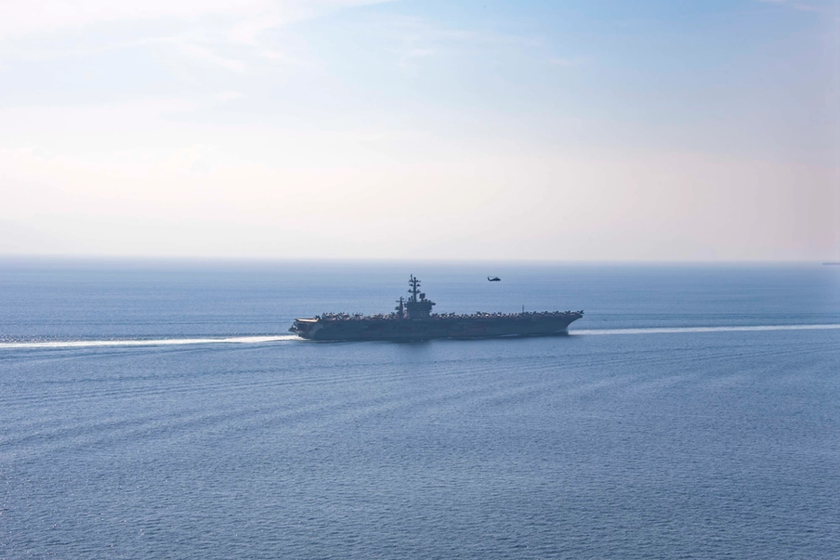
In mid-March 2026, satellite imagery confirmed what many defense analysts had long feared: the USS Gerald R. Ford and USS Abraham Lincoln carrier strike groups had quietly abandoned their forward offensive positions near Iran. The Ford moved south into the central Red Sea near Jeddah; the Abraham Lincoln relocated to the southwestern waters of Oman near Salalah, moving it from less than 350 kilometers to more than than 1,100 from the Iranian coastline. The official language was clinical: a “controlled reallocation of naval assets.” The strategic signal was harder to spin. The most powerful surface warships on earth had been repositioned out of missile range of a state that the United States was simultaneously striking. Whether one calls that prudence or precedent, it deserves serious analysis.
The retreat did not happen in a vacuum. Iran’s Fattah-2 hypersonic glide vehicle, with a reported range of 1,500 kilometers and speeds of up to Mach 15, had already penetrated discussions in every naval war room in the world. Iran’s Islamic Revolutionary Guard Corps (IRGC) then announced that, during the seventeenth round of Operation True Promise 4, its hypersonic missiles and attack drones penetrated the US-made THAAD (Terminal High Altitude Area Defence) system, striking the Israeli Ministry of Defence building and Ben Gurion International Airport. Whatever caveats analysts may attach to Iranian propaganda, the footage circulated, the strategic psychology shifted, and the carriers moved. That sequence reveals a structural problem that no amount of layered defense architecture fully resolves.
Aircraft carriers have become conditional instruments of power, effective against weak adversaries but increasingly liabilities against state and non-state actors equipped with mature missile arsenals, saturation drone tactics, and precision strike. The liability is both fiscal and operational. The Iran conflict demonstrated that even a mid-tier adversary can force a multi-billion-dollar naval asset beyond useful range at a fraction of that cost. Crucially, this is no longer a peer-competitor problem. The Houthis, Hezbollah, and Iran’s IRGC represent the irregular warfare threat, and they are now fielding the tools to neutralize the West’s most expensive conventional asset. Understanding how and why the purpose is of what follows.
The Logic That Made Carriers Great
For seven decades, the aircraft carrier was the clearest symbol of American strategic reach. It solved three problems that almost no other platform could. First, it delivered mobile airpower without reliance on host-nation bases, vital when political access was contested or geographically impossible. Second, it generated persistent sortie capacity, enabling signaling, presence, and sustained strikes across an extended campaign. Third, it offered escalation control because it was a credible instrument of coercion short of full war.
This logic underpinned the US Navy’s enduring commitment to a force of eleven nuclear-powered supercarriers, reaffirmed as recently as 2025. It is worth being precise about what carriers cost, since the figures vary depending on what is being counted. A Ford-class hull alone costs roughly $13 billion to build and a further $3–4 billion a year to operate, covering the ship’s crew, fuel, and maintenance. That figure rises substantially once the full carrier strike group is counted: the embarked air wing of roughly 75 aircraft, the five to seven escort destroyers, cruisers, and submarines, and the logistics ships that sustain it together push the concentrated national investment to $25–30 billion. The underlying assumption was always that this investment, in either accounting or theater, could be deployed into a theater without being held at unacceptable risk. That assumption is now visibly fraying. The clearest early signal came in late 2023, when the USS Dwight D. Eisenhower was deployed to the Red Sea to deter Houthi attacks. Rather than projecting deterrence, it was itself forced into sustained defensive operations, with the strike group expending over $1 billion in interceptor missiles against a non-state actor whose drones cost a few thousand dollars each. The carrier did not project power into the theater; it absorbed threats within it.
The New Threat Environment: Precision, Persistence, and Irregular Actors
Three interlocking dynamics have rewritten the carrier calculus: persistent surveillance, long-range precision fires, and the democratization of asymmetric strike.
Space-based reconnaissance, over-the-horizon radars, and ubiquitous commercial satellite imagery have effectively ended maritime anonymity. A carrier cannot maneuver in obscurity when its support requirements, including replenishment cycles, escort formations, and predictable operational rhythms, create signatures that AI-assisted tracking can exploit. The ocean’s “hiding space” has compressed dramatically.
Hypersonic weapons are the most dramatic element of this threat environment, but not the only one. Iran’s anti-ship arsenal spans subsonic Noor cruise missiles, the Khalij Fars ballistic missile adapted for maritime strike, and saturation drone swarms designed to exhaust interceptor magazines before a precision weapon arrives. China’s DF-21D and DF-26 anti-ship ballistic missiles represent the peer-level version of the same logic: layered, multi-vector, and designed to overwhelm rather than outpace. Electronic warfare that degrades carrier-based aircraft communications, naval mines deployed by irregular actors to restrict littoral maneuver, and over-the-horizon targeting relayed via Iranian proxy networks complete the picture. The threat to carriers is not a single silver bullet; it is an ecosystem designed by adversaries who have studied carrier doctrine and built specifically to exploit its dependencies.
What makes this especially pertinent to irregular warfare is who is now deploying these capabilities. Iran is not a peer competitor in the conventional sense. Its air force is ageing, its conventional navy is limited and now largely destroyed, and much of its offensive reach relies on proxies and asymmetric tools. Yet it possesses a missile arsenal that forces two nuclear-powered supercarriers back 1,100 kilometers. The Houthis, a non-state actor in Yemen, conducted more than 100 separate attacks on commercial vessels between November 2023 and October 2025, repeatedly challenging US carrier strike groups in the Red Sea. The irregular actor’s toolkit has caught up with the carrier’s deterrent logic.
The Iran War: A Live Case Study in Carrier Vulnerability
The 2025–2026 US–Israel military campaign against Iran has served as the most consequential real-world test of carrier doctrine in a generation. The 2026 US military build-up in the Middle East was described by analysts as the largest concentration of US naval and air power near Iran since the 2003 invasion of Iraq. Yet precisely because of that missile threat, US Naval Forces Central Command reduced its fleet headquarters in Bahrain to fewer than 100 mission-critical personnel and moved all ships out of port ahead of the strikes. Carrier aviation had to be supplemented by a network of 14 aerial refueling tankers based at Israel’s Ben Gurion Airport simply to give the Ford’s air wing enough range to reach Iranian targets.
An Iranian parliamentarian captured the strategic logic with unusual candor. “When the US carrier gets that close,” said Salar Velayatmadar of the parliament’s national security commission, “it is effectively like an easy target within our range, and no rational actor would take such a risk.” Iran’s publicly disclosed anti-ship inventory includes Noor cruise missiles, Talaeiyeh long-range smart missiles, and the Fattah hypersonic series. Reports emerged in February 2026 that Tehran was negotiating with China for the CM-302 supersonic anti-ship cruise missile, a system specifically designed to defeat carrier defenses.
The repositioning of both carrier groups validated a fundamental tension in carrier doctrine: the platform that is supposed to project power must itself be protected from the theatre it is projecting into. When protecting the carrier imposes a stand-off distance great enough to require tanker-dependent sorties and extended mission profiles, the sortie rate and strike effectiveness that justify the platform’s cost are directly undermined.
The Liability Calculus: Cost, Risk, and Opportunity Cost
Analysts including Bryan Clark at the Center for Strategic and Budgetary Assessments and the Congressional Research Service have noted that no carrier has been sunk in combat since 1945, that layered defenses remain formidable, and that even a damaged carrier retains significant capability. These are serious points. But the question is not whether carriers can survive; it is whether the operational constraints required to keep them survivable still justify the investment.
Consider the compound liability that the Iran campaign exposed. To reduce the risk to two carrier strike groups, the United States had to redeploy them beyond effective sortie range, build a tanker bridge to restore that range, reduce its forward base presence in Bahrain, and conduct months of coordinated strategic deception to obscure strike timelines. All of this to protect a strike group package representing $25–30 billion in concentrated national capability, built around a single hull that itself cost roughly $13 billion. Meanwhile, the asymmetric actor threatening it had invested in missile systems costing a fraction of that.
The argument’s liability is not that carriers are sinkable, but that they are increasingly expensive to employ effectively in the very environments where their employment is most consequential. Against a weak or disorganized adversary, the carrier remains devastatingly effective. Against a state or non-state actor with a mature missile arsenal, persistent surveillance, and saturation doctrine, the carrier becomes a constraint on operational planning rather than an enabler of it.
Where Carriers Still Matter, and What Must Change
This is not a case for abandoning carrier aviation. China’s commissioning of its third carrier, Fujian, with electromagnetic launch catapults, signals that peer competitors view carrier aviation as indispensable even as they build the systems to defeat it. But China’s carrier doctrine holds a lesson for Washington. Beijing does not plan to deploy carriers into contested waters beyond the protective umbrella of its integrated anti-access and area-denial (A2/AD) network of land-based missiles, submarines, and over-the-horizon radars. Carriers operate within that envelope, not beyond it. The United States, by contrast, has consistently deployed carriers into the most lethal threat envelopes, where their survivability depends entirely on organic defenses. China’s model suggests that carrier utility is maximized when the carrier is one node in an integrated kill chain rather than the decisive instrument operating alone in harm’s way.
Three adaptations are immediately necessary. First, carrier airwings must complete their transition toward longer-range unmanned platforms. The MQ-25 Stingray tanker drone is a step in this direction, but the follow-on requirement is a long-range strike-capable unmanned system that can reach targets from a carrier positioned well outside the most lethal threat rings, removing the stand-off dilemma entirely. Second, the economics of carrier escort must be restructured. Today, each carrier strike group requires two to three guided-missile destroyers for close-in defense. Replacing that function with layered autonomous surface and underwater vehicles would free destroyer capacity for broader sea control missions, reducing the hidden cost of deploying a carrier. Third, the United States must accelerate distributed strike architecture: land-based hypersonic systems in theatre, a larger Virginia-class submarine force, and autonomous underwater vehicles capable of launching precision strikes, so that no adversary can neutralize American offensive reach by threatening a handful of identifiable, trackable surface nodes.
Conclusion
The Iran conflict of 2025–2026 has not proven that aircraft carriers are obsolete. It has proven something almost as consequential: that even a mid-tier adversary with an asymmetric missile arsenal can impose operational constraints on the world’s most powerful carrier force. That finding carries profound implications not only for the current conflict, but for the strategic competition that defines the decades ahead. China has spent twenty years studying carrier doctrine and designing its military precisely to exploit the vulnerabilities this article describes. The DF-21D was built for one purpose: to deny the United States the ability to deploy carriers into the Western Pacific in a Taiwan contingency. If Washington does not internalize the lessons of the Iran campaign now, the consequences in a high-stakes confrontation with Beijing will be far more severe.
The carrier is not the new battleship. But it is, increasingly, a conditional instrument: effective where the threat environment permits, constrained where it does not. Recognizing that distinction, and building a force structure that does not depend on carriers performing decisively in the most dangerous theatres, is the strategic adaptation that the Iran campaign has made urgent and that the China challenge has made unavoidable.
Dr Tahir Mahmood Azad is the Executive Director of London Dialogue, an independent UK-registered research and policy institute based in London. A specialist in nuclear politics, hypersonic weapons, missile proliferation, strategic stability, and emerging military technologies, he is a research scholar at the Department of Politics and International Relations, University of Reading, UK, where his research focuses on the implications of China's hypersonic weapons program for deterrence stability and nuclear strategy. He holds a doctorate in Strategic and Nuclear Studies from the National Defence University of Pakistan and a post-doctorate from the University of Leicester. From 2019 to 2023, Dr Azad served as an Affiliate Researcher and Visiting Research Fellow at the Centre for Science and Security Studies (CSSS), King's College London. He has held competitive research fellowships at Sandia National Laboratories, the Graduate Institute Geneva, PRIF Frankfurt, ISDP Stockholm, and the University of Bristol, and has served as a Research Fellow at the Institute of Strategic Studies Islamabad (ISSI).
The views expressed are those of the authors and do not reflect the official position of the Irregular Warfare Initiative, Princeton University’s Empirical Studies of Conflict Project, the Modern War Institute at West Point, Department of the Army, Department of War, or the United States Government.
Main image: USS Dwight D. Eisenhower (CVN 69) transits the Strait of Hormuz, courtesy of DVIDS.
If you value reading the Irregular Warfare Initiative, please consider supporting our work. And for the best gear, check out the IWI store for mugs, coasters, apparel, and other items.