Russia and China do not need to defeat the 11th Airborne Division or challenge an icebreaker in open water to shape outcomes in the Arctic. The enabling systems that sustain U.S. forces operate on thin margins; they are concentrated, commercially dependent, and far easier to target than the forces they support. An adversary need not match U.S. conventional strength but only identify the margins that force projection cannot afford to lose. Recognizing a cheaper path to strategic effect, adversaries are more likely to exploit these vulnerabilities indirectly, below the threshold that triggers a military response.
Alaska’s logistics systems, the thin margins that make Arctic force projection possible, are the primary target of irregular warfare, and building resilience into them is the foundational act of deterrence in the Arctic. Understanding that argument requires examining what makes Alaska’s logistics architecture structurally exposed, how Russia and China exploit that exposure through irregular means, and what building resilience against those specific techniques actually demands.
Arctic logistics are not uniquely fragile so much as they are uniquely consequential. The logistics systems that enable the United States to rapidly project forces through the polar approaches were built for efficiency, not for the sustained irregular pressure an adversary can apply below the threshold of armed conflict. Alaska’s value as a power projection platform extends beyond the forces already stationed there. Reinforcing units from the lower 48 states, equipment surging forward for Pacific contingencies, and federal civil support all depend on the same logistics architecture. Moving combat power out of Alaska while simultaneously surging federal support into a state that cannot sustain itself are competing demands on the same infrastructure. A planner who assumes these demands can be sequenced will discover the error when the plan cannot absorb them.
The Theater
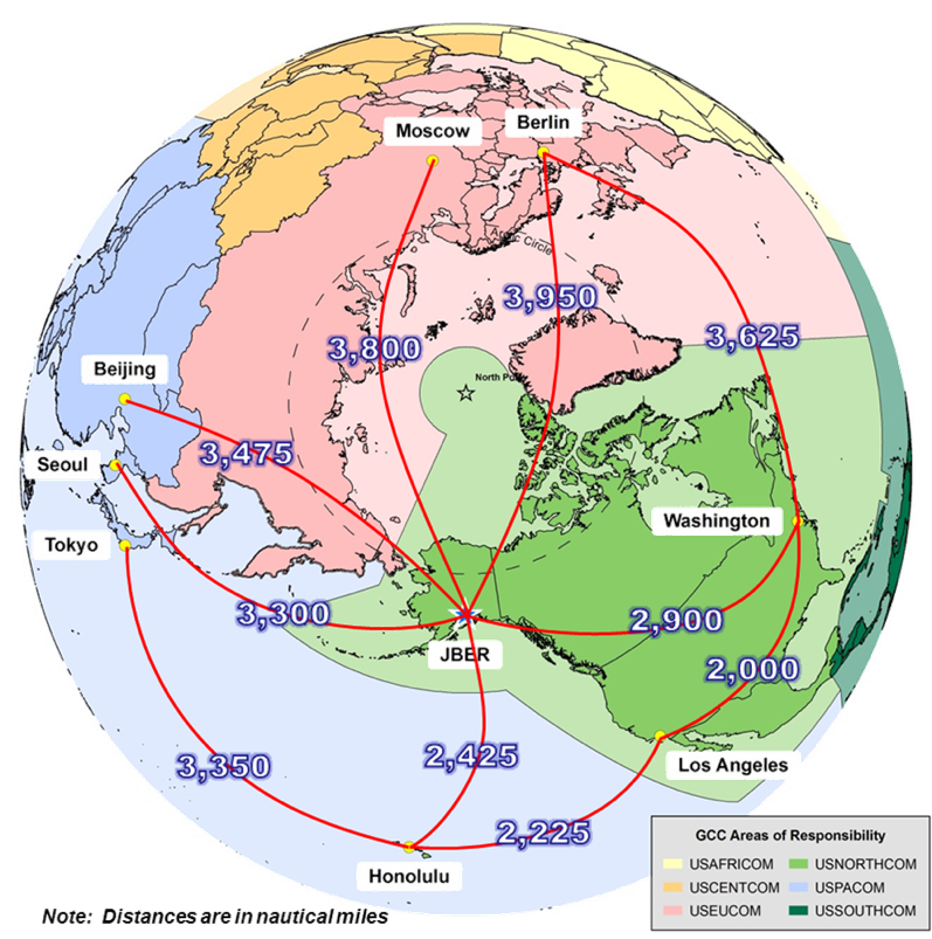
When the Department of Defense (DOD) released its 2024 Arctic Strategy, Deputy Secretary of Defense Kathleen Hicks described Alaska as sitting “at the crossroads between the Indo-Pacific and Europe.” The strategy identifies Alaskan infrastructure as “integral to the execution of Indo-Pacific operations as the northern flank for projecting military force from the U.S. homeland to that region.” The framing is correct, but the strategy leaves unexamined the condition of the systems that enable Arctic force projection.
Alaska concentrates its logistics systems to a degree no continental U.S. state parallels. The Port of Alaska handles more than 40 percent of the state's petroleum products and supports the majority of jet fuel supply for Ted Stevens Anchorage International Airport, the second busiest cargo airport in the world. Much of that fuel also underwrites Department of Defense operations in the region. Approximately 80 to 90 percent of consumer goods, along with most DOD cargo, move through a single port complex with limited road connectivity, minimal rail redundancy, and a maritime access window measured in weeks. When that window closes, it stays closed.
Congress has committed significant funding to expand America's icebreaker fleet. Alaska currently lacks the port infrastructure to support the icebreakers at scale. The deep-water Arctic port at Nome, the most viable long-term solution, will cost $400 million and take a generation to complete. Platforms attract investment while the systems that make those platforms operationally relevant do not. Arctic exercises reveal the same pattern. Arctic Edge, Northern Strike, and Joint Pacific Multinational Readiness Center exercises routinely test whether U.S. forces can fight and win under kinetic conditions. No exercise tests whether the logistics system sustaining those forces can absorb irregular warfare pressure before hostilities.
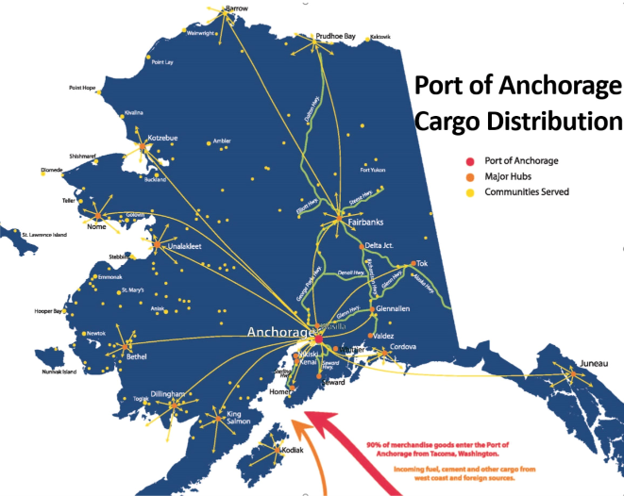
Military sustainment in the region runs on commercial ports, civilian contractors, seasonal sea lift—a tightly coupled civil-military ecosystem where disruption in one component cascades across others. The Anchorage metropolitan area, home to 300,000 people, depends almost entirely on seasonal barge resupply from the Port of Tacoma and air cargo arriving from Asia. When that flow stops, the city has three to four days of food on store shelves. For an adversary who cannot afford confrontation, the competition is a condition to exploit. Delay, degradation, and denial are the tools designed for precisely that purpose.
Delay, Degrade, and Deny
Contesting Arctic logistics requires sustained friction applied below the response threshold. Russia and China need only introduce enough friction at the right nodes and at the right moment, to slow the system down. Adversary pressure expresses itself in three ways—delay, degradation, and denial—each operating differently, together compounding.
The first is delay.
Arctic resupply depends on seasonal windows measured in weeks. Bulk fuel, construction materials, and heavy equipment move by sea lift during narrow summer periods. Distribution follows a tightly sequenced chain of transportation, contracting, and regulatory processes. When that sequence breaks, recovery within the same operating cycle is impossible.
Delay does not require physical attack. Russia has shown what deliberate, non-kinetic friction looks like in practice. Since 2022, GPS jamming attributed to Russian electronic warfare systems has become a near daily occurrence across Baltic shipping lanes and aviation corridors. In 2025 alone, analysts recorded 733 interference incidents in the Baltic Sea. The Baltic case is strategically distinct from the Bering. Russia’s campaign demonstrates how a state actor applies deniable, below-threshold friction against a commercially dependent maritime system. Alaska's commercial aviation and maritime approaches depend on satellite-dependent navigation across vast stretches of the Bering Sea, without the land-based backup infrastructure that denser operating environments provide. When adversaries degrade that navigation, the tightly sequenced chain moving people and supplies through narrow seasonal windows breaks.
The arithmetic for an adversary is straightforward. In temperate regions with redundant infrastructure, delays measured in days are absorbed or rerouted. In Alaska, the same delay pushes delivery entirely outside a logistics window. For China, preparing a decisive move in the Pacific, disrupting an Alaskan logistics cycle is a low-cost, deniable action. For NORTHCOM, a disrupted logistics cycle costs a deployment window and hands the commander an options set already narrowed before the first order is written.
The second effect is degradation.
The insurance market illustrates how market-based pressure erodes logistics capacity below the threshold of visible disruption. Lloyd's of London has moved to exclude state-backed cyberattacks from coverage, increasing financial exposure for commercial operators in contested environments. Insurance markets price perceived risk, not proven threat. An information operation does not need to be verified to move an underwriter’s risk model. Ambiguous vessel behavior near critical nodes, sustained rumors of electronic interference, or plausible manufactured reports of navigational hazards are enough. When premiums rise, carrier participation drops. When carrier participation drops, throughput decreases. Adversaries degrade the system without a single attributable hostile act and without crossing a threshold that justifies military or diplomatic response.
Market-based pressure exploits exactly this vulnerability in Alaska’s logistics architecture. Commercial carriers serving Alaska ports already operate with limited competition and thin margins. In a competitive logistics market, degradation is an inconvenience. In Alaska, degradation is a structural constraint, leaving operators with few alternatives and customers with none.
The third effect is denial.
Arctic military exercises almost universally assume large-scale combat operations with an invasion force that the environment itself would punish before any defender could. Denial in the Arctic is more temporal than territorial. The objective is rendering a port unusable at the moment it matters most.
China's economic coercion campaign against Australia between 2020 and 2023 demonstrates the mechanism. Tariffs, biosecurity measures, and unannounced import bans across twelve Australian export sectors reduced a billion-dollar barley trade to zero within a year. The campaign concentrated costs at the sub-national level creating political pressure that shaped Australian federal decision-making. Australia had market depth to reroute. Alaska does not. A logistics ecosystem that cannot substitute import sources within a seasonal window is more vulnerable to targeted commercial coercion than any economy with alternatives.
Russia has pursued the same outcome through narrative rather than economics. The European Centre of Excellence for Countering Hybrid Threats has documented Russia's deliberate campaign to contest Norwegian authority over Svalbard through gray-zone provocations, legal challenges, and narrative operations. Most recently, Russia has accused Norway of militarizing infrastructure that Norway maintains is within treaty bounds. A paper published by the Ted Stevens Center for Arctic Security Studies draws the operational implication directly: “such accusations, while unsubstantiated, have strategic consequences and can influence operational planning, defense investments, and alliance cohesion.” Alaska’s governance environment requires no manufactured conflict. Legislative debates over basing access shape what infrastructure gets built on timelines measured in years. A narrative operation finds existing friction, funds it, amplifies it, and directs it toward the nodes that matter most.
None of these mechanisms, acting independently, cross the threshold that triggers a collective defense response. In combination, they determine whether key logistics nodes can be relied upon at the point of decision. Irregular warfare targeting logistics infrastructure exposes the joint force’s most significant recognition gap, and resilience directly counters it. Critics argue that sufficient conventional capability deters all forms of competition. Conventional strength is exactly what irregular methods are built to avoid. A rapid deployment of a weapons platform does nothing to stop an insurance underwriter from repricing Arctic transit risk.
Deterrence Through Resilient Northern Systems
Resilience is deterrence. Irregular warfare deliberately avoids the thresholds that trigger punishment by making attribution plausibly deniable and escalation unwarranted. When planners harden a logistics architecture against specific techniques of delay, degradation, and denial, those techniques become unreliable. The NORTHCOM planner whose adversary shapes options before anyone drafts the first order needs resilience built now—resilience that deliberately denies adversaries the friction points identified in this analysis.
Three lines of effort address each pathway directly.
The first is stress testing against irregular threats alongside kinetic threats. Military exercises in the Arctic routinely simulate missile strikes, enemy invasion, and maritime blockades. The exercises rarely account for cyber interference with port scheduling systems, insurance market withdrawal, labor disruption, or influence operations targeting community consent. These are the specific techniques Russia and China have demonstrated against commercially dependent logistics environments and the techniques most likely to shape Alaskan force projection pre-conflict. The U.S.-Japan Yama Sakura exercises offer a model where integrating local government officials, emergency management agencies, and private sector actors into scenario design helps examine how disruption moves through civil-military networks. Test the logistics system as the whole-of-society network it is.
The second is distributing capacity rather than concentrating it. Efficiency and resilience pull in opposite directions in a thin-margin environment. Expanding fuel storage beyond single-port systems, developing alternative ports of debarkation, and prepositioning supplies closer to likely operating areas all reduce the consequence of disruption at any single node. Senator Dan Sullivan’s push to reopen Adak Naval Air Facility, backed by $115 million in committed funding, would extend operational reach into the North Pacific while breaking the single-corridor dependency that makes Alaska’s logistics architecture exploitable. During the Aleutian campaign in World War II, U.S. forces dispersed airfields and logistics nodes across the island chain for exactly this reason. Concentration created vulnerability and distribution denied the adversary a decisive point of leverage.
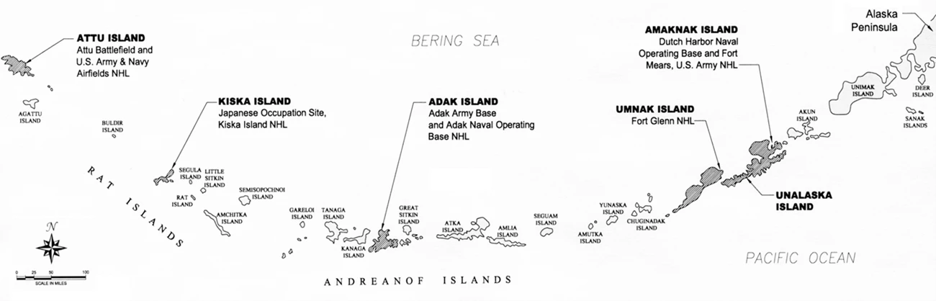
The third is treating legitimacy as infrastructure. The Canadian Rangers demonstrate what this means in practice. Drawn largely from Indigenous and remote communities, they provide persistent presence, local knowledge, and domain awareness across vast and austere terrain. The Rangers are trusted local networks that make logistics nodes harder for adversaries to isolate through governance friction. Where those relationships break down, adversaries find the node open to governance friction no physical hardening addresses. Russia’s campaign against Norwegian authority in Svalbard demonstrated how narrative operations exploit that exposure, contesting infrastructure legitimacy until operational planning, investment, and alliance cohesion bend to the pressure. Alaska has its own version of the Rangers model in the Alaska Territorial Guard, an Indigenous-led militia that secured the state’s coastline during World War II before its 1947 disbandment. Reviving it as a State Defense Force component with a domain awareness mission tied to Alaska’s logistics nodes gives Alaska Native communities the same operational role the Rangers play in Canada.
These measures change the adversary’s calculus. Disruption may still impose costs; however, it becomes far less likely to shape outcomes in the adversary's favor.
Conclusion
Arctic security has a visibility problem. Investments easiest to observe—new formations, platforms, exercises, and forward presence—do not determine whether force projection works. Rather, it is the systems that make those investments operationally relevant. Russia and China understand the asymmetry. In a crisis measured in days, who controls access to the North Atlantic and Pacific approaches depends on whether Alaska’s logistics architecture holds under pressure.
For a NORTHCOM planner, the implication is direct. Non-kinetic friction such as regulatory delay, insurance market pressure, information operations targeting local consent, and labor disruption belongs in the plan as a first-order operational constraint. Legitimacy with Indigenous communities and local governments whose consent determines access is an enabling condition without which critical infrastructure cannot be reliably used. Redundancy across logistics nodes transforms single points of failure into a resilient system.
Alaska's thin margins determine whether the 11th Airborne Division and every force flowing through it can answer the call. You do not have to break the Alaskan logistics system to constrain it. You only have to make the system overly cautious and slow. The time to build that resilience is now.
Lieutenant Colonel Stephen A. Gagnon is a U.S. Army Special Forces officer with operational experience in Arctic environments across assignments with 10th Special Forces Group and the 11th Airborne Division. He is an Arctic Security Fellow at the Ted Stevens Center for Arctic Security Studies in Anchorage, Alaska. He is pursuing a PhD in Interdisciplinary Studies at the University of Alaska Fairbanks, focusing on irregular warfare, Arctic strategy, and Indigenous partnerships in defense. The views expressed are his own.
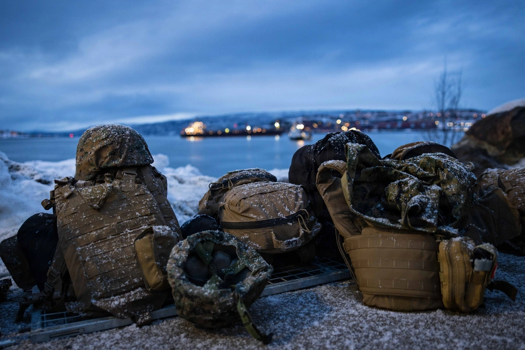
Main image: U.S. Marine Equipment during Exercise Cold Response in Norway, March 2026, taken from DVIDS.
The views expressed are those of the author(s) and do not reflect the official position of the Irregular Warfare Initiative, Princeton University’s Empirical Studies of Conflict Project, the Modern War Institute at West Point, or the United States Government.
If you value reading the Irregular Warfare Initiative, please consider supporting our work. And for the best gear, check out the IWI store for mugs, coasters, apparel, and other items.