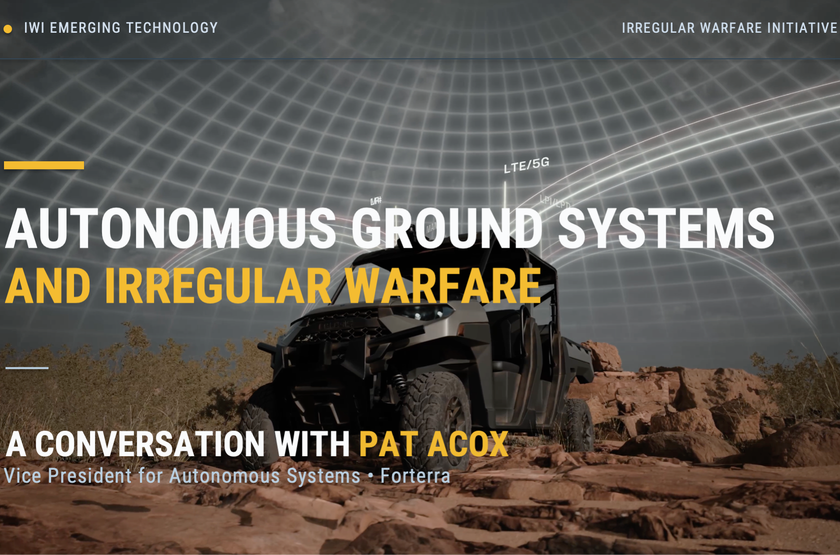
In this IWI Emerging Technology conversation, Jeff Szuchman and Matt Sansone speak with Pat Acox, Vice President for Autonomous Systems at Forterra, about the impact of autonomous ground vehicles on military operations. They discuss how these systems move supplies, evacuate injured personnel, support troops in dangerous environments, and help small teams and partner forces operate more effectively. The conversation also explores how autonomous systems can be made easier to repair and update in the field, when humans should remain involved in critical decisions, and how emerging technologies reshape the way the United States works with allies and prepares for future conflicts.
Note: This transcript has been edited for readability while preserving the meaning and substance of the conversation.
Jeff Szuchman: Hello, and welcome to the second in a series of conversations on how technology is changing the nature of irregular warfare. I’m Jeff Szuchman, co-director of the Emerging Technology Program at the Irregular Warfare Initiative.
Matt Sansone: And I’m Matt Sansone, an advisor to IWI’s Emerging Technology Program.
Jeff Szuchman: Our first conversation in this series explored how artificial intelligence and open-source intelligence are helping decision-makers better understand the battlefield and make decisions faster. But those decisions are only valuable if someone can act on them.
Matt Sansone: Today, we’re expanding that conversation to examine how autonomous ground systems are becoming an increasingly important part of the battlefield equation. When people hear the word autonomy, they often think of drones. Ground autonomy, however, is changing how militaries move people and supplies, extend their operational reach, reduce risk to the force, evacuate personnel, and sustain operations in contested environments. In irregular warfare—where success often depends on small teams and partner forces operating with a limited footprint in austere conditions—the ability to move and sustain those forces, sometimes under fire, can be as important as the ability to find and strike a target.
Jeff Szuchman: To explore these issues, we’re joined by Pat Acox, Vice President for Autonomous Systems at Forterra, a company developing autonomous ground systems for military and commercial applications. Pat, thanks for joining us.
Pat Acox: Thanks for having me.
Jeff Szuchman: So I want to start with kind of a predictable question, which is the origin story. Do you recall at some point a light bulb going off, having some awareness that there was a problem that needed a solution that technology could solve, or some gap that could be filled with some thinking and technology around specifically ground autonomy? Can you tell us what that was like?
Pat Acox: Yeah, absolutely. So, at its heartbeat, Forterra as a company was founded as Robotic Research and dealt in deep tech for, you know, 20 years prior to a capital raise. And during that period of time, had touched on ground autonomy, autonomous mobility, for every organization you could imagine—each describing a unique set of conditions that largely resembled their counterparts, all while saying, “Hey, this is a completely bespoke need for complete customization.”
So the light bulb moment was, “Hey, this is a universal need,” right? I’m a Marine by background, and shoot, move, and communicate are inherent to the DNA. And whenever we think about how we operate within any kind of space, the ground is where we live, right? We are terrestrial beings. Where we operate, and where we partner, and where we do any of these things, it inherently has a ground component to it. So bridging that gap with technology in the space felt like a blinding flash of the obvious.
Matt Sansone: Awesome. Yeah, no, love the callback to shoot, move, communicate—the fundamentals right there.
So, Pat, I know we’ve talked before about this, and I’ve heard you mention before how corporals and captains are actually the ones who carry the fight, and the Pentagon historically optimizes for high performance and for exquisite platforms.
I guess a question building off of that is: We’re living in a relatively unique point in time where we’re able to actually learn active lessons from not only the ongoing war in Ukraine, but then also from ongoing operations like Epic Fury, where we’re seeing cheap, adaptable commercial technology be able to be distributed at scale across the battlefield.
So how have these real-time conflicts either validated some of the ideas that Forterra has been stood up on, or been able to change your thinking on how warfare is evolving in real time on the battlefield? And what are some possible emerging implications for future high-stakes environments, such as a potential Taiwan scenario?
Pat Acox: Yeah, no, I appreciate the question. I appreciate the callback to captains and corporals, right? Like, I fully believe they carry the fight—the most innovative breed. We’ve seen that many, many times throughout U.S. history, and probably world history, but especially U.S. history.
And I think that, at its core, when we look at—you said it just now—with commercial technology becoming readily available, that exquisite gap is quickly shrinking, right? So even from an adversary-posturing perspective, you see technologies that emerged, shoot, during the Global War on Terror, with DJI drones dropping, you know, 40-millimeter grenades, right? Like, that came out, and we’re like, “Oh my gosh.” Precision targeting off of something that costs maybe like $3,000 total to make.
And so, if anything, out of Epic Fury, out of the war in Ukraine, you’re seeing this timeline collapse because the barrier to entry isn’t, you know, a billion dollars for a nuclear submarine. It’s a couple thousand dollars in a garage and some know-how, with an existential threat to go close that gap.
So, you know, whether it’s something that moves around in the water, flies through the air, or, in this case, drives on the ground, there’s an ability to have standoff, right? U.S. principle of war—we like our standoff, we like our precision-guided munitions, we like lowering human capital at risk, human—like, people’s lives at risk in breaches.
And because of that, like, I won’t say it’s commodification, but it’s inexpensive to rapidly innovate and adapt within a wartime environment that doesn’t have a seven- or ten-year development cycle on the back end of it.
So I guess, on a Taiwan scenario, there’s room for both. I think maybe that’s the unsung part of the story: there’s actually room for both sets. And when I hearken back to corporals and captains, I think about folks that are very much in the fight and the tools that are available to them. If there’s a focus on exquisite, it just lives at higher and higher echelons, right? So that technology gap doesn’t actually get bridged for them. It might manifest for, like, attack aviation or something along those lines, but bringing exquisite to the edge with relatively inexpensive approaches, I think, is at the core for Taiwan.
Matt Sansone: Yeah, no, love the callback, too, about the 40-millimeter grenades with some of the quadcopters, because I remember when that first news started matriculating, and it was like, “Oh wow, that’s brand-new threat stuff that we never even thought of.”
And now, looking at some of the stuff going on out on the battlefield, whether in Epic Fury or in Ukraine, it is leaps and bounds ahead of where even that was during the Global War on Terror.
Pat Acox: Yeah, yeah, spot on. And I think, you know, it’s fascinating because the inner engineer in me comes out. I’m like, “What’s the core thing they’re trying to go solve?”
And at the end of the day, it’s rounds on target with standoff. And if you boil it down to those core precepts, there’s a bunch of different ways to tackle that, and FPVs are a natural manifestation.
Jeff Szuchman: Yeah. So thinking about lessons from recent, ongoing conflicts, there’s a lot that’s being learned, that’s being applied and adapted. The bulk of the conversation is drones, right? Drones, drones, drones—which is a little bit different than what Forterra is looking at.
So do you agree that ground autonomy, in the ways that Forterra is approaching it, is overlooked? And is that an issue? What do we lose by not focusing on that issue? And then how do you bring attention to it when the conversation is so heavily focused somewhere else?
Pat Acox: No, for sure. And, you know, with shoot, move, communicate, we always have maneuver warfare, and that usually includes cross-domain fires, right?
And so, if I think air: great range, great field of view. If I think maritime: there’s a lot of blue stuff on the globe, right, to go navigate through. And then when I think ground, I tend to think persistence and mass, right? Inherently, I don’t have to worry about a plane falling out of the sky, right? Like, wheels touch the ground.
When I think about trafficability, ships can’t drive on land, right? Unless you’re, you know, Marine Corps, and then you have your famous tracks.
And so it’s not a gap when I look at warfighting and how we operate. That said, right, if you look at the evolution of UAS, it took 20 years for us to really, really maximize on what Group 5 would look like from a strike-warfare perspective. USVs are, you know, having their heyday. And then on the ground side, again, what you look at is persistence and mass.
So I think there was an amphibious landing last week in Ukraine. When you start looking at charges being delivered, et cetera, there’s a ground aspect in how do you go into tunnels or anything along those lines and reach locations.
So, yeah, there’s a gap. There’s a gap in conversation. I think that’s partially because we like our standoff, and air and maritime tend to give a lot more standoff. And as we get into actual, you know, troops in contact, then we remember that there’s a pretty heavy ground component to it.
Matt Sansone: Yeah, there certainly is. So I kind of want to build off that point a little bit. I guess I’ll layer this question.
Previous life of mine, I was a SOF JTAC, so having to actually do ground maneuvering in accordance with actual cross-domain fires, whether it’s artillery or actual air platforms in a stack. So I want to build off that and see: Where do you see Forterra fitting within that stack, and ground autonomy fitting within that?
Because I think part of this is helping me wrap my mind around it. I see where the aerial drones go. I want to get your point of view of where you think the ground autonomy goes within a ground maneuver with cross-domain fires.
Pat Acox: Yeah, for sure. And maybe the first place is fires, right? Like, that to me is a relatively obvious area of it.
So I appreciate the JTAC analogy, right? You’re managing a stack of aircraft, and then you’re also managing, call it, ground fires—artillery, rockets, et cetera. When I think about mass coming back, there is a troop constraint to what a traditional battery would look like.
And so, if you were able to make a battery fire like a battalion, or a section fire like a battery, you’ve inherently restored mass out in the fires realm. And a lot of that is executable through—I mean, Marine Corps has NMESIS, right? We run the autonomy for NMESIS. That’s moving, call it, robotic ground vehicles around with Naval Strike Missiles on the back.
And so it’s an additive layer into what would otherwise be a constraint, whether it’s boots on the ground, as we talk about irregular warfare, and what does that look like in areas that maybe aren’t at a no-joke, full-blown war mobilization, but in something in a conflict—right? Like, in some kind of outside declared theater of active armed conflict environment. How do you move those in, and how do you support partner forces as the U.S. postures for war?
Matt Sansone: Yeah, so it’s almost like you would see it as basically using a different type of call for fires. Like we had said, there’s the artillery call, air call, potentially some sort of autonomous fires call. That is kind of what I’m getting out of that. Am I right on that?
Pat Acox: Yeah, absolutely. And then you get back into maybe the thing underpinning it all, which is there is a network aspect to it.
So the way in which you run a network, or like a joint range extender, is very, very similar to how you start organizing these autonomous formations or robotic formations of fires assets.
Matt Sansone: Okay. And then would you think, too, that there’s any sort of either evac or CASEVAC type of functionality that can be called into?
Pat Acox: A hundred percent. So we hit the shoot part of it, but yeah, absolutely, logistics aspect is just as critical for sustaining momentum.
We look at any of the conflicts or wars going on—that logistics line is pretty critical. And if you start talking about how do you move a lot of things in a distributed manner, right, then you get into logistics lines.
And then the last part: CASEVACs, right? So war is inherently a violent expression. Folks are going to be injured or killed, and doing right by them within a contested air domain—I see a lot of those going on by ground as we, you know, start running triage care.
Matt Sansone: Yeah, no, and I think the ground component is, as you mentioned at the very top, even overlooked just because, obviously, air is quick. You’re able to get in, get out, and be able to actually get to a higher level of care quickly, especially within any sort of golden hour.
However, ground mobility is going to need—that’s really for, like, primary field care or some sort of actual long-term sustainment of care. So being able to use an autonomous system and not even risk the force is, frankly, an advantage for the U.S., I’d think.
As we think about, hey, what that care looks like and how does it triage back, it’s a huge part. And again, that contested air domain, where you might have had the benefit of, hey, standby 60s, like a DUSTOFF-type routine—as you enter a contested environment, folks are hurt. You still have to move them.
Matt Sansone: Yeah, a hundred percent.
Jeff Szuchman: I wanted to ask about sort of a different aspect of irregular warfare, which is working closely with partners and partner forces, and how we integrate technology with other nations.
So when you’re thinking about developing ground autonomy, when you’re thinking about systems and software, do you think about how to support partner forces in a way that’s different from—
Pat Acox: A hundred percent. So, sorry, we do have a little bit of a delay. I think it’s on my end.
Jeff Szuchman: That’s okay. Yeah, go ahead.
Pat Acox: With partner forces, yeah, spot on. Some of it’s silly, right? Some of it’s like, well, it sounds like a blinding flash of the obvious, which is, hey, usability trumps a lot of exquisite workflows. Inherently, things have to be designed to be intuitive. The human factors engineering is remarkably important.
The second part is language, right? Like, whether it’s Ukraine or otherwise, having some kind of user interface which is easily translatable, so that, you know, it’s not like a sticky note on the side of this which is like, “Push here when you want this,” in a native language against an English UI.
To me, it’s again kind of like a blinding flash of the obvious, but it’s inherently important for how we operate with partner forces. And that’s before we touch on, like, sovereignty-type things of, hey, how does this become more like theirs? And then how do we actually generate a coalition-type approach, and how do we run operations?
Matt Sansone: Yeah, the partner force aspect is incredibly important. So I kind of want to go touch on a point now that we hit on a little bit earlier about the idea of learning and adapting.
And I know that this is something that is being pushed forward now, is the initiative to learn and adapt from ongoing conflicts. And how is it that we can actually best push, as we hit on a little bit earlier, moving away from some of these exquisite systems to more scalable autonomous systems?
So, noting how the adaptation cycle on the modern battlefield is starting to accelerate a little bit, how is it that Forterra is building its software architecture so that units out in the field can get updates pushed to them and be able to actually outlearn an adversary in real time with real-time data feedback?
Pat Acox: Yeah. So, you know, we talked about shoot, move, and communicate as being core elements of how we fight. I think trust is, like, at the heart of how we operate with partner forces.
Matt Sansone: Yep.
Pat Acox: And so, with that, there is, one, the trust and feedback they give, either through official or unofficial means, right? Like, think about how we operate in a digital, mobile-device-type world. There’s a lot of times where feedback will come back over, like, Signal or WhatsApp: “Hey, this thing’s here. How quickly can you push something? Hey, we’re seeing this adapt.”
And then, from a link perspective, that is everything from, hey, how are we embedding with that country, to, hey, how do we remotely support with, call it, one of a thousand engineers to go solve really unique problems?
But the bottom line is, one, there has to be trust that, hey, when they raise an issue, it’s actually going to get handled.
Matt Sansone: Yep.
Pat Acox: Think about, like, how many times you leave a one-star review on a shopping website, and does it ever get fixed?
So, obviously, never want to have that happen. But usually when feedback comes in, it’s tied to either an ongoing operation, an upcoming operation, or a tweak on, “Hey, this would be better if...” And because I trust that it’s coming from a good space, and, you know, they trust us, then it’s really, really straightforward to iterate, design, push, test, verify, and then execute.
Matt Sansone: Yeah, no, and trust, as you just mentioned, is highly important, and not only for these systems in general, but even just as a unit as a whole.
And so, going a little bit further on the same topic here, I kind of want to pull a little bit on the idea of either reconstitution or repairability. So I think we’re all in pretty good agreement here that exquisite systems themselves are costing too much and they’re not scalable up for the size necessary for the modern battlefield. And as you’ve noted, maintaining mass is critical as well.
So what is it that you see as being necessary? Do these autonomous ground systems need to be reconstitutable, or do they need to be repairable in the field? Like, can we just give repair kits to, I don’t know, say a platoon out in the field using them? Or does it need to be reconstitutable, as in being able to push mass at a critical moment?
Pat Acox: Yeah, I’ll give you the old answer: it depends. The real answer is, like, it’s actually both.
Matt Sansone: Oh, yeah.
Pat Acox: The real answer is actually both. And so, when we think about, call it, base platforms or the unit that we build the autonomy on top of, how do we partner? A lot of that boils down to supply-chain repairability based off of that locality. And those are, I’ll call, first design principles.
Because at the end of the day, if an axle breaks and it’s a 15-week supply lead time to get something out there, then inherently you have a deadline vehicle. It’s basically down to zero.
And with some of the partner forces—incredible engineers, incredible mechanics—they’ll find a way. But if there’s an easy supply-chain button for them of, you know, readily available parts from the local market, then it’s immediately repairable.
And then when you get into some of the more technical aspects of it—so, call it compute or sensors—having that supply forward-positioned allows for an easy swap-out. And then the next part is, hey, what does that calibration look like, or restored baseline?
At the end of the day, you essentially want it to feel almost like a modern car dealership, where you can drive in, drop your thing off, and have it fixed, or you can get a part and do it in your own house. You know, both have trades to them. But at the end of the day, that return to uptime is a baseline characteristic because its mission persists.
Matt Sansone: Yeah, no, it definitely does. So then I guess the question leading off of that is: How is Forterra planning to actually scale its product line so that components can be easily either replaced or rebuilt by said corporal or captain out in the field?
Pat Acox: Yeah, for sure. So the first part is we design around, like, large replaceable units, so it’s a relatively easy swap. If you have a pre-positioned stock, then there’s things to burn down against. And as things come back, there are some things which will eventually have to come home.
But the concept is we’ve built around, you know, relatively similar building blocks that allow that timeline to be short on the build side, and on top of that, easily swappable with other things.
Right? Now you get to, like, the triage game. It does twofold things for us as a company. The first being, hey, because it’s a repeatable motion, that inherently drives—it provides us pricing power, right, with suppliers. Like, you buy more, you have a more robust supply chain, there’s more in stock, it’s super easy to ship out.
The second part is, if it’s designed to be replaced, then really what we’re driving at is that maintainability aspect, right? How do I, with a standard set of tools, pull something off, put something back on, and then recalibrate with onboard software and get it back out?
But that’s designed really to be done at the front line. Probably a couple things that can still work on it. And I’ll share a dirty secret, which is, you know, cable harnesses and boxes must have been the hardest W-class in mechanical engineering class. They tend to be where the most amount of redesign and iteration tends to happen.
But understanding that, right, and going to the quality side of it, it’s easy to go stock those things forward and have them replaceable.
Matt Sansone: That’s good to at least have that identified, right?
Pat Acox: Yeah.
Jeff Szuchman: I want to go back to the software part and talk a bit about what it means to deal with autonomy on the ground. We talked a bit about decision-making and who’s making the decisions, but in a world where that’s increasingly, you know, a place where autonomous systems can be deciding, there are a lot of conversations about where the humans come in.
So, we had a conversation previously with Charlie Winter and Stephanie Rotolo from ExTrac about OSINT data and decision-making around that, and we presented a scenario to them and asked them a question about it. And I kind of want to present it to you to get your take, if that’s okay.
The scenario would be an environment where an autonomous ground vehicle is moving a casualty, and the open-source picture shows there’s a protest forming on its route, so it reroutes itself without anyone asking it to, without a human in that loop.
How far off are we from a scenario like that? Are we there already? And at what point in that chain should there be a human verifying information, validating decisions, making those decisions, relaying those decisions? Or, you know, at what point and under what conditions might we get to a place where we’re okay without that?
Pat Acox: Yeah, you picked a great example, right? Had it been like, “Hey, this is a routine movement back or logistics-type thing,” I’d probably have been like, “Yeah, man, I’m actually good with routing around that.”
But with the casualty that has, you know, probably some kind of timeline before they need to be back at a layer of care, it’s an interesting one.
And so, what I’ll say is, the plumbing is in place in order to start having those, you know, trolley-car kind of problems or trolley-car scenarios. In reality, the way it’s going to function is, I think somebody is going to be sitting at, call it, a remote operating station or, you know, a tactical operations cell or something along those lines.
They’ll consume that information. They’ll see it. They’ll get a prompt of, like, “Hey, do we reroute?” Similar to, I don’t know, if I’m looking at, like, a maps thing and traffic pops up: “Hey, there’s an eight-minute quicker route. Do you want to take it?”
How good that decision-making is in terms of, you know—what’s the old joke? Like, a taxi driver in New York tells you, you know, “Take the bridge,” and you’re like, “No, don’t take the bridge.” You’re kind of taking your life in your own hands.
In this case, it’s probably a similar type of scenario where the operator is literally taking somebody else’s life in their own hands. They have that dilemma that they’re facing. A protest forming: should I reroute? Should I not?
I don’t think it’s that much different from how we operate today, right? Those kind of moral and ethical decisions are what I think about freeing up the mental capacity for, because that’s, like, to me where a lot of the—again, going back to captains and corporals carrying the fight—is they’re going to face those life-and-death decisions. How are we making that workflow easier for them?
A little way of answering the question and dancing around with it, but punchline there: tooling’s there. I don’t think we get away from moral and ethical decision-making anytime soon. And as an American, like, I’m not sure how much of that I want to divest into Skynet.
Jeff Szuchman: Yeah, and you can think of any number of scenarios. And I like the frame of, like, the technology enables the hard thinking in any one of those scenarios.
Matt Sansone: Yeah, I’m in full agreement with you, too. I’m not sure I trust Skynet to be able to actually handle those questions right either.
All right, so I’m going to take a real quick pivot here, and I want you to expand your horizons with me. I’m going to think, you know, five to ten years out from here, from now. What do you see as being some of the bigger challenges that ground autonomous systems and Forterra are going to have to overcome within the next, say, five- to ten-year window as we’re coming up here?
Pat Acox: I think collaborative, multidomain autonomy is going to be a major challenge. We’ve hinted at it already.
If we wear our parochial Army, Navy, Marine Corps, or Air Force hats, we’re all like, the world is all ground, the world is all air, the world is all ocean, or the brown waterways.
In reality, if we think about it from a joint-force fight, or even with partners and allies, there’s inherently overlap. We are actually stronger when operating together, whether it’s through overlapping fields of fire or cross-domain and joint operations.
I think one of the interesting parts is: what orchestrates what? What are those network pathways that we tackle? And what do we trust to be the master brain of it, and how does collaborative decision-making go on? Not just between companies from an industry perspective, but between services.
That’s a pretty gnarly problem to go tackle before we even get into what does cross-domain fires look like. And to harken back to your JTAC days, doing a Type 3 control—hey, free weapons fire over here—but once we cross this line, we’re back within some kind of more orchestrated control for fires.
Matt Sansone: Building on that, what do you see as the ultimate asymmetric advantage that Forterra offers—not only to the joint force, but to U.S. and allied warfighters more broadly?
Pat Acox: So I think one of the things is clearly mass, right? I think it’s popped up, whether it’s assisting partner nations—that’s a huge one.
If we look at, hey, just even harking back to GWOT and multiple deployments and those op tempos, right? Reconstituting a force to go back out—that used to be an emotional event.
And as that only occurs more across the globe, the part that I look at is, hey, there is a force posture which maybe doesn’t require the same amount of literal care and feeding, whether it’s access, basing, and overflight, that allows you to pre-position forward and hedge those risks.
And the same thing with partner force operations or special operations, right? Augmenting that partner force in a remote advise-assist way, or to overcome the difficulty of, like, if that accompanying authority hasn’t come into play, then you have proximity to the fight. It’s a different way of thinking.
To kind of correlate it back to maybe the intelligence aspect: I think about it as the principal-agent problem. How do you position to be in a managerial role for trusted agents that you know are going to go out and execute their missions, but that you might not have direct access and placement to directly influence at that time and place?
Matt Sansone: Yeah.
Pat Acox: And just on the force posture aspect, I mean, that’s hugely asymmetric. The risk calculus of, hey, what does it take to bring together a Marine Expeditionary Force or a division to get out the door and take ground, with a strategic Air Force and then also plus a carrier strike group? The math is very, very different when you’re already pre-positioned.
Matt Sansone: Yeah. I think you’re right. And I think one of the big lessons I’ve at least personally taken away from all the ongoing conflicts and operations that we see across the globe is the need for these asymmetric advantages, where we’re really able to bolster ourselves, but also be able to actually poke at adversaries where they are not expecting it to be. So, no, it’s great to hear.
Pat Acox: Yeah, absolutely. I think there’s another really interesting one. As we talk about, you know, if we look at the old DIME model, right—diplomacy, information, military, economic—I think there’s an emerging technology one.
I’ve heard it come up a lot in recent conversations with different partner forces. There’s a sovereignty aspect: how do you share technology? You see this going on with manufacturing abroad. You see it going on with IP and licensing deals for domestic production to overcome those gaps.
And it’s almost like a bilateral exercise under a different approach, right? Or a foreign internal defense mission under a different approach. You’re building partner-nation capacity under a technological bent, which really goes back to their national security and then advances, from maybe the political aspect, advances U.S. objectives in terms of securing partners and allies in a way different than just a bilat going on.
Matt Sansone: Yeah, so really almost arguing for a DIME-T—that technological prowess itself is actually a lever of national power, and how you can actually use it is just as important as how you can diplomatically isolate an adversary or informationally isolate them as well.
Pat Acox: Yeah, 100 percent.
Jeff Szuchman: Well, I think that’s actually a good place to end this. That was really a good, future-looking and comprehensive wrap-up.
So, Pat, thank you for joining us as part of this IWI Emerging Technology conversation series. It’s been a really great window into a critical capability that’s being transformed by new technologies.
And if people didn’t get a chance to see or listen to the previous conversation in this series that my colleagues Kristina Kempke and Curry Wright had with Charlie Winter and Stephanie Rotolo from ExTrac on changes that are happening in the way open-source intelligence is being collected, analyzed, and interpreted, please check it out at irregularwarfare.org. And while you’re there, subscribe to the newsletter. If you have comments, questions, or suggestions for the Emerging Technology team, please send us an email at emergingtech@irregularwarfare.org.
Thanks for listening. And thanks again, Pat, for being part of the conversation.
Pat Acox: Yeah, thanks, guys.