It is difficult to find anyone satisfied with the definition of irregular warfare. Even its parents recoil from the ugliness of the definitional baby. In a 2025 IWI podcast, Mark Crnkovich, the Pentagon official responsible for overseeing the revision of Department of Defense Instruction (DoDI) 3000.07, Irregular Warfare, described the drawn-out haggling over the definition as the most frustrating part of the process. The clash of views produced a Frankenstein’s monster of a definition, an unnatural cobbling together of different parts.
Practitioners will be tempted to dismiss this debate as an irrelevant slap fight among the pointy headed. Tellingly, a veteran Special Forces officer with impressive academic accomplishments privately admitted that he generally ignored the definition, focusing instead on the far more practical issue of authorities. That is a sensible view to the extent that authorities are what ultimately matter on the ground. But if we follow the problem upstream, then muddled definitions create real-world problems. Lawmakers are unlikely to trust a community that cannot explain what it is about.
In a recent IWI podcast—tellingly titled “What the Hell is Irregular Warfare Anyway?”—no less a practitioner than Lieutenant General (Retired) Mike Nagata asserted that the lack of a good definition is “debilitating” because the lack of clarity causes policymakers to undervalue irregular warfare and turn to more conventional, understandable tools instead.
Decades of fruitless debate over the definition are an indication that something larger is amiss. Ironically, a community premised upon breaking conventions to achieve tangible results is shackled by its adherence to an abstraction.
Irregular warfare has resisted definition because it is not actually “a thing” at all. Instead, it is four distinct but overlapping communities working on four distinct but overlapping real-world problems: How should we deal with irregular adversaries? How should we structure our own irregular forces? How should we advance our interests in irregular situations outside of armed conflict? How should we employ irregular methods, or what might also be called “dirty tricks”?
These practical questions provide a much better starting point for doctrine and policy than continuing the fruitless search for a theoretical definition. Doing so will avoid pointless conflicts among the four communities that only undermine all causes, as Nagata described.
Sometimes Words Don’t Matter
A close reading of doctrine and policy demonstrates that different conversations are already jostling for space within the existing framework. Of the several iterations of joint doctrine in recent years, the constant has been a “top-down” or conceptual, deductive approach. That would be appropriate if irregular warfare were a cohesive analytical construct. But it is not, so these definitions quickly yield absurdities. Take, for instance, the current definitions of conventional and irregular warfare in the 2023 edition of Joint Publication 1, volume 1:
Conventional warfare is “a violent struggle between nation-states or coalitions, and alliances of nation-states, fought with conventional forces.”
Irregular warfare is “a form of warfare where states and non-state actors campaign to assure or coerce states or other groups through indirect, non-attributable, or asymmetric activities.”
These definitions imply that they are two halves of a theoretical whole. If so, then logically they should be differentiated by only a single binary variable. If not, there will be instances that meet some but not all of the criteria, casting them into definitional purgatory.
But not only do the doctrinal definitions of the two warfares have multiple elements, they do not even mirror each other. Irregular warfare is defined by three elements: strategic actors (state or non-state), strategic outcomes (assure or coerce), and the characteristics of the actions (indirect, non-attributable, or asymmetric). But conventional warfare is defined by only two elements, and neither completely complements any of the elements in irregular warfare. Instead, the definitions overlap in regard to strategic actors: state actors can do either conventional or irregular warfare. And where the definition of irregular warfare uses the characteristics of the activities (indirect, non-attributable or asymmetric), the definition of conventional warfare uses the type of forces employed (conventional forces).
These poorly constructed definitions readily yield absurdities. For instance, the U.S. deployment of carrier strike groups to the Taiwan Strait in 1995 and 1996 meets the definition of irregular warfare because it was asymmetric—the People’s Liberation Army did not have aircraft carriers at the time—and was meant to both assure Taiwan and coerce China. (This example highlights the analytical uselessness of asymmetry as a differentiator between conventional and irregular warfare: an A-10 destroying a tank is also asymmetric.) The raid that killed Osama bin Laden, however, falls into definitional purgatory. It was not carried out by conventional forces, so was not conventional warfare. But neither was it irregular warfare by JP 1, vol 1, as it was forcible action rather than assurance or coercion. It was also a direct method to achieve the outcome and was attributed, although—like virtually everything else—was arguably asymmetric.
These examples demonstrate the problem with definitions that begin with an abstraction. Applying a definitional label after the fact is just pedantry. Any useful definition must be grounded in questions related to real-world communities of action.
One Step Forward, Two Steps Back
By that measure, the long-standing definition in policy seems more promising. Department of Defense Directive 3000.07, “Irregular Warfare,” issued in 2014 and updated in 2017, reflected the practical concerns of its proponent, the civilian office overseeing the special operations forces enterprise. It used a more grounded, inductive, “bottom-up” approach that simply listed the specific mission types that constitute irregular warfare, such as unconventional warfare, foreign internal defense, and counterinsurgency. But even this yielded some ambiguity, as it also identified several missions that might be irregular warfare—for instance, security cooperation, cyberspace operations, and strategic communications—without stating under what conditions they were or were not irregular warfare. The reason for this ambiguity will be obvious to practitioners: it depends on the underlying authorities being employed.
Unfortunately, rather than taking the next step toward clarity grounded in the real world, the new DoDI 3000.07, published in 2025, veered back toward abstraction by beginning with the “top-down” joint definition of irregular warfare which is followed by a shorter, slightly modified “bottom-up” list. The result is the worst of all worlds, in which the irregular warfare described in one paragraph contradicts what is said in another.
Artificial Construct, Real Harms
The contradictions created by trying to shoe-horn four distinct discussions into a single conceptual framework sets the conditions for needless fratricide that might be the cause of the distrust among policymakers described by Nagata. The search for a single definition creates a zero-sum competition in which one community in making its case for relevance is forced to diminish the others.
This dynamic is evident in an otherwise excellent article by Christian Tripodi in Small Wars & Insurgencies. Notably, Tripodi hints at the artificiality of the idea of a single irregular warfare when he laments the “tendency in some quarters to seek to draw disparate threats, actors and activities into the embrace of a single overarching theory.” This insight is then followed by an excellent overview of three distinct “approaches” that closely align with three of the conversations discussed below. But despite having gone so far in demonstrating that irregular warfare is not just one thing, Tripodi does not quite break free of the idea of a singular irregular warfare. Thus, to make his case that the West should think more deeply about how special operations forces might be employed to gain advantage over Russia or China, he is forced to argue that too much attention has been given to counterinsurgency and counterterrorism. But is it really necessary to think less about ISIS, for instance, to give due attention to Russia and China?
Similarly, Tripodi is critical of the broad approach exemplified by the new Journal of Strategic Competition, which seeks “analysis across the fields of diplomacy, information, military, and economic competition.” Tripodi is correct that discussions of high-level diplomacy and economic statecraft leave military organizations “grasping at what ‘warfare’ actually means in this context.” But why should there only be one conversation? Abandoning the fiction of a single irregular warfare would allow each of the conversations to fully develop, producing better thought to guide resource decisions, capability development, and force employment.
Four Conversations, Four Communities
The best way to avoid getting mired in useless abstraction is to begin with the real-world questions and identify the associated stakeholders.
How should the United States deal with non-state adversaries like Al Qaeda, the Afghan Taliban, Somali pirates, or transnational criminal organizations? (Irregular Adversaries) This conversation encompasses a broad range of stakeholders. Depending on the situation, it might include both conventional and special operations forces. It is virtually certain to include other government departments, non-government organizations, the private sector, and foreign governments and militaries. For instance, operations against Somali pirates included everything from special operations forces to arranging international naval task forces, building host-nation capacity, and shipping companies using private security.
How should the Department of Defense structure and employ its special operations forces? (Irregular Forces) This conversation is the converse of the first. Rather than many stakeholders acting against a single problem, this conversation is how a single entity—special operations forces—should balance its efforts among many different problems. The current debate is to what extent should these forces reorient toward supporting conventional forces in large-scale conflict rather than combating irregular adversaries or shaping the environment prior to conflict. Although this is a conversation primarily about U.S. Special Operations Command and its constituent parts, it is a matter of great concern to civilian policy- and lawmakers, the military services, and other combatant commands.
How should the United States advance its interests outside of conventional conflict? (Irregular Situations) This conversation is by far the broadest. Indeed, it might fairly be described as nothing more than statecraft in relation to a particularly threatening competitor. As such, it is a national-level conversation bigger than national security. It also entails matters like values and economic prosperity. For instance, to what extent should the United States align itself with unsavory governments with whom we share a common adversary? Or how much should trade be sacrificed when employing economic coercion against a hostile regime?
Whether, when, and how should the United States employ irregular methods—what might also be called dirty tricks—in both peace and war? (Irregular Methods) This conversation mainly concerns covert action and clandestine activities, and thus includes both special operations forces and the intelligence community. Indeed, many irregular methods are likely to occur under Title 50 authorities. Although the nature of irregular methods requires this be a closely guarded conversation, it is still one with multiple stakeholders. Inclusion of policymakers and Congress helps ensure that irregular methods do not get out of hand, leading to hard corrections like the Church Committee of the mid-1970s.
There is, of course, considerable scope to refine these suggested questions. The critical step is to acknowledge that what is currently called irregular warfare actually encompasses several distinct, if overlapping, questions. This should be reflected in doctrine and policy in the form of more precise definitions that are directly tied to real-world problems rather than abstractions. As a by-product, these new definitions will almost certainly align with authorities, and thus avoid the pitfall identified by General Nagata.
More broadly, each of these four conversations deserves to be analyzed fully without the confusion caused by artificially lumping it into a single artificial construct. Combining questions like whether we should limit the export of NVIDIA chips with what the proper balance of counterterrorism versus counterinsurgency in Afghanistan is does not improve either conversation.
Our irregular warfare circus should remain a big tent, but one with distinct rings inside. It’s best to keep the clowns separate from the lions.
J.P. Clark is an associate professor teaching in the Basic Strategic Art Program at the U.S. Army War College. He is a retired colonel who was the lead author for the Joint Concept for Integrated Campaigning (2017). He is the author of Preparing for War: The Emergence of the Modern U.S. Army, 1815-1917.
The views expressed are those of the author and do not reflect the official position of the Irregular Warfare Initiative, Princeton University’s Empirical Studies of Conflict Project, the Modern War Institute at West Point, the U.S. Army War College, or the United States Government.
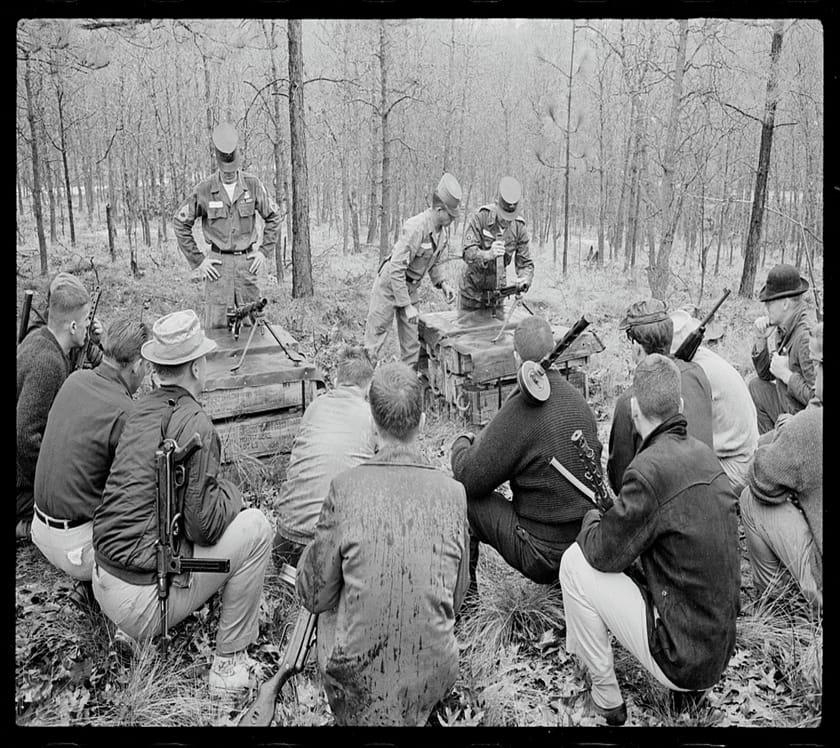
Main image: In 1961, Special Forces soldiers from the 7th Special Forces Group (Airborne) teach a guerrilla band how to clean and maintain German light machine guns. Photo by Marion S. Trikosko. Courtesy of Library of Congress, Prints & Photographs Division, U.S. News & World Report Magazine Collection, [reproduction number, e.g., LC-U9-15739, frame 18].
If you value reading the Irregular Warfare Initiative, please consider supporting our work. And for the best gear, check out the IWI store for mugs, coasters, apparel, and other items.