Rules governing warfare are nearly as ancient as warfare itself. In the Iliad, Achilles loses favor with the gods and invites his own destruction by abusing Hector’s corpse. In 1139, the Second Lateran Council prohibited the use of crossbows against Christians because of the severe injuries they inflicted. Across history, norms have constrained both the conduct and weapons of war.
Over time, the body of norms limiting weapons has also grown. The nuclear taboo is the most prominent example, but it is not the only modern weapons prohibition. Many states have accepted treaties banning chemical and biological weapons. Additional legal regimes—though not universally adopted—seek to prohibit anti-personnel landmines, cluster munitions, incendiary weapons, and blinding lasers, among other weapons.
These norms shape wartime actions and inform public support for political violence. Stated differently, military effectiveness alone does not determine whether the use of force is sustainable. In fact, many of the most powerful weapons in the US arsenal, such as nuclear arms, are the least politically viable to be employed. This is the case because modern conflicts increasingly unfold in environments where legitimacy drives outcomes as much as battlefield success.
Debates over appropriateness often operate independently from a weapon’s military utility. Cluster munitions are an efficient way to achieve widespread anti-personnel effects but are politically contentious because they are associated with civilian harm. Unexploded ordnance remains deadly long after fighting ends. Russia’s use of cluster munitions in Ukraine drew sharp criticism, and the Biden administration’s later decision to send these armaments to Kyiv proved controversial as well.
Similar dynamics have emerged in the Middle East. Israeli bombing in Gaza, with US support, has generated backlash due to the scale of noncombatant casualties and destruction of civilian infrastructure. In Ukraine, Gaza, and beyond, the means of violence matter politically as well as militarily. Weapon choice communicates restraint, escalation, and legitimacy to domestic and international audiences alike.
These cases do not show that humanitarian norms always prevent controversial uses of force or weapon transfers. Rather, they demonstrate that norms can raise the political stakes of these decisions. When leaders choose weapons associated with civilian harm, they must often defend those choices to skeptical audiences as necessary or exceptional. Meanwhile, criticism at home and abroad can shape the sustainability of these policies.
How the American Public Evaluates Weapon Use
Publics do not evaluate military force solely through a strategic lens. Weapon types carry associations about controllability, civilian harm, escalation, and moral legitimacy that shape how individuals assess trade-offs between effectiveness and destruction. To evaluate how these perceptions influence support for military operations, we conducted a survey experiment examining how US citizens respond to different forms of force.
Our results appear in a recent article in the Journal of Peace Research. We asked over 1,000 respondents to react to vignettes about hypothetical strikes involving US support for Japan in a conflict with either Russia or China. The scenario was designed to reflect the high-stakes alliance crises policymakers increasingly anticipate in potential confrontations with major powers. We varied the type of weapon proposed, as well as the strike’s chance of success and its level of destructiveness.
Survey respondents treated some forms of force as inherently more acceptable than others. When individuals choose between competing military options, their preferences reveal a consistent ordering about which weapons to use.
Respondents viewed cyber operations and conventional strikes as the most acceptable forms of force. Nuclear, chemical, and biological weapons were the least favored, reflecting a strong aversion to weapons associated with indiscriminate harm and long-term human consequences. Cluster munitions—which also carry risks of delayed and indiscriminate consequences—occupied an intermediate position: more acceptable than weapons of mass destruction (WMDs), but less legitimate than conventional or cyber alternatives.
These perceptions can meaningfully constrain support for military operations. Respondents in our study were highly sensitive to both weapon type and expected civilian harm, even when more destructive attacks promised significantly better outcomes. Non-WMD strikes consistently received higher levels of support than WMD strikes even when controlling for effectiveness and casualties. Respondents strongly preferred non-nuclear options even when those alternatives carried substantially greater operational risks. Faced with a highly effective nuclear strike and a conventional strike that was seven times more likely to fail, respondents chose the non-nuclear option 76% of the time.
Furthermore, respondents prioritized reducing civilian harm over maximizing the probability of success. Preferences for a low-fatality strike with only a 65% chance of mission success were 23 percentage points higher than for a high-fatality strike with a 95% chance of success. Respondents identified civilian casualties and weapon type as the most important factors shaping their preferences, placing considerably less weight on operational effectiveness.
That is not to say that effectiveness is irrelevant. Its influence, however, varies across weapon types. For weapons viewed as legitimate, higher effectiveness greatly increases support. But when weapon types generate strong moral opposition, enhanced effectiveness produces only a limited change in opinion. This interaction reveals a layered decision-making process. Individuals weigh outcomes, but they do so through the lens of prior beliefs about acceptable forms of force.
The Civilian Harm Constraint
These patterns meaningfully constrain the options available to militaries. Strong public aversion to nuclear, chemical, and biological weapons suggests that their use would carry immediate political costs regardless of operational effectiveness. Even outside the context of WMDs, systems associated with indiscriminate harm, such as cluster munitions, can generate backlash. This matters because research has shown that government policymakers, military officers who might recommend strikes, and elected national legislators are all sensitive to public opinion about the use of force. Opposition to the transfer of cluster munitions to Ukraine and arms to Israel are recent demonstrations of these political effects.
At the same time, publics appear substantially more comfortable with forms of force perceived as precise, discriminate, and limited in their effects. In our study, cyber operations received the highest levels of support, likely because respondents viewed them as less destructive and less escalatory than kinetic alternatives. That creates incentives for states to rely more heavily on armaments that remain politically tolerable below the threshold of major war. The persistent use of drone operations throughout the War on Terror is one key example.
But it is critical to note that civilian harm was the strongest driver of opposition to military strikes in our study. Respondents were often willing to accept significantly lower probabilities of success in exchange for operations expected to produce fewer casualties. This suggests that collateral damage can directly erode the political support needed to sustain military campaigns over time.
These findings also have implications for emerging technologies. Public acceptance of cyber operations may reflect the fact that most cyberattacks are still perceived as limited, reversible, and relatively bloodless. But those perceptions may change. AI-enabled cyber capabilities that produce large-scale infrastructure failures, prolonged civilian disruption, or physical effects could shift cyber operations into the contested political space occupied by cluster munitions and other indiscriminate systems. The lack of international legal instruments regulating the use of cyberspace exacerbates this problem. Efforts to establish “rules of the road” in cyberspace—such as agreements limiting attacks on hospitals, power plants, or other critical infrastructure—are needed.
Our results suggest that the politics of war are shaped not just by what military action accomplishes, but by what kinds of violence publics are willing to tolerate. Weapons associated with indiscriminate effects or high civilian costs can impose political penalties even when they promise battlefield advantages. For policymakers, that means choices about force are also choices about legitimacy. In future conflicts, the sustainability of military operations may depend not only on whether force succeeds tactically, but on how that success is achieved.
Lauren Sukin is the John G. Winant Associate Professor in US Foreign Policy in the Department of Politics and International Relations at the University of Oxford. She is a Nonresident Scholar in the Nuclear Policy Program at the Carnegie Endowment for International Peace and a Research Fellow at Charles University’s Peace Research Center Prague.
David M. Allison is a Lecturer in the Department of Political Science and a Fellow of the Nuclear Security Program at Yale University. Prior to academia, Dave served as an officer in the United States Army, deploying to Afghanistan in support of Operation Enduring Freedom.
Stephen Herzog is Professor of the Practice at the Middlebury Institute of International Studies at Monterey. He is a Visiting Scholar at the Project on Managing the Atom of Harvard’s Belfer Center for Science and International Affairs. Prior to academia, Stephen was a US Department of Energy nuclear arms control official.
The views expressed are those of the authors and do not reflect the official position of the Irregular Warfare Initiative, Princeton University’s Empirical Studies of Conflict Project, the Modern War Institute at West Point, the Department of the Army, the Department of War, or the United States Government.
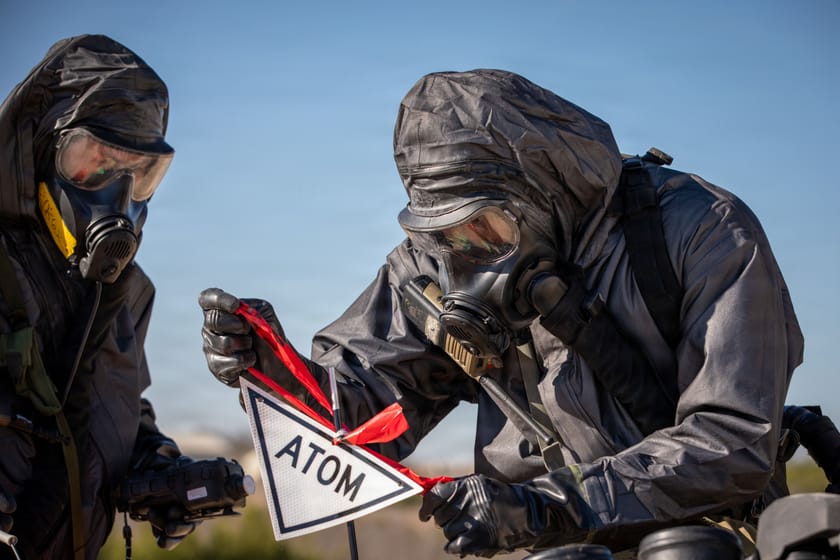
Main image is soldiers at Fort Hood during a CBRNE exercise in February 2026 taken from DVIDS.
If you value reading the Irregular Warfare Initiative, please consider supporting our work. And for the best gear, check out the IWI store for mugs, coasters, apparel, and other items.