How did Iran’s regime not just master social media but come to dominate the information space? Their propaganda rarely traveled far outside sympathetic political audiences until recently. Viewers recognized the visuals quickly. Messaging arrived wrapped in rigid ideological framing, heavy handed symbolism, and visual language detached from the environments where online political culture percolates. Even polished productions struggled to circulate organically once audiences processed them as overt state messaging.
That pattern is changing rapidly. Widely circulated Lego-style videos are moving through Western social media with unusual fluency. These generated reposts, reaction clips, memes, and political commentary reached well beyond audiences traditionally receptive to the Iranian government’s narratives. The significance of these videos lies in what they reveal about a broader transformation already reshaping modern influence operations. Understanding why these productions gained traction requires looking past the political message. Effectively countering this malign trend requires a deep dive into their creation, appeal, and emotional power.
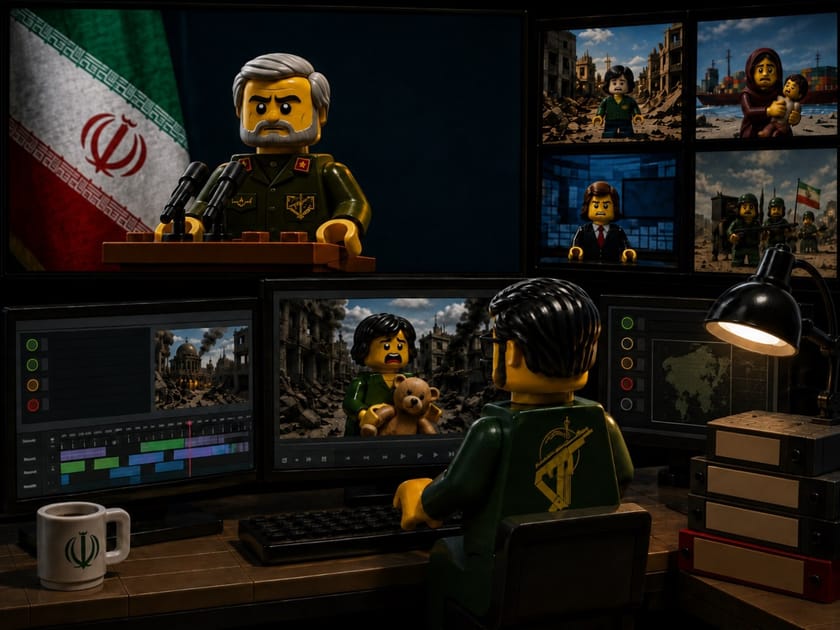
The productions succeeded by invoking familiar emotive visual storytelling, dark humor, parodies, and other references audiences have absorbed through years of engagement in hyper online culture. These include imagery linked to Epstein, exaggerated portrayals of Trump and Netanyahu, retaliatory scenes, and vulnerable civilians all appearing in formats viewers may associate with gaming aesthetics and chaotic internet humor. Iran’s government has learned to troll effectively.
Familiarity shaped perceptions from the outset. The Lego aesthetic evoked nostalgia and playfulness before the political framing fully emerged. By the time videos shifted toward escalation, corruption, retaliation, or suffering, viewers already entered the material through recognizable visual cues. Humor collapsed into panic quickly. Caricature gave way to rubble and dead civilians.
Animations also sharply marked an understanding of how political information now circulates. Audiences absorb geopolitical events through shot clips, screenshots, reaction videos, and memes moving across algorithmically accelerated feeds. Iranian government animators exploited these vectors to deliver their message. During post-release interviews, the creators discussed pacing, editorial choices, and production strategy with the fluency of experienced digital content producers. Broader reporting on the production and circulation of these videos further showed how effectively the animations embedded themselves within creator culture.
The more revealing question concerns how influence operations now shape perception through emotional familiarity, symbolic reinforcement, cultural fluency, and repeated circulation inside media echo chambers full of people already conditioned for indoctrination.
Cognitive Warfare and the Structure of Digital Persuasion
Political influence campaigns increasingly succeed or fail before audiences consciously evaluate the argument. The influencers—whether malign foreign actors, activists, intelligence services, or corporations—now know that the first few seconds are crucial. This is why the information space is saturated with scandals, spectacles, conspiracies, and conflicts. All of these serve to create low information viewers, people who passively accept what they are given without critically thinking about the content.
The recent Iranian animations reactivated associations surrounding corruption, retaliation, elite misconduct, institutional decay, and geopolitical instability. This is all “common knowledge” and circulates constantly across Western media ecosystems.
Contemporary cognitive warfare frameworks treat perception itself as contested terrain shaped by emotional response, memory, repetition, identity, and attention. Material aligned with familiar emotional patterns travels more easily than messaging audiences perceive as culturally foreign or ideologically rigid because recognition frequently determines receptivity before viewers begin evaluating political intent.
The Lego-style videos demonstrated how efficiently those mechanisms could be exploited. Epstein-linked references invoked years of accumulated suspicion surrounding secrecy, corruption, and impunity. The portrayals of Trump drew on a familiar archive of theatrical confrontation, exaggerated gestures, political parody, and relentless digital exposure.
As the videos unfolded, the emotional atmosphere shifted rapidly around the unsuspecting viewer. Humor gave way to panic, rubble, retaliatory imagery, destroyed schools, smoke, and scattered children’s belongings before audiences had fully processed the previous cue. A child’s backpack lying in rubble communicated vulnerability and shock without extended exposition. Charged imagery reshaped how viewers interpreted what followed, allowing earlier visual associations to exert pressure after disappearing from view.
Once those images circulated independently, reposts, screenshots, parody edits, stitched reactions, commentary clips, and imitation transformed recurring motifs into cognitive reference points audiences could draw upon. Familiarity deepened through repetition, and repetition strengthened emotional recall after the original upload faded.
The algorithms powering major platforms enhanced these effects by rewarding provocative material that generates engagement with larger audiences. Outrage, reinterpretation, participation, and repeated interactions earn more exposure, contributing to the advance of cognitive warfare goals. Indeed, the very use of social media platforms to repost politically charged messaging could be construed as a form of cognitive warfare.
Short form animation optimized for these conditions through compressed pacing, symbolic immediacy, and visual clarity, can increase circulation potential. During later interviews, the creators showed familiarity with these dynamics. Reporting on the production and circulation showed how comfortably the productions entered creator culture.
From Animation to Weaponized Satire
Iran’s recent propaganda evolution grew out of a tradition of storytelling dating to pre-Islamic works such as the Shahnameh, Shi’a narratives of suffering and martyrdom drawing on Ali and Hossein, as well as years of adaptation to the emotional rhythms, visual habits, and participatory culture shaping political life online today. Earlier Iranian animation relied heavily on revolutionary symbolism, ideological messaging, historical allegory, and state centered narratives of resistance. Some productions achieved artistic sophistication, yet few moved organically through global digital culture. Iran was preaching to the choir.
That foundation still matters, as aesthetics build a pathway towards wider public acceptance, even when the messaging is disagreeable. Works such as The Little Black Fish established traditions of politically symbolic storytelling rooted in allegory and social critique. Later productions, including The Last Fiction, showed growing visual ambition and familiarity with international animation aesthetics. Persepolis exposed Iranian creators and audiences to the possibility that Iranian experiences could travel globally through stylized visual storytelling. Cartoons, in particular, have evolved to a greater sophistication as part of a significant political narrative tradition.
Digital media in recent years has transformed political communication. Social platforms, meme culture, gaming aesthetics, participatory editing, short form video, and AI-assisted production tools are lowering the barriers to participation. Smaller teams with inexpensive software and strong instincts for internet culture can now compete for attention inside spaces once occupied by entertainment companies, governments, and established media.
Iranian media producers adapted steadily. Years spent observing partisan spectacle, internet humor, media distrust, outrage cycles, livestream commentary, and accelerated political discourse across Western societies provided a growing archive of emotional material. The recent animations reveal close familiarity with Western political discourse and with the symbolic habits shaping online culture.
Israeli satire likely also influenced the Iranian’s online acculturation. Productions such as Eretz Nehederet compressed military tension, political anxiety, leadership dysfunction, and regional confrontation into satirical formats capable of sustaining mass audiences despite sharp political edges. Dark humor, caricature, abrupt tonal shifts, and rapid movement between absurdity and geopolitical crisis became recognizable features of a wider online media environment that Iranian creators observed closely. The Israeli social environment accelerated access to cultural mores.
In recent years, Israeli and Israel-linked public platforms and institutions have enthusiastically hosted, amplified, or publicly welcomed what they perceived to be Iranian opposition and dissident voices. Israeli media, policy circles, cultural centers, and civil society actors have repeatedly opened public space to Iranians, from organized visits and public diplomacy initiatives to media profiles and diaspora engagement. That openness created opportunities for dialogue and cultural familiarity, while also making the environment accessible to outside actors.
The same public forums that allowed genuine dissidents to study Israeli political language, satire, media behavior, and audience response could also have been monitored or exploited by participants with different political commitments. Iranian-linked influence operations have not merely targeted dissident spaces from the outside. They have also attempted to contaminate those spaces from within. In some documented instances, Islamic Republic mouthpieces posed as dissidents in order to accuse genuine Iranian dissidents of regime collaboration.
U.S. intelligence has separately assessed that actors tied to Iran’s government posed as activists online. Open democratic and diaspora spaces therefore provide opportunities for genuine opposition engagement while also creating openings for regime-aligned actors to observe, imitate, discredit, and exploit dissident discourse.
AI-accelerated the process by increasing production speed and reducing institutional constraints. Smaller teams could respond rapidly to unfolding political events, shifting discourse, and algorithmic trends while testing multiple emotional approaches. Technology expanded the ability of politically sophisticated creators to refine symbolic material and adapt content to changing digital conditions.
The recent Lego-style productions revealed how thoroughly satire now functions as an operational instrument. Humor lowers resistance while encouraging circulation, imitation, repetition, and participation, allowing political material to move as culturally recognizable internet content already aligned with existing habits of consumption.
Strategic Implications and the Future of Cognitive Warfare
Iran’s propaganda breakthrough revealed how profoundly modern influence operations have adapted themselves to the emotional logic governing contemporary online culture. The animations circulated so effectively because they never felt entirely separate from the media ecosystems audiences already inhabit daily. This enabled them to produce content that didn’t feel like clearly identifiable ideological propaganda.
Participation has also become part of the persuasive process itself. While casual users consume political messaging passively, other users reshape it, circulate it, joke about it, and integrate it into broader online discourse.
Humor performs especially important strategic work inside this environment because satire lowers emotional resistance far more effectively than overt ideological messaging. Audiences, especially young people, are more willing to circulate emotionally satisfying or psychologically provocative satirical content when it aligns with their frustrations, suspicions, anxieties, or desires to fit in and be part of a trend. All of these factors serve to insulate the message from direct challenges.
Major digital platforms continuously reward emotionally provocative material capable of generating outrage, reinterpretation, participation, and repeated interaction. Short form animation aligns particularly well with these conditions, increasing circulation potential. During interviews discussing pacing, editing choices, audience retention, and production strategy, the creators spoke with the fluency of experienced digital content producers rather than conventional propagandists. The recent Lego-style videos also revealed how thoroughly creator culture now overlaps with influence operations themselves. Broader reporting on the production and circulation of these videos illustrated how seamlessly the productions had embedded themselves inside creator ecosystems where satire, internet humor, political messaging, and participatory media coexist.
Open democratic societies face a particularly difficult structural challenge because participatory online culture exposes enormous quantities of emotional and symbolic data in real time. Viral controversies, livestream commentary, influencers, meme, and algorithmically amplified outrage continuously reveal the emotional reflexes shaping public perceptions. Foreign influence actors study those patterns constantly, refine propaganda strategies accordingly, and adapt rapidly to changing online behavior.
Iran’s Narrative Adaptation and the Changing Structure of Influence
Iran’s recent propaganda success reflected a growing ability to adapt political messaging to the emotional rhythms shaping contemporary online culture. The animations arrived already calibrated to the pacing, irony, visual volatility, symbolic shorthand, and fragmented attention patterns of the intended audience.
The Lego-style videos revealed how thoroughly the boundaries separating political persuasion, satire, internet entertainment, emotional manipulation, and participatory online culture have already blurred. Open digital environments continuously expose emotional and symbolic data, allowing foreign influence actors to observe audience reflexes in real time and refine their operations accordingly.
Iran’s model is likely to be replicated by other malign foreign actors who are similarly immersed in exploiting Western social tensions, political grievances, humor, symbolic language, generational anxieties, and other aspects of digital culture. Developing effective counter measures, however, requires far more than identifying adversarial propaganda once it has already circulated successfully within our own societies. Offensive campaigns are needed to disrupt and deter advisories. The same adaptiveness that allowed Iran’s propaganda to succeed could be turned around. American and allied influence operations could create content that is culturally fluent and in formats that audiences instinctively recognize as their own, too. Even within contested or authoritarian environments, culturally savvy and emotionally authentic content can break through. Iran isn’t the only one who can play with Legos.
Irina Tsukerman is a geopolitical analyst, information warfare specialist, and national security attorney whose work focuses on hybrid threats, influence operations, intelligence competition, strategic communications, and geopolitical developments across the Middle East, Eurasia, Africa, and the Indo-Pacific. She is the President of Scarab Rising, Inc., a media and security strategic advisory firm, and serves as a Board Member of The Washington Outsider Center for Information Warfare. Tsukerman is a frequent commentator, author, and speaker on information warfare, foreign policy, national security, and emerging geopolitical trends, with publications and media appearances spanning the United States, Europe, the Middle East, and Asia. Her research examines the intersection of technology, intelligence, strategic influence, and statecraft in an increasingly contested global environment.
The views expressed are those of the author and do not reflect the official position of the Irregular Warfare Initiative, Princeton University’s Empirical Studies of Conflict Project, the Modern War Institute at West Point, the Department of the Army, the Department of War, or the United States Government.
Main image is an AI-generated Lego-style depiction of an Iranian propagandist at work created August 2026.
If you value reading the Irregular Warfare Initiative, please consider supporting our work. And for the best gear, check out the IWI store for mugs, coasters, apparel, and other items.