Small states have a military problem that more defense spending alone will not solve.
Russia’s war against Ukraine and demands from the Trump administration pushed European governments to significantly increase defense spending and rebuild national defense capabilities. But for smaller states, buying more tanks, aircraft, air defense systems, and long-range fires capabilities risks reproducing an old problem with newer and more expensive equipment. Their militaries remain, in important respects, miniature versions of forces designed by much larger powers.
I have argued elsewhere that this creates a particular problem as NATO embraces multidomain operations. Small allies are being asked to develop increasingly sophisticated capabilities across land, air, maritime, cyber, space, and information environments even though they lack the resources of the great powers whose military concepts helped produce these requirements. The result risks turning small militaries into “jacks of all trades” that are masters of none. But the problem is bigger than multidomain operations. It concerns the basic model of military power small states are trying to build.
A country with a small size, population, GDP, and limited defense industrial capacity cannot build the same military capability and capacity as great powers. Increasing the defense spending of a country may narrow the gap, but it cannot eliminate the structural asymmetry. Small states therefore must stop trying to build miniature versions of great-power militaries and must understand that they need a different military revolution.
An example of such military revolution is the transformation unleashed by the French Revolution. Revolutionary France did not initially gain its military advantage from a technological superweapon, but the changed relationship between the military, the state, and society. Organizational innovation and new methods of generating military power were the factors that helped transform European warfare.
The twenty-first-century version for small states should not be another levée en masse. It should be a revolution built around distributed mass: integrating professional forces, reserves, territorial defense, inexpensive autonomous systems, civilian infrastructure, industry, cyber capabilities, allied capabilities, and prepared resistance into a national defense network. Its purpose would not be to make a small state as powerful as a great power. It would be to make the small state extraordinarily difficult to defeat.
The Miniature Great-Power Trap
When it comes to military capabilities, small states face an impossible asymmetry problem. Modern tanks, aircraft, long-range fires, intelligence systems, and sophisticated command networks are prohibitively expensive for most small countries. Even those countries who can afford to purchase modern systems can only field relatively few of them. This produces what I call the miniature great-power trap.
A military can possess every category of conventional capability and still lack meaningful depth of them. A few combat aircraft, a battalion of main battle tanks, or a heavy brigade equipped with modern armored vehicles can constitute significant peacetime capabilities while being meaningless in a long-term war. Small countries’ military capabilities may appear as capable on the first day of a war but be critically fragile by the end of the first week of hostilities. Therefore, small states’ defense planners should change their fundamental questions from “How much combat power can we field when the war begins?” to “How much combat power can we still generate after 30 days, a month, or a year of sustained attrition?” Such question produces a very different military system.
From Mass to Distributed Mass
The French Revolution expanded military power by mobilizing society on an unprecedented scale. Small states need to rediscover the idea of mass, but not in its nineteenth- or twentieth-century form. They are highly unlikely to defeat much larger opponents by trying to build large conventional armies. Instead, small states should create distributed mass.
Imagine thousands of interconnected sensors, drones, decoys, electronic warfare systems, territorial defense teams, mobile weapons, civilian vehicles, communications nodes, cyber defenders, reserve personnel, and logistics networks dispersed throughout national territory. No individual component needs to be decisive. The network becomes decisive because destroying enough of it to collapse national defense becomes extraordinarily difficult. This reverses the traditional relationship between concentration and military power.
While great powers can afford to concentrate significant military capability, small states should derive their combat power from dispersion, redundancy, mobility, and regeneration. For small countries, the foundational principle should be straightforward: anything easily found should be difficult to destroy, and anything easily destroyed should be easy to replace. That principle should become the driving factor behind designing small-state militaries.
Stop Buying Platforms. Start Building Systems.
The proposed revolution also requires small states to change their legacy procurement systems. Defense planning and modernization is frequently organized around platforms: Which fighter? Which tank? Which air-defense system? How many of each? Instead of these questions, small states’ defense planners should ask how many functioning networks they can acquire and sustain for a long period of time. They should plan for maximizing effects per dollar spent.
Instead of trying to purchase high-tech, modern systems that are expected to remain technologically relevant for decades, small countries should aim for constructing open systems that can absorb new software, sensors, unmanned systems, and electronic warfare capabilities quickly and effectively. This does not mean that traditional conventional systems have become obsolete. Recent analysis of Ukraine reaches almost the opposite conclusion. Legacy systems remain important, but they increasingly need integration, protection, and employment as parts of combined systems. The revolution is therefore not about replacing the old systems, but it is about changing the architecture connecting everything together.
Turn the Professional Military into a National Force Generator
In the proposed approach, professional militaries should remain at the center of the system but their purpose needs to be extended. While small countries’ professional forces should maintain capabilities in command and control, combined-arms operations, long-range fires, aviation, intelligence collection, and special operations, they should also become the backbone of a much larger defense ecosystem. The professional military forces should train reserves, support territorial defense, integrate emerging technology, and serve as connecting tissue between national capabilities and allies. The professional military should therefore not simply provide traditional military power but generate power by tapping into the entirety of the society.
This approach requires a different type of military leaders. While small states’ military leaders should maintain their skills and understanding related to the art and science of conventional warfare, they should also transform from military commanders to architects capable of integrating reservists, territorial defense formations, civilian technology companies, local governments, universities, and allied capabilities into a single system. Such adaptive military leaders require fundamental changes in the structure and curriculum of the national professional military education ecosystem as well.
Make Society Part of the Defense System
Here the analogy with revolutionary France is especially instructive. The French Revolution changed who participated in national defense and altered the relationship between the citizen and the military. Small states need a contemporary version of that transformation. This does not mean militarizing society. It means acknowledging that many capabilities essential to modern warfare already reside outside defense ministries.
Telecommunications and energy companies operate critical networks. Technology companies possess software and cyber expertise. Transportation companies control logistics networks. Universities and businesses contain engineering, artificial intelligence, manufacturing, and scientific expertise. These capabilities should not be discovered after a war begins; rather, becoming components of national defense planning beforehand. Some small NATO members are already moving in this direction.
Estonia's, Latvia, and Lithuania all developed comprehensive national defense concepts explicitly defining defense as the responsibility of multiple institutions and integrating military and nonmilitary capabilities from the public sector, private sector, and civil society. Sweden and Finland also built a similar approach emphasizing the idea of total defense, and national resilience alongside military capabilities. While none of these models represent a complete answer to contemporary challenges together, they point toward something important: small states can compensate for limited standing military capacity by widening the national base from which defense power is generated.
Plan to Keep Fighting After Losing Territory
The revolution must go further. Small states must explicitly prepare for the possibility that conventional forces will fail to hold every part of national territory. Planning for occupation is many times treated as defeatism; however, I suggest it is precisely the opposite. A defense strategy that ends when conventional units are destroyed or when territory lost gives an aggressor a relatively straightforward theory of victory: defeat the military, occupy the territory, and control the population to achieve political objectives. A well designed and prepared resistance breaks that sequence. In such case the aggressor will confront several layers of problems. It must penetrate conventional defenses, then survive distributed fires, suppress territorial forces, control critical infrastructure, establish functioning occupation authorities, and finally confront organized resistance among a population denying political consolidation. This is particularly important for geographically small countries because they cannot trade vast amounts of territory for time. They must instead trade resistance for time. An adversary should never be able to identify the moment at which defeating the armed forces means defeating the state.
Turn Adaptation into a Weapon
There is one final component to the needed revolution. Small states’ militaries must be designed in a way that guarantees that they can adapt faster than their opponents. The Ukraine war is a great example of a contest of adaptation between a small state and a great power. Recent research on unmanned warfare in Ukraine describes accelerated cycles of technological adaptation and battlefield innovation, while NATO training programs themselves have had to change repeatedly to incorporate Ukrainian battlefield experience. The military advantage provided by a particular technology may therefore be temporary. The enduring advantage is the ability to adapt repeatedly. This may be one area where small states possess an overlooked advantage.
While small states militaries are smaller, the relationships among government, military organizations, universities, and industry can potentially be much tighter than within great powers. That means that decision chains in small countries can theoretically be shorter and much faster. Small size can also produce agility, but institutions must be designed to exploit the advantages of smallness. Therefore, small states should create permanent systems linking operational military units, intelligence organizations, experimentation centers, universities, startups, defense industrial companies, training organizations, and political decision-makers into a continuously adapting single ecosystem. The objective should be to create a cycle of Observe – Learn - Experiment - Produce – Deploy – Assess – Adapt – Repeat. A small military capable of completing this cycle in weeks would create a form of asymmetric military power that traditional force inventories cannot capture.
Conclusion
The French Revolution demonstrated that revolutionary changes in military power do not necessarily begin with major technological changes. They can begin by reorganizing the relationship among the military, the state, and society. Small states now have an opportunity to go down a similar road. Their disadvantages should become drivers of their military innovation and design of their future forces. Limited physical space should encourage dispersion, concealment, deception, mobility, and prepared resistance. Limited populations should encourage automation, reserves, and intelligently designed national mobilization. Limited military budgets should encourage inexpensive, numerous, replaceable systems. Dependence on allies should encourage forces optimized to remain viable until coalition combat power arrives. All these factors should create obsession with regeneration and adaptation, not copying American, British, French, German, or Russian military formations.
A small state does not have to become as powerful as its larger adversary. That is simply impossible. Rather small states need to deny an adversary an affordable and reliable path from military attack to political victory. Building a military that has a chance for that requires a different type of military revolution.
Dr. Sandor Fabian is a former Hungarian Special Forces lieutenant colonel with twenty years of military experience. He was previously an MWI and IWI nonresident fellow and is the author of the book Irregular Warfare: The Future Military Strategy for Small States.
The views expressed are those of the author and do not reflect the official position of the Irregular Warfare Initiative, Princeton University’s Empirical Studies of Conflict Project, the Modern War Institute at West Point, the Department of the Army, the Department of War, or the United States Government.
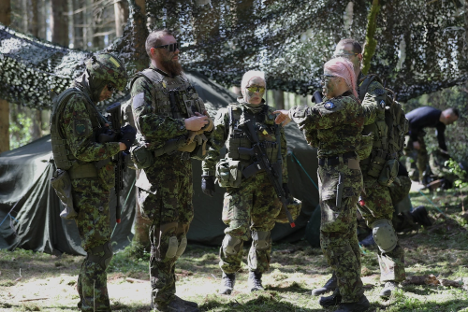
Main Image: Soldiers of the Estonian Defence League, a voluntary national defense organization under the management of the Ministry of Defense, discuss mission training during exercise Swift Response 23, one of three linked exercises for DEFENDER 23, in May 2023. Image courtesy of DVIDS.
If you value reading the Irregular Warfare Initiative, please consider supporting our work. And for the best gear, check out the IWI store for mugs, coasters, apparel, and other items.