Why does providing aircraft to partner forces so often fall short of building an effective air force? Retired Lieutenant General Anthony Rock, Michael Horowitz, and Tobias Switzer join Kyle Atwell to examine the gap between acquiring technology and turning it into military power. Drawing on Switzer’s RAND report, Build Partner Airpower, Not Air Forces, the conversation explores what American air advisors learned in Iraq and Afghanistan and what future missions should do differently.
The panel discusses the appeal of prestige aircraft, the organizational demands of modern aviation, and the case for affordable equipment that partners can put to use quickly. They examine dependence on contractors, the risks facing advisors, and the tension between building partner forces and planning a complete U.S. withdrawal. Throughout, they ask how policymakers should define success when useful combat capability may still require years of outside support.
Takeaways
- Providing aircraft does not automatically create airpower. Effective capability also requires trained people, maintenance, logistics, doctrine, intelligence, and functioning bases.
- Building a Western-style air force and generating useful combat airpower are different objectives, particularly during an ongoing insurgency.
- Iraq and Afghanistan presented unusually difficult starting conditions, including war-damaged institutions, limited technical skills, and urgent operational demands.
- Technology transfers should reflect a partner’s ability to absorb and employ equipment, not just its ability to acquire it.
- Political loyalties, patronage, and rival institutions can undermine personnel decisions and create organizational barriers that outside advisors cannot control.
- Prestige aircraft can appeal to partner leaders even when simpler platforms better meet immediate operational needs.
- Switzer argues that “cheap, fast, and good enough” should guide aviation acquisitions for partners fighting insurgencies, with attention to availability, spare parts, and the problem at hand.
- Arms transfers also shape strategic relationships. Partners may turn to competing suppliers when American equipment is unavailable or restricted.
- Contractor maintenance and logistics may be enduring requirements rather than temporary bridges to full self-sufficiency.
- Policymakers should reconcile withdrawal plans with the continuing support that partner aviation capabilities may need to remain effective.
- Advisor and contractor protection is a strategic concern as well as a tactical one; casualties can erode the political support needed to sustain a mission.
- American use of simpler aircraft could improve advisor proficiency and demonstrate their value to partners, particularly in permissive operating environments.
- Militaries that define their missions around outcomes, encourage experimentation, and reward merit are better positioned to adopt new technologies.
- Success should be assessed against explicit political and military objectives, distinguishing immediate battlefield effects, lasting capability, and strategic influence.
- Preserving air-advising experience matters even when current priorities shift. Future advisors need access to earlier lessons before another crisis begins.
Guests
Lieutenant General Anthony Rock is a retired U.S. Air Force officer who led the Iraqi Training and Advisory Mission–Air Force and commanded the 321st Air Expeditionary Wing in Baghdad in 2011. He later served as Chief of the Office of the Defense Representative in Pakistan and as Inspector General of the Air Force.
Professor Michael Horowitz is the Richard Perry Professor and Director of Perry World House at the University of Pennsylvania. His research examines military innovation and the adoption of new technologies. He is the author of The Diffusion of Military Power and served as Deputy Assistant Secretary of Defense for Force Development and Emerging Capabilities from 2022 to 2024.
Colonel Tobias Switzer is an adjunct senior policy researcher at RAND and a retired U.S. Air Force officer. A former special operations helicopter pilot and combat aviation advisor, he commanded a NATO special operations advisor team supporting Afghanistan’s Special Mission Wing. He is the author of Build Partner Airpower, Not Air Forces and previously served as IWI’s Editorial Director.
Kyle Atwell is the host for episode 166. Please reach out to him with any questions about the episode or IWI.
About the podcast
The Irregular Warfare Podcast is a production of the Irregular Warfare Initiative (IWI). We are a team of volunteers dedicated to bridging the gap between scholars and practitioners to support the community of irregular warfare professionals. IWI generates written and audio content, coordinates events for the IW community, and hosts critical thinkers in the field of irregular warfare as IWI fellows. You can follow and engage with us on Facebook, Twitter, Instagram, YouTube, or LinkedIn.
Subscribe to our monthly newsletter for (always free!) access to our written content, upcoming community events, and other resources.
Support for the Irregular Warfare Podcast comes from Hadean, an AI company focused on synthetic environments for training, planning, and decision support. Learn more at hadean.com.
Support is also provided by Leidos, a company focused on cyber and technology innovation, intelligence analysis, and mission support. Learn more at leidos.com/intel.
All views expressed in this episode are the personal views of the participants and do not represent those of any government agency or of the Empirical Studies of Conflict Project.
Credits
Intro music: “Unsilenced” by Ketsa
Outro music: “Launch” by Ketsa
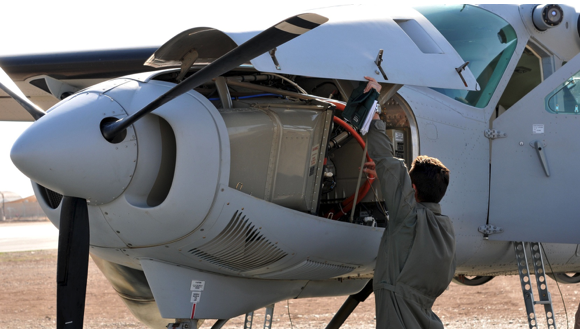
Photo: An Iraqi air force trainee inspects a Cessna 208 Caravan during U.S.-supported flight training at Kirkuk, Iraq, November 10, 2008. U.S. Army photo by Sgt. 1st Class Marvin Daniels, Joint Combat Camera Center Iraq. DVIDS photo 129393. Public domain. Cropped to match the episode cover format.